
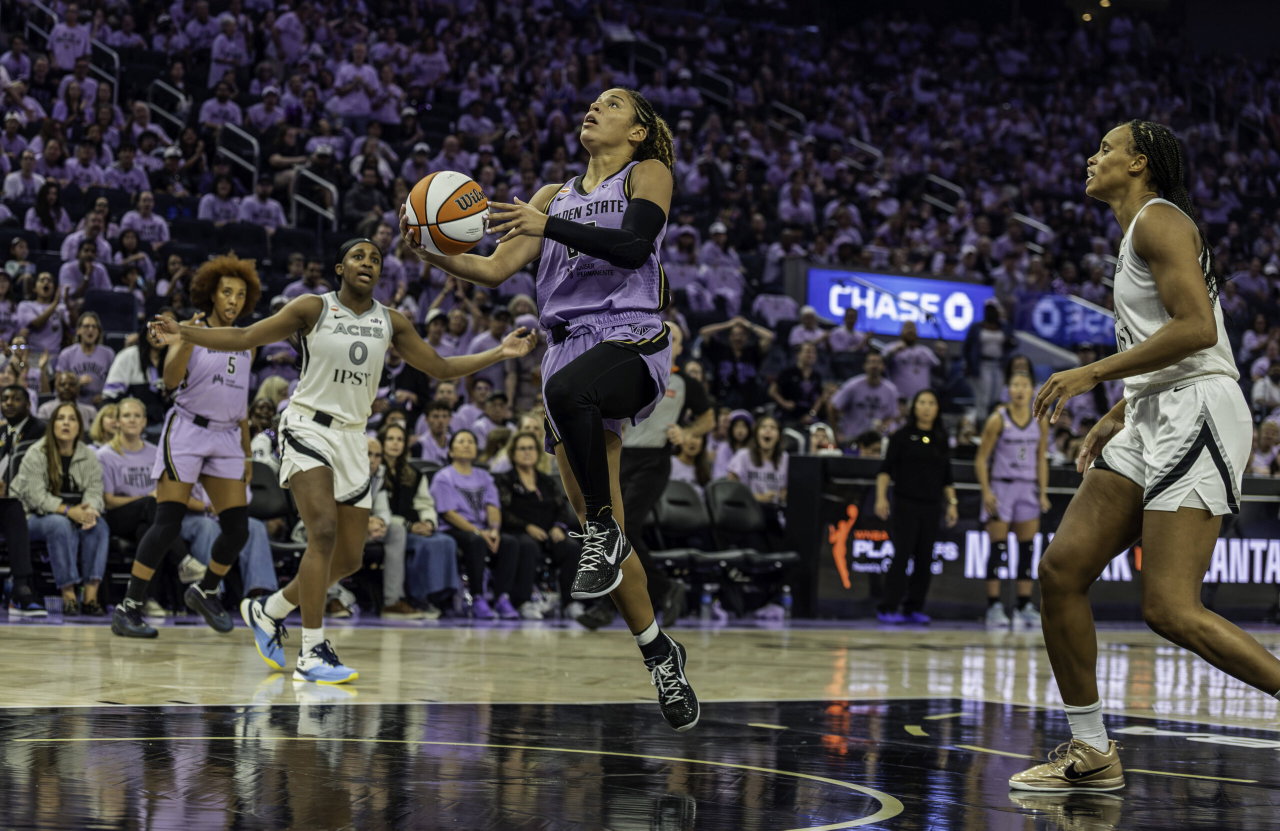
In July 2024, Golden State Valkyries owner Joe Lacob sat down with Natalie Nakase and placed all his faith in her. Lacob didn’t beat around the bush, telling the former Las Vegas Aces assistant coach, “You have to win a title in five years.” However, Nakase has needed just two seasons to put the Valkyries in a position where they can contend for the title.
Watch What’s Trending Now!
Yet the path to becoming the first expansion franchise to earn a place in the WNBA Finals in their second season didn’t happen. A lot of things, including the very intention behind the inception of the Valkyries, paved the way for this success.
Long before he bought the Golden State Warriors in July 2010, Lacob had attempted to build a legacy in women’s basketball in 1996 with the San Jose Lasers in the American Basketball League. Unfortunately for Lacob, the ABL folded in 1998, but his desire to build a women’s team never went away, and following the Warriors’ 2022 NBA Championship win, he went all in to create the Valkyries.
It was that same intentionality and passion that brought together minds like the Valkyries General Manager, Ohemaa Nyanin, and coach Natalie Nakase as they navigated the challenges a WNBA expansion team faces when building their roster.
Unlike the more tenured teams, expansion franchises face an uphill battle when constructing a roster. As per WNBA rules, expansion teams are not automatically placed into the Draft Lottery for the top overall pick, nor are they given the #1 pick outright. They usually get a guaranteed pick after the non-playoff lottery teams.
While the Valkyries did get their expansion draft to round out their inaugural roster for the 2025 season, the top talents of the WNBA remained out of reach as existing teams protected their players. The Golden State Valkyries dream pick of trying to sign Paige Bueckers was a perfect example, as Dallas had no intention of parting with their No. 1 Draft pick.
So the Valkyries didn’t chase after stars and, in an unexpected move, signed seven international players. Of those seven players, four have remained with the Bay Area team, namely Iliana Rupert, Veronica Burton, Kayla Thornton, and Cecilia Zandalasini. However, it was the new wave of players they picked ahead of the 2026 season that has truly turned the Valkyries into a powerhouse.
How free agency helped shape the Golden State Valkyries
In their first WNBA draft, the Valkyries signed Justė Jocytė as the fifth and Kaitlyn Chen as the 30th overall pick of the 2025 WNBA Draft. However, some of their biggest stars, including Gabby Williams, came on board through free agency.
Once again, Nyanin’s philosophy remained the same, as they didn’t chase after big names. In fact, the Valkyries picked up talents many teams had actually let go, like Kiah Stokes.
Stokes has played an integral part in helping the Valkyries create the highest-rated defensive unit of the 2026 season since she joined the team in April 2026, on a two-year, $761,250 deal.
Stokes had been one of the 2025 WNBA champions, Las Vegas Aces’ defensive anchor since 2022, but they let Stokes walk, and the Valkyries picked her up.
Then there’s Gabby Williams. Before signing with the Valkyries, Williams played four seasons with the Seattle Storm. During her final season in Seattle in 2025, she posted career-high averages of 11.6 points, 4.2 assists, and 2.3 steals per game, earning her first WNBA All-Star selection and a spot on the All-Defensive First Team.
Under coach Natalie Nakase, Williams has unlocked a whole level of performance. She averaged 14.4 points, breaking her previous regular-season career high. But it’s in the postseason that Williams has truly established herself as a special player.
Currently, Williams has averaged a whopping 22.7 points, 4.8 rebounds, 4.0 assists, and 1.7 steals in her six postseason games so far.
Another French star the league seemingly overlooked, but has produced a stellar season with the Valkyries, is Janelle Salaün. With the Valkyries, Salaün has won her first Sixth Player of the Year award this season.
The team’s other notable free agency signings include Tiffany Hayes, whom they convinced to come out of retirement, and 6’3 Frenchwoman Aminata Gueye. Despite just four postseason appearances, Gueye played an essential role in countering the physicality and size advantage of the Las Vegas Aces as the Valkyries swept last year’s champions 3-0 to reach their first WNBA Finals.
Yet, the Valkyries haven’t just succeeded in picking out the right players. In just two years, Golden State has fostered a loyal fanbase the likes of which no WNBA team has ever seen, making ‘Ballhala’ a formidable venue for any visiting team.
The Golden State Valkyries invested in their fans
The one advantage the Valkyries had was being associated with the Warriors. Having the backing of a seven-time NBA Championship-winning team was a huge marketing flex in itself, but President Jess Smith prioritized creating the Valkyries’ own, unique identity.
“I think the honest answer is there is an incredible market that’s been waiting to be served a women’s sports product that they feel is all in, that represents their fandom, that is bold,” Smith said, as per Forbes.
“People want to wear the gear to their office, out with their friends. Because when people are wearing women’s sports products, they’re often saying, ‘This is a reflection of me.’”
So the Valkyries have spent these two years fostering this passionate community. Not just through winning but through outreach and giving back to the fans who support them.
“So it’s like you have this base of connection and boldness, and yet, we are giving back millions of dollars a year through actual access and not shying away from the important conversations that impact the communities on our court,” Smith added.
That investment has paid off in spades as the Valkyries have set a benchmark for fan engagement in more ways than one.
In their first two seasons, the Valkyries have welcomed 794,816 fans into Chase Center, becoming the first WNBA team to sell out every home game in their first two seasons. In 2026, the Valkyries broke their own benchmark and achieved a season ticket renewal rate of 90%. And last but not least, they became the first WNBA team in history to average 18,000 fans per game across a full season.
A blueprint that’s yet to be replicated
While the Valkyries’ journey to success both on and off the court has not been a secret, the fact that their rapid rise has truly been special became clear when two new expansion franchises joined the WNBA this year.
While the Valkyries beat the odds that the expansion franchise faces, making it to the WNBA playoffs in their inaugural season, the same can’t be said for the Portland Fire and the Toronto Tempo.
The Tempo and Fire’s inaugural seasons looked much more in line with what’s expected from expansion franchises, like the Seattle Storm, who took five years before tasting real success.
Despite showing early promise, the Fire ultimately finished their inaugural season as a 9th seed, with a 17-27 record, and missed the playoffs. The Toronto Tempo fared even worse, amassing an 11-33 record and finishing 13th among the league’s 15 teams.
Notably, the Tempo’s season completely collapsed in the final phase, where they lost 19 of their final 20 games.
Whether these expansion franchises can turn things around in their second season remains to be seen. However, it may be safe to say that they would want to take a closer look at the Golden State Valkyries’ journey as they rebuild during the offseason.