

It has been raining guards in Indiana. Re-signing Kelsey Mitchell was a no-brainer and a top priority. The team already had returning guards in Sophie Cunningham and Lexie Hull, along with, of course, Caitlin Clark. But the depth doesn’t stop there. They added Tyasha Harris, Kayana Traylor, and Shatori Walker, drafted Raven Johnson at No. 10, and signed Megan McConnell and Jessica Timmons to training camp contracts. With questions growing around the team’s roster construction, Fever GM Amber Cox has addressed the influx of guards.
Watch What’s Trending Now!
Last year, they struggled against bigger teams like the Atlanta Dream, as their average height was just about six feet. This year, it has, in fact, decreased slightly. The concern is that the roster may be too guard-heavy, with Caitlin Clark and Kelsey Mitchell essentially locked in as starters. However, Amber Cox has explained that this is a corrective measure from last season.
“Sophie and Ty have not played in game action, so we don’t want to overload someone coming back from injury. We expect them to be available and practicing, but there’s a difference between not playing games and playing games,” Cox said in an interview with IndyStar’s Fever Insider.
Cunningham is coming off an MCL tear that ruled her out towards the end of last season, while Tyasha Harris missed most of 2025 with a knee injury, too. Cunningham did not play in the Unrivaled, or any offseason league, and neither did Harris. They will be rusty after such major injuries, which means some extra support is necessary.
“That factored into some of the decisions in terms of having guard depth to make sure we allow these players to ramp up in an appropriate fashion,” Cox added. “One of the learnings from last year was that we don’t want to play players 40 minutes every night. This schedule is incredibly difficult. We have back-to-backs, and even when we don’t, we’re playing almost every other day.”
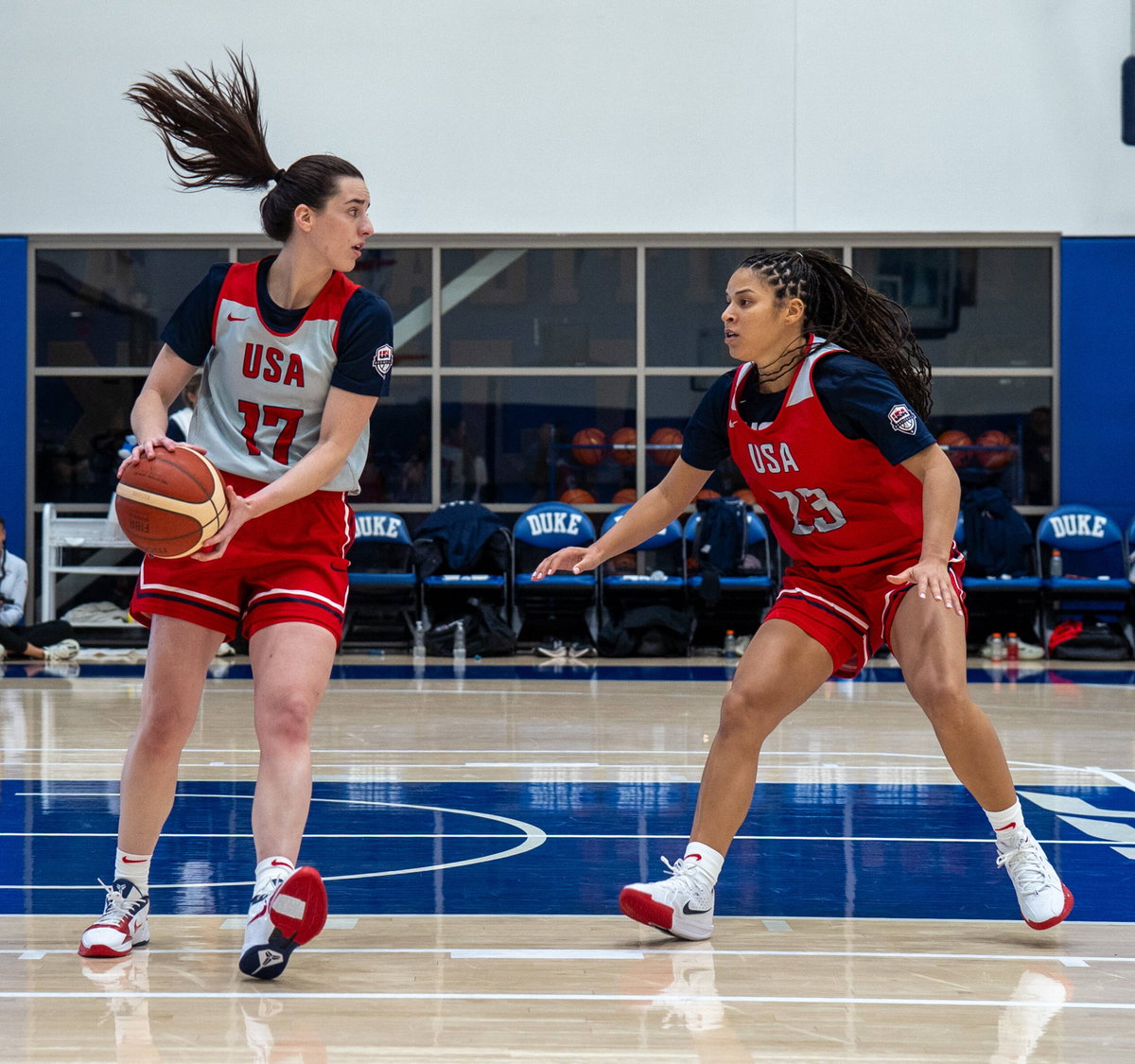
Imago
December 13, 2025, Durham, North Carolina, USA: Caitlin Clark 17 is guarded by Veronica Burton 23 during a scrimmage at the USA Basketball Women s national team, Nationalteam December Training Camp. Durham USA – ZUMAh304 20251213_zsp_h304_004 Copyright: xAlexxHallowayx
As per the Indiana Fever’s website, heading into training camp, the Fever has 10 guards, including Clark and Mitchell, 3 forwards, and 1 center.
Moving on, the 2025 season, it seems, did a number on them. The Indiana Fever had much of their core sidelined, forcing them to rely on emergency signings. In Game 5 against the Las Vegas Aces, which they lost, Kelsey Mitchell’s legs reportedly gave out from exhaustion, and she had to be rushed to the hospital. So now the approach is cautious.
They are taking a cautious approach with Caitlin Clark as well. She played only 13 games last year because of soft-tissue injuries. But she came storming back with an MVP in the Team USA Qualifiers earlier this year. Despite that, Stephanie White has a “bubble wrap” plan for Clark.
“We also want to be smart. She doesn’t need every rep in practice. We want to continue to ramp her up,” she said.
Arguably, that is not the best plan, as the more she plays, the more Clark gets comfortable on the court and gets back to her best. But creating the surrounding depth was part of the strategy.
“Being able to create a rotation that has depth is important. We have a lot of versatility in this group, and I’m really excited about that,” Cox said.
But then the question arises regarding depth in the frontcourt. The Fever only has 5 forwards, out of which only 2 are above 6’3″. One injury to either Aliyah Boston or Monique Billings means they could be easily blocked out of the paint. Yet, the 5-out or 4-out-of-1 system has worked for White for the last year.
They have elite three-point shooters like Mitchell, Clark, and Cunningham, while Johnson, Hull, and Boston form the building blocks of their defense. However, there was another aspect to their team planning this season: the financial flexibility.
Amber Cox explains financial preparation ahead of Caitlin Clark’s max extension
The Indiana Fever were in a tricky spot in retaining their squad. Kelsey Mitchell required a supermax, Aliyah Boston was up for a max after the EPIC clause inclusion, and Caitlin Clark is eligible next year. Three million-dollar-plus contracts within two years are difficult to maintain when handing out multiyear deals. They found a solution by giving Mitchell a single-year contract, and Boston took a pay cut. She will earn $1 million this season instead of the $1.19 million she is eligible for.
The Indiana Fever need to plan for Aliyah Boston’s supermax contract and Caitlin Clark’s max deal, which would account for 37% of their cap space in 2027. By 2028, both players could be on supermax contracts, combining to take up 40% of the cap. As things stand, the team is projected to have just $4,000 in cap space remaining. However, Clark and Boston remain top priorities for the franchise.
“We want those two around for their careers, the duration of their careers,” Cox said. “And (the EPIC clause) really gives us the opportunity to plan now, whereas under the old CBA, they would be coming off of their rookie-scale contract, and then you’re going into restricted free agency, and that’s only a couple of years. This gives us a longer runway to really plan, so we love this.”
So, this certainly affected their signings in free agency, which led to a lack of size and a guard-heavy rotation. But financial flexibility was a must for the Fever. This is a compromise they chose to have. It’s a calculated move, but only time will tell if they can succeed, regardless.