
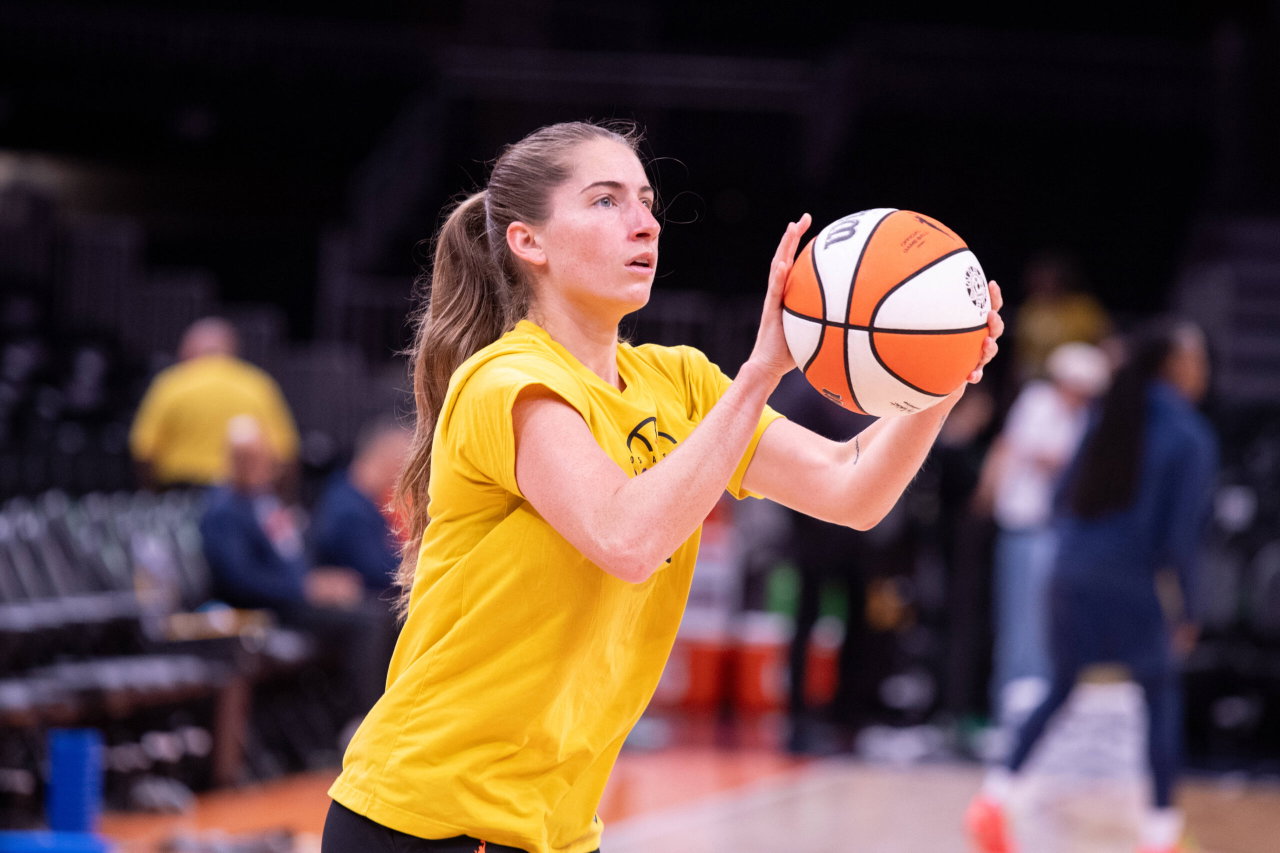
Hardly 10 days ago, Lynne Roberts said Sparks ownership wanted to see the bench play over the final stretch. She described it as an intentional evaluation of what the team had. For Martin, who had barely played since July 22 before getting back into the rotation against Atlanta, the final five games should have meant something.
Watch What’s Trending Now!
Instead, Martin’s audition may have ended before the season did. She played just four minutes against the Dream, hardly the kind of opportunity that suggested a larger role was coming. Then, away from the WNBA, her career took an unexpected turn, making what happened next even more surprising.
Unrivaled, the 3×3 league, recently announced that the 26-year-old would be returning for her third season on a multi-year deal. Martin quickly shared that news on her Instagram Stories with a simple “Yayyy.”
The timing raised an obvious question: If Martin was no longer in Los Angeles’ plans, what did Unrivaled see in her that made it want her back for the long haul?
The answer may lie in what the two teams were actually deciding. The Sparks were making a late-season roster move, while Unrivaled was making a multi-year investment in Martin. Martin’s WNBA numbers this season may explain why she never forced her way into a larger role in Los Angeles. But her career contains more than those 17 games. She was one of only four second-round picks from the 2024 draft to make a WNBA roster as a rookie, and she averaged 6.2 points and 2.7 rebounds in 16.4 minutes with Golden State in 2025.
Furthermore, the move also comes with Los Angeles sitting at 14-25 and 11th in the WNBA standings, with only five games remaining in the regular season. The Sparks’ playoff hopes are already over, so their decision to reshape the roster this late in the season is all the more surprising.
Kate Martin has yet to address the end of her time in Los Angeles publicly, but this marks the second time this season that a WNBA team has moved on from her.
After being selected by the Golden State Valkyries from the Las Vegas Aces in the 2024 expansion draft, Martin was waived by Golden State just days before the 2026 regular season began. When the Sparks opened their season, Martin admitted that the Valkyries’ decision “was brutal,” fighting back tears as she discussed the setback.
She eventually found her place with the Sparks on a player-development contract. And Los Angeles initially appeared to see something worth keeping. On July 6, the Sparks converted Martin to a standard WNBA contract, making her the first player in franchise history to move from the Player Development Pool to the active roster. Then-general manager Raegan Pebley said Martin had made “a meaningful impact” on the group and praised her “versatility on both ends of the floor,” competitiveness and team-first approach. That is why the waiver is more complicated than simply looking at her final averages.
Martin ultimately appeared in 17 games for Los Angeles, averaging 2.3 points, 1.1 rebounds and 0.4 assists in 7.1 minutes per game while shooting 37.1% from the field and 30.8% from three. Her production was modest, but so was her opportunity to establish a consistent role. Earlier in the season, she had scored a season-high 11 points against the Toronto Tempo, while her 10 games as a development player had been enough for the Sparks to award her a standard contract. Late in the season, her lack of playing time became a talking point.
“I love Kate. She’s an incredible member of this team. The rotations are tough with the amount of guys we have in that position… There’s a lot of players, and so it’s hard to play 12 people,” Roberts said during a practice session after the game against the Dream, per a YouTube video from John W. Davis.
When Roberts was asked whether Kate Martin having more experience in the league than some of the younger players meant the coaching staff had more information to evaluate her on, she acknowledged that was also a factor. “Yeah, there’s some of that for sure.”
In other words, the Sparks were not necessarily looking at Martin with the same unanswered questions they had about every younger bench player. Los Angeles had already seen her in practice, games and two different contract roles. The problem was that knowing more about a player does not always guarantee a place for her on the roster.
Martin’s departure also came during a wider roster shuffle. The Sparks claimed Aaliyah Nye off waivers, waived Alissa Pili and signed Ndjakalenga Mwenentanda to a development contract. That makes it more accurate to view Martin’s exit as part of a late-season restructuring than as a one-for-one swap with Nye.
There is another little-known complication to Martin’s immediate future in Los Angeles. Development players can appear in only 12 regular-season games before they must be converted to a standard contract to continue playing. Martin had already appeared in 17 games for the Sparks, meaning she had crossed that threshold. So even if Los Angeles had an open developmental spot, simply returning Martin to that role was no longer a straightforward option.
With Martin now on waivers, attention will naturally turn toward where she could land next. One team that will inevitably draw speculation is the Indiana Fever, largely because of Martin’s Iowa connection with Caitlin Clark. The reunion would make for an easy storyline, but the roster math makes it difficult.
Indiana’s 12-player roster is already set, while both developmental spots are occupied as well. The Fever would need to create an opening before Martin could become a realistic addition, making the Iowa connection more of a fan-driven possibility than an immediate roster solution.
For now, her next WNBA destination remains uncertain. But Martin’s basketball future is not.