
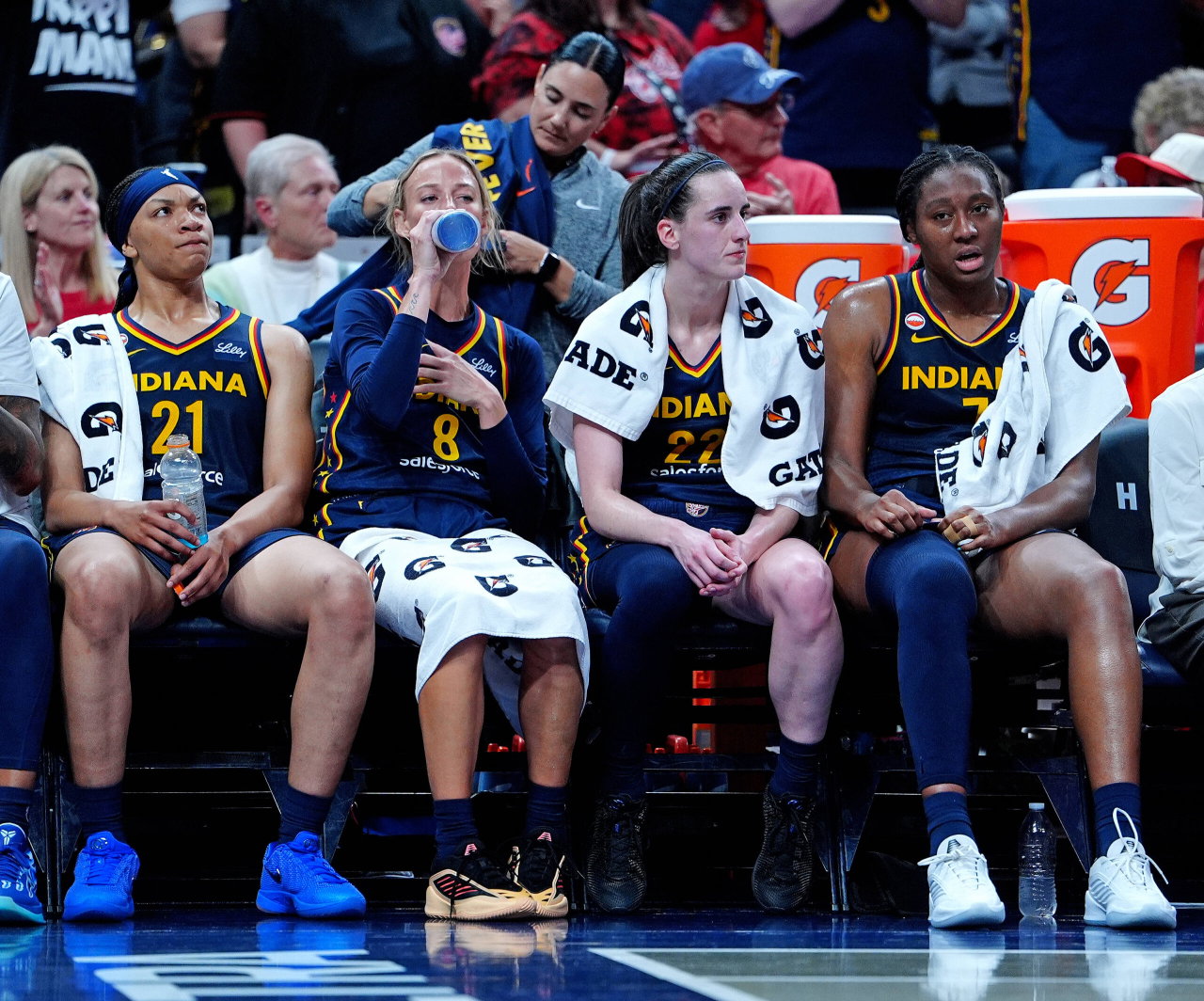
Aliyah Boston knows exactly where the Indiana Fever went wrong in their playoff opener against the Las Vegas Aces. The game, which ultimately ended in a 102-85 loss for the Fever, was indeed a hard lesson for them on how playoff basketball leaves little room for careless mistakes. And for Boston, that was a big part of their undoing in that game.
Watch What’s Trending Now!
“And that killed us in game one for sure,” Boston said, speaking to Candace Parker on Episode 51 of their Post Moves podcast. “I mean, it was like it was constant. We just turned it over, and they went, and they got open threes in transition.”
“And then game two was a lot better. I mean, we talked about it like dead-ball turnovers, being able to set our defense way better than getting in transition. And now we’re mismatched completely, and they do what they want. But Game 2 was way better.”
Like Boston pointed out, the Indiana Fever did suffer heavily from turnovers in Game 1 of their first-round playoff series against the Las Vegas Aces. They committed 17 team turnovers in that game, and the Aces, for the experienced playoff team that they are, heavily capitalized on those giveaways to score 28 points off turnovers en route to the 102-85 victory.
But it was not actually only the Fever that struggled with ball security in that game. The Las Vegas Aces also had the same number of turnovers, finishing with 17 themselves. However, the difference was mainly in who capitalized on those mistakes the most. And it was not the Fever. Indiana scored only 18 points off turnovers, 10 fewer than the Aces’ 28.
Head coach Stephanie White was, in fact, highly critical of the team’s ball security and execution in her postgame press conference. She specifically lamented the 28 points the Las Vegas Aces generated directly from Indiana’s 17 turnovers, calling the performance “sloppy.”
“I mean, 28 points off of turnovers,” White said. “It’s, you know, your first line of transition defense is offensive execution, and 28 points off of turnovers and 17 points from the free-throw line – so, you know, those are easy buckets. So we didn’t do our job.”
Caitlin Clark, who committed six of Indiana’s turnovers herself, was also quite critical of the team’s overall execution, describing their offensive actions as “sloppy.”
“I thought just like our actions were sloppy. I thought what we were running just wasn’t great and just nobody got an easy, open look. So I think a combination of both,” Clark said.
The turnovers were, however, something both the Aces and Fever managed to reduce in Game 2. Both teams ended up with 12 turnovers, though Clark again led Indiana’s giveaways with five. In that second game, which ended in a 99-89 win for the Indiana Fever, however, they actually got more points off turnovers. They scored 16 points off the Aces’ 12 turnovers while conceding just 11 points off their own 12 giveaways.
But ultimately, the eventual outcome of that series, which was sealed by the Aces’ Game 3 win, was not all down to turnovers alone. In fact, in Game 3, both teams once again cleaned up their ball security, ending with 10 turnovers each. They also each conceded 14 points off those turnovers.
Perhaps the biggest difference in that third game was shooting efficiency and free-throw execution. While the Fever did a much better job protecting the ball compared to the series opener, they simply could not match the Aces’ production in those two categories.
Indiana shot just 38.5% from the field, while the Aces shot 45.3%. The Fever also made just 14 of their 20 free-throw attempts, while Las Vegas converted 24 of its 35 attempts. In fact, the Aces shot 10 free throws in the final three minutes of the game, helping them withstand the Fever’s desperate comeback attempt and ultimately run away with the win.
In the end, turnovers may have been what “killed” the Fever in Game 1, as Boston put it, but the series ultimately showed that Indiana’s problems went beyond simply giving the ball away.