
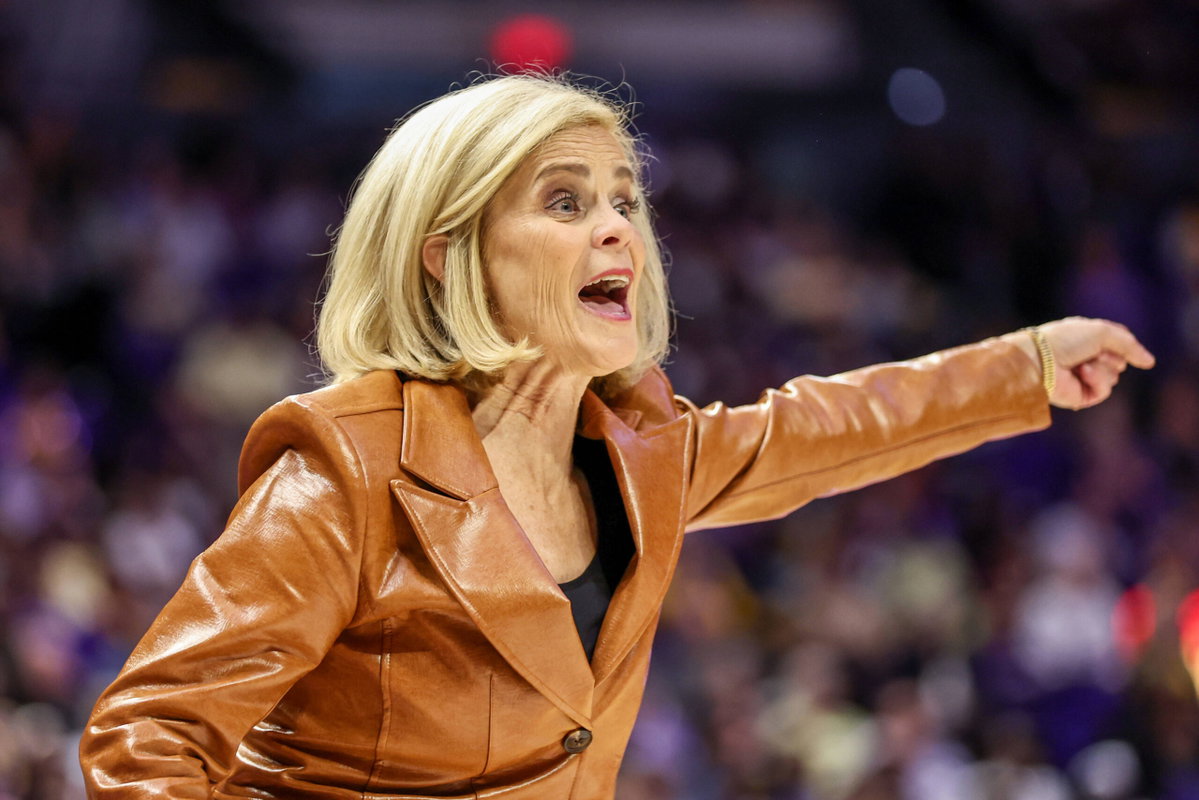
Kim Mulkey opened LSU’s Monday practice by addressing the frontcourt hole nobody really needed to ask about. Kate Koval, the Tigers’ expected starting center just a month ago, was already in Waco. Now, standing in her place was a 17-year-old from Moscow who had barely been on campus for five weeks. And instead of giving reporters a stat line, Mulkey gave them a nickname.
Watch What’s Trending Now!
“Baby Jokic,” Mulkey said at LSU’s open practice on September 21, before describing what she’s seen from Anna Minaeva since she landed in Baton Rouge.
“Remember, she’s only 17 years old, and as you watch her today, her body is very mature, and she’s fundamentally sound. She has tremendous footwork. She’s really, really gonna be special now. 17 years old. That’s just
remarkable that you would come that far from home. Took her 34 hours to get here”.
Minaeva’s path to Baton Rouge ran through MBA Moscow, where she played in Russia’s Premier League and Superleague during the 2025-26 season. Across 29 games there, she averaged 11.2 points and 9.6 rebounds, numbers that convinced Mulkey and her staff that she could contribute immediately at 6-foot-5.
LSU made the signing official on August 14, and Minaeva arrived in Baton Rouge that week. Since then, she has been adjusting to a new country, a new style of coaching, and a frontcourt that no longer includes Koval.
Koval is a 20-year-old born in Kyiv who left Long Island Lutheran as the No. 5 overall recruit in the 2024 class. She spent one season at Notre Dame, blocking 55 shots as a freshman, before transferring to LSU in April 2025. Last season she started 17 games for the Tigers, second on the roster in rebounding at 6.3 boards a game to go with 8.3 points.
Koval’s father serves as a drone operator in the Ukrainian military, something Mulkey had known well before Minaeva’s name entered the picture. In fact, the program had already renamed a “Russian Rebounding Drill” to the “Ukraine Rebounding Drill” at Koval’s request.
Now, according to Koval, she wasn’t told LSU was pursuing a Russian recruit until days after the transfer portal had already closed. Mulkey has said she drove to Koval’s apartment complex to deliver the news in person, telling her, “I’m not here to ask you to change how you feel about Russia. I’m just here out of respect for your family and out of respect for you”.
Mulkey reportedly floated the idea that the two players could become “ambassadors” for their countries. Koval’s response, by Mulkey’s own account, was a smile and a flat “I doubt that.” Koval then left the program on August 24.
“For me, this war is not distant or abstract,” she wrote on Instagram in early September. “People close to me have been killed and wounded in Russian attacks, and places where I grew up and first began playing basketball have been destroyed by missile strikes”. She added that she needed to “remain true to myself, my values, and my country.”
Because the transfer portal had already closed, Koval needed a legislative relief waiver from the NCAA just to suit up elsewhere this season. The NCAA granted her the waiver that week, and Baylor, the program Mulkey built into a national power before she left for LSU, announced her signing on September 12.
That said, back at Monday’s practice, Mulkey made clear the two departures weren’t tangled up in bitterness. “It was not a departure with any angriness, none of that,” she said. “You want kids to go find their happy place”.
LSU is coming off a 29-6 season that ended at the hands of Duke in the NCAA Tournament, and Minaeva is now part of the answer Mulkey has built for it.