
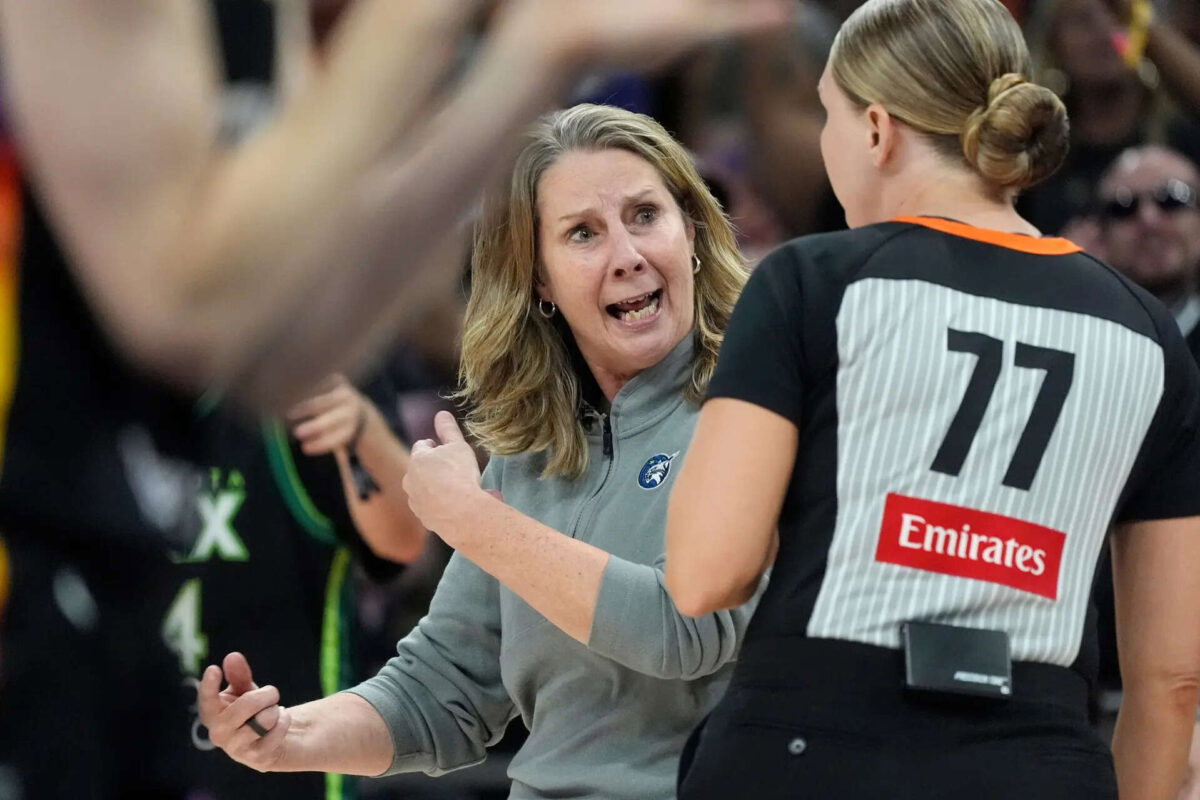
Cheryl Reeve was hailed as the queen of crashouts. The Minnesota Lynx coach’s frustration peaked after Alyssa Thomas’ contact with Napheesa Collier went uncalled as she limped to the locker room in tears. Reeve was handed the biggest fine in the history of the WNBA ($15,000) as she called for a “change in leadership at the league level when it comes to officiating.” Now, the fine amounts are set to rise further under the new CBA but Reeve remains confident regarding the game’s future.
Watch What’s Trending Now!
A Front Office Sports report noted that the fine for a technical foul now starts at $500 rather than the $200 last year. It doubles at Technical foul numbers 4-7 and up to $1500 at No. 8 with a game suspension. The increase is applied to the Flagrant fouls as well, with each foul costing the players $500 and not $200. The league also introduced fines for flopping, with a $100 fine for their second violation, increasing by $100 with each. While the fines are on the rise, Reeve is looking forward to reducing physicality and raising standards of the game.
“I think what I’m excited about is that there is an understanding that how our game has looked the last two years is not how we want it going forward. While they were hard at work on the collective bargaining agreement, we were hard at work on the state of the game,” she said in the recent media availability. “There were a lot of stakeholders involved in this, and it may take a little while to calibrate and get where we want to be.”
Many players and coaches were handed technicals for protesting against referee decisions such as Stephanie White , Caitlin Clark, Brittney Sykes among others. So, better refereeing can lead to a lesser number of technical fouls. In addition, the growth of the fines is slower than it is in proportion to the salaries. The wages went up by 5 times, while the fines are increasing by 2.5 times at the maximum. But that subtle increase will discourage players from committing flagrant fouls. And Reeve wants exactly that, a decrease in contact.
“We’re working really hard because we don’t want the level of physicality that we’ve seen in our game,” Reeve further said. “I’m confident the game is going to be more fluid and have more freedom of movement. We play beautiful basketball in the WNBA, and we have to make sure it’s not marred with unnecessary physical contact.”

Imago
Minnesota Lynx head coach Cheryl Reeve reacts after being ejected from the game during their 84-76 loss to the Phoenix Mercury during Game 3 of WNBA semifinals at PHX Arena on Sept. 26, 2025.
The preseason has already had the referees calling more fouls for lesser contact. “I thought you could be physical in the W, and anytime you touch someone, it’s a foul,” Azzi Fudd said. The early signs suggest the league is pushing toward a faster, more free-flowing game. Like the NBA, it is expected to give the edge to the offense. It’s debatable whether that is progress or not but it is much needed with regard to player fitness.
The WNBA experienced 220+ injuries in a 44-game season in the same window where it conducted a 40-game season. Excess contact and the limited roster capacity made things worse. Now, there are 2 compulsory spots and 2 developmental spots to give some breathing room to the teams.
Cheryl Reeve wants the WNBA to move on from its “physical” reputation towards a more NBA-like format. And this change in officiating and approach is set to impact the defensive schemes of multiple teams in the league.
Cheryl Reeve’s Demand Will Force Multiple WNBA Teams To Pivot
The WNBA’s tendency to allow brute force gave multiple teams a pretty straightforward strategy on how to defend. Have a look at the best defensive teams last year. Cheryl Reeve’s Minnesota Lynx topped the charts, the Atlanta Dream were second, and the Valkyries were third. All three used physicality as a weapon but the Dream and Valkyries even more so. Especially against undersized teams like the Indiana Fever or the Washington Mystics.
“We didn’t handle their physicality. That’s going to be the M.O. against us all year long,” Stephanie White said after their Dream loss. “Teams are going to be physical. That’s how I’d play us.” Then later on in the season, Golden State Valkyries managed to hold off Caitlin Clark using the same strategy. She scored just 11 points and went 3-of-14 from the field, missing all seven of her 3-point attempts.
“I mean, you guys saw what we’re doing. We were being disruptive. We know she doesn’t like physicality,” Natalie Nakase said. The Phoenix Mercury also did the same, particularly in that semifinal series against the Lynx which led to Reeve’s frustration. Now, with the referees calling more fouls on contact, these teams will be forced to change their ways.
And it is not easy to flip the approach within a month’s training camp. So, fans can expect these teams to top the fouling charts. The sets would change as defenders wouldn’t be able to get in the face of a shooter anymore, which could increase the advent of double teams. Of course, that is assuming the referees continue with this trend and erode the excess physicality.