
Imago
imagn
Imago
imagn
NBA Commissioner Adam Silver is being pulled into a conversation he’s long avoided, and the timing couldn’t be more critical for the WNBA.


That conversation took a sharper turn recently, especially in the wake of tense CBA negotiations between the WNBA and its players, when FOS reporter Annie Costabile openly pointed to the commissioner as the one who should be held accountable for the league’s missteps.
Watch What’s Trending Now!
During a recent appearance on the Flagrant and Funny podcast, Costabile didn’t hold back while discussing the WNBA’s direction.
“I think he bears the majority of the responsibility. You’re the leader, and you – through every step of this – have communicated that in various ways, right? Never outwardly, but it’s always been communicated in various ways that Adam, at the end of the day, is the voice of all voices.”
“I think what we struggled to do with the WNBA is hold two truths at the same time. David Stern deserves a lot of credit for making this league a reality. Adam Silver deserves a lot of credit for ensuring it continues. And again, carrying on David’s plans for this league. But the other reality is there have been missteps along the way, and that deserves scrutiny too, and I don’t know that there’s been enough of it rightfully put on Adam through this.”
Imago
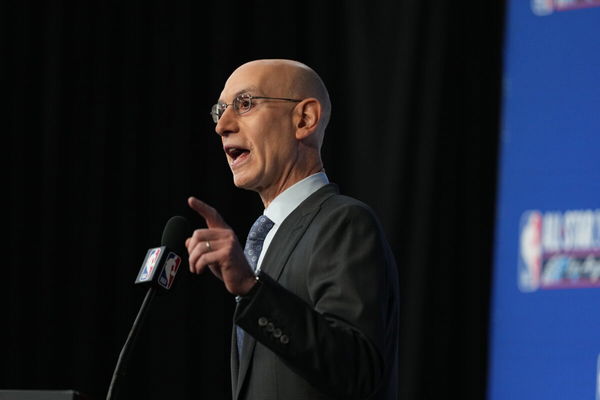
Feb 14, 2026; Los Angeles, CA, USA; NBA commissioner Adam Silver speaks to the media during a press conference before 2026 NBA All Star Saturday Night at Intuit Dome. Mandatory Credit: Kirby Lee-Imagn Images
That statement alone reframes the conversation.
Because while Cathy Engelbert remains the league’s public-facing commissioner, Costabile’s argument is simple: the real power sits with Silver. And if that’s the case, then so should the blame, especially as criticism around the league’s recent decisions continues to grow.
From the outside, the WNBA is experiencing unprecedented growth. Viewership is surging, expansion teams are being added, and player visibility has reached new heights. But behind that momentum, several decisions tied to the league’s structure and leadership have drawn increasing scrutiny.
In the recent negotiations, one of the biggest sticking points was revenue sharing.
Despite the league’s rise, concerns have emerged about how that growth is being translated into player compensation. After all, the players are the ones who are driving this growth. While the new CBA promises increases, critics argue the overall structure still falls short of reflecting the league’s trajectory, especially when compared to the NBA model. Reports suggest that after expenses, WNBA players could receive less than 15% of total revenue, which is a stark contrast to the NBA’s roughly 50% split.
So, because the NBA holds significant financial and structural control over the WNBA, that criticism circles back to Silver.
But then there’s the question of long-term valuation.
Past investment decisions, particularly around how the league was valued during earlier capital raises, like when the league sold 16% of its stake for $75 million, are now being revisited in a very different landscape. With the WNBA gaining momentum faster than expected, some believe the league may have been undervalued at critical moments, which has limited its current financial flexibility.
Individually, these might seem like growing pains. Together, they form the basis of the current criticism.
However, Costabile’s sharpest critique was about presence.
The Invisible Leader Problem
For all the conversations around growth, investment, and player compensation, one of the biggest issues, as per the FOS reporter, is visibility at the very top.
While Adam Silver is widely understood to be the ultimate decision-maker when it comes to the WNBA’s biggest calls, that authority hasn’t always come with a consistent public presence. And in a league that’s rapidly evolving, that absence is starting to stand out more than ever. Take the recent CBA issue, for example. The WNBA has just navigated over 100 hours of negotiations to reach a CBA agreement that is expected to completely redefine player experience after a 17-month process. But Silver remained largely out of the spotlight throughout the process, even though the NBA controls roughly 42% of the WNBA.
While Engelbert leads the league publicly, the NBA, and by extension Silver, still holds significant influence behind the scenes.
“I think he does a really good job at keeping the separation, like visibly, or publicly, right? He’s the commissioner of the NBA. We don’t really see him in the WNBA. It’s not like he’s holding press conferences regarding WNBA news, or he’s not really at the major events throughout the year, the tent pole events, the All-Stars, the finals, all the time.”
“He’s kind of like this ghost figure who isn’t consistent enough. But everyone knows is the puppet master behind it all, right? And so, I think he gets to evade and escape that way.”
“And again, through this next era of the WNBA, it’s like either step into the light fully, Adam, and be that voice that everyone behind the scenes knows you are. Or be the man that everyone knows behind the scenes, you are, as in the person who’s the decision maker, etc., or hire somebody who you can fully allow to take this league to the next level. I think it’s got to be one or the other,” Costabile further added.
So if Adam Silver is truly the decision-maker behind the scenes, then the next step is simple: match that authority with visibility. Because if the influence ultimately traces back to Silver, the criticism will land exactly where many now believe it belongs.
Does the WNBA Need a Leader on Adam Silver’s Level?
For years, the WNBA has been viewed as an extension of the NBA. As a league supported, guided, and at times defined by its parent organization. While that may have been true in its early years, today’s reality looks very different.
From being labeled the fastest-growing brand in sports to pushing toward a future where million-dollar player salaries are becoming possible under the new CBA, the league has clearly outgrown the limitations of its past perception. But with that growth comes a bigger question: does its leadership structure still match its ambition?

Getty
Cathy Engelbert, chief executive officer of Deloitte LLP, speaks during a Bloomberg Television interview in New York, U.S., on Tuesday, March 8, 2016. Engelbert said Deloitte would hire 25,000 people in 2016. Photographer: Chris Goodney/Bloomberg via Getty Images
“I think this league needs a leader that is going to work side by side with Adam. Not be a step below Adam,” Annie Costabile argued. “I know that’s a lot to ask because this league was founded by the NBA.Was brought to life by David Stern… But if that’s how you’re going to treat it, that’s all it’s ever going to be. You can’t expect this league to truly reach its full potential, to maximize its value, if the leader of the league is responding to the leader of another league.”
As long as the WNBA operates under the shadow of Silver, the concern isn’t just about visibility; it’s about autonomy. Can a league truly maximize its value if its top decision-maker ultimately answers to another? And that concern isn’t new, either.
Economists and analysts have long pointed out that the NBA historically viewed the WNBA as a complementary product. Something that filled arenas in the offseason rather than a standalone business to fully scale. But the current moment suggests that approach may no longer fit.
The WNBA isn’t just a partner league anymore. It’s a growing business with its own audience, its own stars, and its own trajectory. And if that’s the case, then the next step isn’t just better deals or bigger numbers. It’s a leadership structure that reflects that independence.
Written by

Edited by

Snigdhaa Jaiswal