
Angel Reese had every reason to celebrate on April 2, 2023. LSU had just beaten Caitlin Clark and Iowa 102-85 to win the national championship, and Reese had finished the night with 15 points, 10 rebounds and the tournament’s Most Outstanding Player award. Then came the moment that would follow both players for years.
Watch What’s Trending Now!
Reese pointed to her ring finger and hit Clark with the famous “you can’t see me” gesture. The image spread everywhere, becoming one of the defining moments of their rivalry. Yet even after all the noise that followed, Clark defended Reese and said she did not deserve the criticism coming her way. Six months later, Reese offered a very different view of the player she had just beaten.
After Team USA’s 97-79 win over France in the FIBA World Cup final, Clark was asked about Reese and made a declaration that seemed to put years of speculation to rest. “We’ve always been friends. Don’t try to do that. Don’t try to do that,” Clark said. Veteran analyst Ric Bucher, however, wasn’t buying it. “I’m never going to believe they’re friends because of their rivalry, their history, and just how generally different their personalities are,” Bucher said in a video posted on his X handle.
That sounds like the same rivalry all over again. But Bucher’s argument did not end with Clark being wrong about the friendship. In fact, he made a much more interesting point about what happened when the two finally spent a full international tournament on the same side.
“I also don’t believe their differences are so deep-rooted that they can’t develop, or haven’t developed, a mutual appreciation for what they both bring to the table,” Bucher said. “Shared success and a common cause has a way of breeding an appreciation and respect that supersedes personal differences.”
And that distinction matters because the history between Clark and Reese has never been as simple as the rivalry made it look.
Go back to that night in April 2023.
LSU had just beaten Iowa 102-85 in the national championship game. Reese finished with 15 points and 10 rebounds and was named the tournament’s Most Outstanding Player. Clark scored 30 points.
Then came the image that changed how millions of people viewed the two players.
Reese used the “you can’t see me” gesture toward Clark and pointed toward her ring finger. It became the moment most closely associated with their rivalry, and the reaction around it quickly grew beyond the game itself.
But even then, Clark wasn’t treating Reese like an enemy.
After the game, Clark defended her.
“I don’t think Angel should be criticized at all. No matter what way the game went, I should never be criticized for the emotion I show. I’m just thankful I get to play this game.”
Six months later, Reese was talking about playing with Clark.
“I love Caitlin. We’ve been competing since we were in AAU… It was always fun and always competitive. One day, hopefully, me and her can be teammates, because she is a great player and a great shooter and a great person and a great teammate.”
Reese wasn’t saying that after a Team USA gold medal. She was saying it while the rivalry was still one of the biggest stories in college basketball.
That makes what happened in 2024 even more interesting.
When Iowa and LSU met again in the Elite Eight, the two stars were asked directly about the idea that they hated each other.
Reese’s answer was simple.
“Me and Caitlin Clark don’t hate each other.”
Clark had her own way of putting it.
“Me and Angel have always been great competitors.”
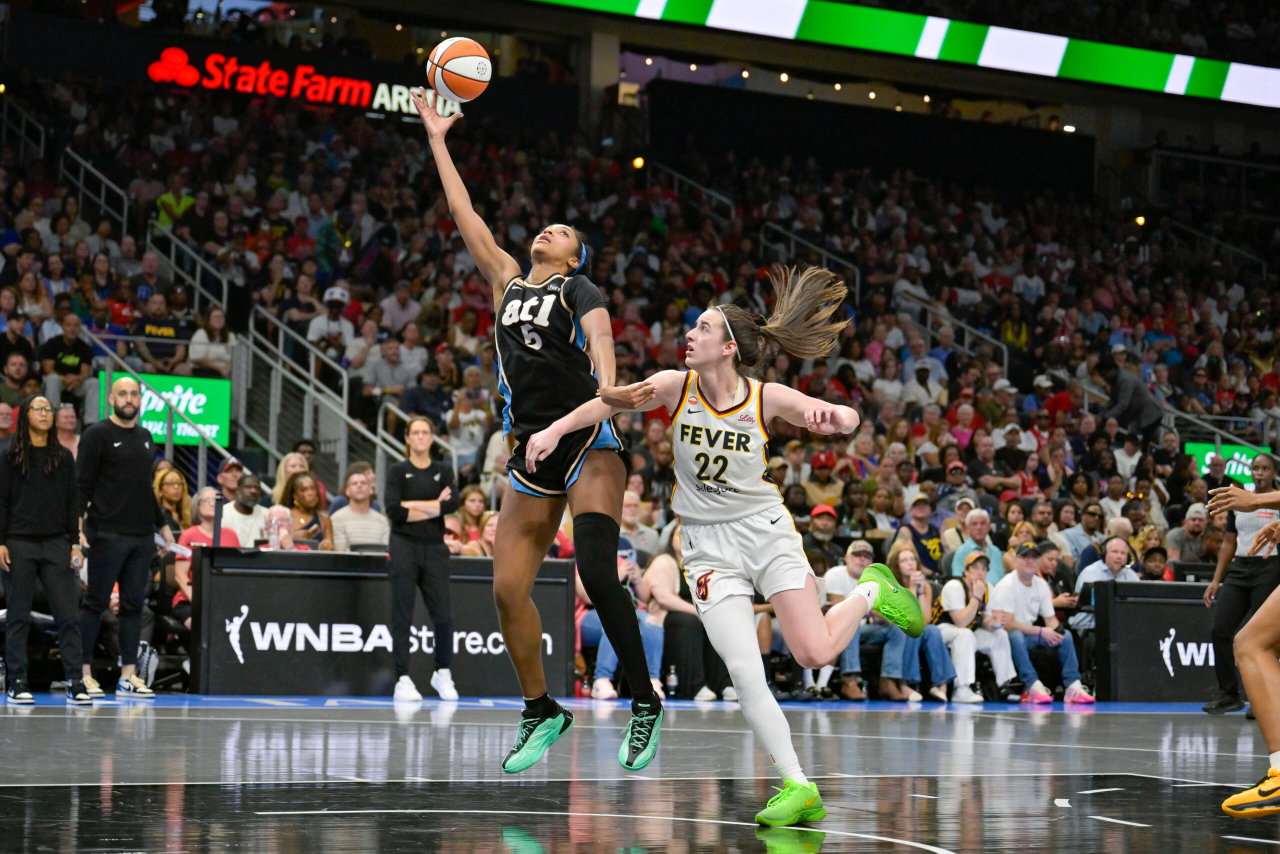
The public story had become much bigger than those words. Their games were massive television events. Their WNBA careers began in the same draft class. Every hard foul, stare and reaction could become another chapter in the rivalry.
Yet the players themselves kept drawing a line between competition and personal animosity.
That line became even clearer when Clark spoke to TIME later in 2024.
“We’re not best friends, by any means, but we’re very respectful of one another. Yes, we have had tremendous battles. But when have I ever guarded her? And when has she guarded me? The only thing people cared about was this controversy that was really fabricated and made up…”
So what changed?
The answer may have less to do with friendship and more to do with basketball.
Clark and Reese first became teammates during the 2024 WNBA All-Star Game. Clark finished with 10 assists, while Reese posted 12 points and 11 rebounds as Team WNBA beat the U.S. Olympic team 117-109.
It was a fun preview, but it was still just one game.
The 2026 FIBA World Cup was different.
This time, they had six games together. There was a real tournament to win, a rotation to figure out and opponents trying to stop them. Both came off the bench, and their roles began to make sense alongside each other.
Clark became Team USA’s leading passer, averaging 5.3 assists per game. Reese brought her rebounding, defense and interior scoring. Neither had to become the other player’s type of player.
They could simply do what they already did best.
That was especially clear in the quarterfinal against Hungary.
Clark finished with 10 points and nine assists. Reese had nine points, six rebounds and three assists. More importantly, the two repeatedly found each other.
Clark could pull defenders toward the perimeter and then feed Reese inside. Reese could run toward the rim, attack the glass and give Clark another target when the defense collapsed.
Then Reese started returning the favor.
“We’ve played against each other so many times, so I’m sure we know each other’s game like the back of each other’s hand, she knows my spots. Dishing it off to her, she dishes it off to me. So it’s fun. We just continue to build chemistry because we know we’re going to be USA teammates for a while,” Reese said after the Hungary game.
That may be the most important quote in the entire story.
Reese wasn’t talking about becoming best friends.
She was talking about knowing Clark’s game.
And that is exactly where Bucher’s argument becomes harder to dismiss.
Clark’s own comments during the tournament pointed in the same direction.
“We’re both fiery, fiery competitors and we want to win and it’s one of the things I really admire about her game. She’s competitive and she has a tremendous motor, like she has one of the best motors in the league. She works just as hard as anybody on the court,” Clark said.
That is not the language of two players simply trying to get along for the cameras.
It is the language of two competitors who understand exactly what the other brings to the floor.
And then came the gold-medal game.
France jumped out to an early lead, but Team USA fought back. Near the end of the first half, Reese helped force a turnover that eventually led to Clark receiving the ball for a long three at the buzzer. Clark knocked it down, cutting France’s lead to 45-43.
Reese immediately jumped off the bench and ran toward Clark to celebrate.
The image looked nothing like the one from Dallas three years earlier.
But the basketball story was more important than the picture.
Team USA went on to win 97-79 and finish the tournament 6-0. Clark ended the World Cup averaging 7.8 points and 5.3 assists per game, leading Team USA in assists despite coming off the bench. Reese averaged 6.0 points, 5.7 rebounds and 1.2 assists per game.
Their roles were different.
Their value wasn’t.
And that is why the World Cup may have changed something between them, even if Bucher still refuses to call them friends.
Clark and Reese did not need to erase their rivalry to become effective teammates. They did not need to stop being competitive. They did not even need to agree on how to describe their relationship.
They needed to win.
That common goal gave them a chance to spend far more time learning each other’s game than they normally get when they are wearing different uniforms.
For years, the public had been trained to look at Clark and Reese through the lens of who won the argument, who made the bigger play or who got the last word.
The World Cup offered something different.
It showed what happens when two players who helped create one of women’s basketball’s biggest rivalries are asked to solve the same problem instead of trying to solve each other.
And the result was pretty simple.
They fit.
That does not necessarily prove Clark’s definition of their relationship. Being great teammates does not automatically make two people close friends.
But the history also makes it difficult to paint their relationship as a feud.
Reese was talking about wanting to play with Clark back in 2023. Clark defended Reese after the championship controversy. Both players rejected the idea that they hated each other before their 2024 rematch. Clark later described their relationship as respectful. Then, in 2026, they spent a World Cup finding each other on the court and celebrating each other’s biggest moments.
So perhaps the more interesting question was never whether Clark and Reese were secretly best friends.
Maybe it was whether the rivalry had become something bigger than the players themselves.
Reese once said, “Social media is going to put two women against each other… I’ll take that of being the person that gets the hate, but I know at the end of the day, I’m growing women’s basketball. For her, for me, it’s all competition. It’s just basketball.”
The World Cup gave that statement a different backdrop.
For six games, there was no need to choose a side.
Clark needed Reese.
Reese needed Clark.
And Team USA needed both.
Now they head back to the WNBA, where the uniforms will change again and the competition will return. Clark will once again try to beat Reese instead of feeding her. Reese will once again try to make life difficult for Clark instead of celebrating her shots from the bench.
The rivalry isn’t gone.
But after Berlin, it may be a little harder to believe that the rivalry was ever the whole story.