

Breanna Stewart didn’t expect the CBA talks to break the way they eventually did. She thought they would drag on for weeks with no real end in sight. And for a while, that’s exactly what happened.
Watch What’s Trending Now!
“Listen, when we first got started, I was like, ‘this thing is not getting done,” Stewart said at the Post Moves podcast. “We are going to be here for weeks, because it was like there was no light at the end of the tunnel. Our first meeting was like the first day, we were there until 2:30 a.m., and they were like, see you back at 10. That happened for eight days in a row. I learned a lot.”
That grind wasn’t an exaggeration. The two sides spent roughly seventeen months at the table, dating back to when players opted out of the previous agreement. The final stretch alone involved something close to 100 hours of in-person negotiating packed into just eight days. Stewart said the process left its mark on her either way.
“I really learned a lot.,” Stewart said. “I joke that I don’t want to be a lawyer. I really don’t. But the way they have to read between the lines, the in’s and out’s, words matter. There was no revenue sharing before this. There was so much that needed to be fixed. And I think the best part was that we actually had boots on the ground.”
In the final weeks, a group of prominent agents sent a letter to the union’s executive director raising concerns about transparency. Stewart and fellow vice president Kelsey Plum followed with their own private letter questioning how much players were actually being kept informed. That letter leaked publicly and became its own distraction in the middle of an already tense negotiation.
None of that stopped the union from getting what it set out for, even if it took longer than anyone wanted.
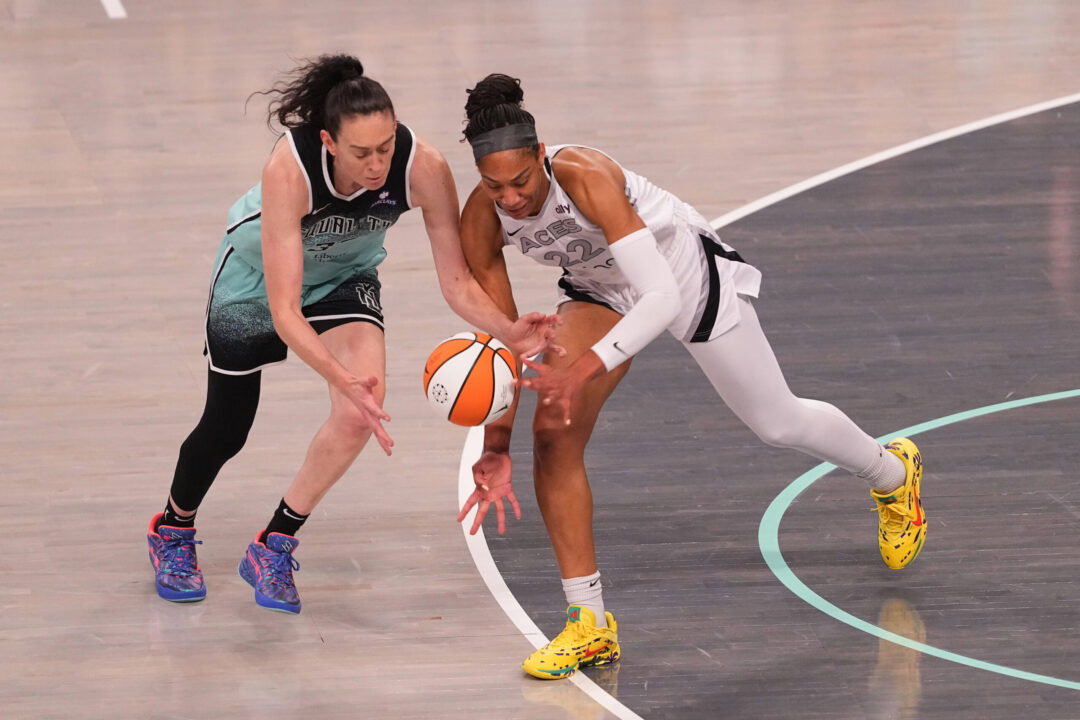
Imago
BROOKLYN, NY – JULY 08: New York Liberty Forward Breanna Stewart 30 and Las Vegas Aces Center A ja Wilson 22 battle for the ball during the first half of the WNBA, Basketball Damen, USA game between the Las Vegas Aces and the New York Liberty on July 8, 2025, at the Barclays Center in Brooklyn, NY. Photo by Gregory Fisher/Icon Sportswire WNBA: JUL 08 Las Vegas Aces at New York Liberty EDITORIAL USE ONLY Icon250708031
The gap between the two sides was massive for most of the process. Players pushed for roughly 26% of gross revenue at one point, while the league’s counteroffers were built around giving players just over 70% of net revenue, a much smaller number once expenses are stripped out first. The salary cap structure was just as contested, with league proposals climbing slowly from $1.5 million toward figures in the $5-6 million range before the two sides finally landed on a deal.
What they settled on reshaped the league. Players secured 20% of a newly created revenue category called Shared Basketball Revenue, along with a salary cap that jumped from $1.5 million to $7 million overnight. The agreement also introduced new provisions the league had never offered before, including guaranteed housing standards, expanded developmental roster spots, and other player-experience commitments the union had been pushing for throughout.
Getting seven different union leaders, plus the league, the owners, and their respective lawyers, onto the same page took the full stretch of those months. Stewart, Nneka Ogwumike, Napheesa Collier, Kelsey Plum, Alysha Clark, Elizabeth Williams, and Brianna Turner made up the WNBPA’s executive committee steering the process, and when the deal finally closed, the room celebrated with a champagne toast.
Stewart described the toll that stretch took on her personally in a separate interview with USA Today.
“I want to make sure I’m doing everything I can to make the sport and the league better,” she said. “There are moments where I could say I’m tired, or I want to be with my kids and my family. But the way I expect greatness from myself on the court, it’s the same way off the court.”
That mindset traces back further than this one negotiation.
Breanna Stewart Weighs In on the Importance of Player Representation in the League
Stewart’s path into union leadership started small, as a player representative for the Seattle Storm. She’s since become one of the WNBPA’s longest-serving vice presidents, a role she said she didn’t originally see coming.
“I didn’t know that from being a player rep I would eventually be a VP or things like that,” Stewart said on the Post Moves podcast. “But I remember when Sue was my vet, she was like, you need to do this. There were two player rep spots open, and she was like, you need to do it, your voice matters.”
She’s since tried to pass that same push along to newer players.
“It might seem small or marginal, but it’s still important,” Stewart said. “Now I take that and carry that. I made Sabrina, I’m like, you need to be player rep, because you need to be representing this league.”
That same instinct hasn’t gone quiet now that the CBA is signed. Stewart has continued speaking up about officiating and other issues affecting the league’s product this season, treating her voice off the court as an extension of the same standard she holds herself to on it.
The union’s next real test comes when the current agreement’s opt-out window opens after the 2031 season. However, long before that, the league’s ratification numbers already showed where the players stood: 93% turnout, with 98% voting to approve the deal Stewart helped negotiate.