
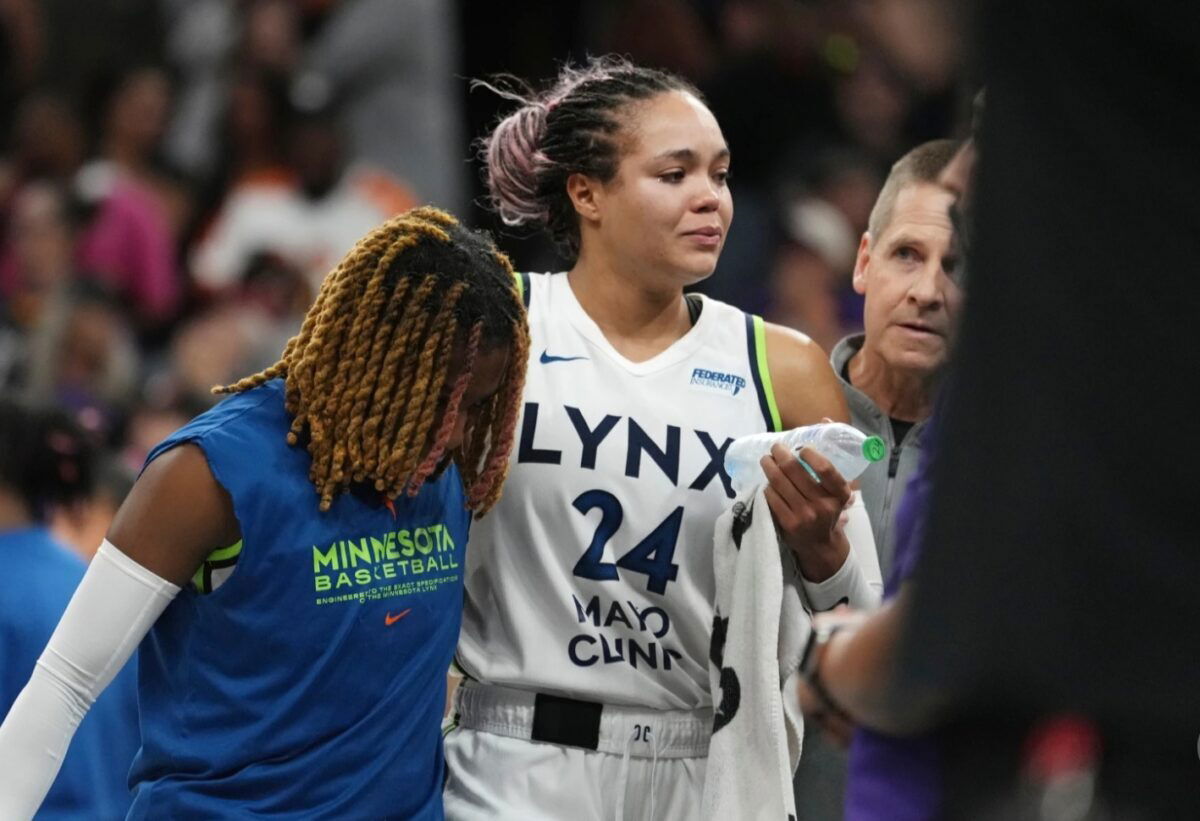
Physicality has always been a part of the WNBA’s identity. But Napheesa Collier has had enough because, according to her, the league may have crossed the line as the games have gone from competitive to exhausting. With the 2026 season still fresh and officiating already becoming a league-wide talking point again, Collier recently stepped into a debate that players and coaches have been circling for years. But what grabbed the most attention was the NBA comparison she made.
Watch What’s Trending Now!
During a recent interview with NPR, the Minnesota Lynx star admitted she believes the WNBA’s current level of physicality is becoming a problem for both players and fans alike.
“I do feel like the game is too physical right now,” she said. “We’ve been compared to the NBA of the 80s, just our physicality. And I do think that hinders the players, obviously. Like, you come to watch players play offense and score. And so, it’s so physical, the game is not fun to watch, and it’s not fun to play.”
But Napheesa Collier wasn’t just talking about hard fouls that happen in the game or any isolated moments. Her frustration centered around how the league currently rewards defense over offense, especially with the way games are officiated.
“I think consistency in reffing is the number one thing that (players) ask for every year,” she further explained. “I think the game right now is catered to the defensive player. Because you always hear ‘defense wins championships,’ and it does. But in my opinion, it should be catered to the offensive player, because that’s why you play basketball.”

“You come to watch the players play offense and score.. so when the game is so physical, it’s not fun to watch and it’s not fun to play.” - Napheesa Collier on the physicality of the WNBA
Honestly? The comparison she made to the 1980s NBA is not random at all.
Back then, the players in the men’s league used to jam up the paint, and the league allowed constant off-ball contact. That turned every drive to the basket into a physical battle. Though they have moved away from that now by introducing rules like the defensive three-second violation, where defenders can’t camp near the rim for too long.
However, the WNBA still hasn’t acknowledged that rule. So the elite rim protectors are allowed to stay planted near the basket indefinitely, which naturally creates more contact around the rim and makes interior scoring far more difficult. Now, combine that with referees often “letting players play” through heavy contact, and you understand where Napheesa Collier is coming from.
Since the last season, complaints about officiating and physicality have steadily grown louder across the WNBA. Players and coaches have repeatedly questioned the consistency of calls, especially as the popularity of the league continues to explode.
Becky Hammon once bluntly described the current product as “rugby,” while Angel Reese publicly said officiating “has to be fixed.” Even veterans like Natasha Cloud and Kelsey Plum have openly criticized how games are being called.
According to ESPN Research, teams were averaging 18.7 fouls per game in 2025, which was the highest mark since 2017.
Even Azzi Fudd, who just joined the league this season, admitted she still doesn’t fully understand how physicality is being called at the professional level after her preseason debut.
“Honestly, I feel more confused,” Fudd said. “I thought you could be physical in the W, and anytime you touch someone, it’s a foul.”
And that’s exactly where the frustration around officiating becomes more complicated. The issue is not simply whether the league is too physical or too soft. It’s the inconsistency. Some nights, referees allow extremely heavy contact. Other times, even minor contact gets whistled immediately. That unpredictability is what players like Collier have increasingly pushed back against and continue to do so.
But there is good news: the WNBA is actively working on improving these conditions.
Napheesa Collier may already be getting what she asked for from the WNBA
Last month, commissioner Cathy Engelbert revealed that the league spent the offseason working closely with referees to improve foul consistency and create clearer standards around physical play heading into 2026.

Imago
Sep 1, 2025; Minneapolis, Minnesota, USA; Minnesota Lynx forward Napheesa Collier (24) is fouled by Dallas Wings forward Amy Okonkwo (0) in the first quarter at Target Center. Mandatory Credit: Matt Blewett-Imagn Images
And preseason game reactions do suggest players are already noticing the difference.
After the Indiana Fever faced the Dallas Wings in a preseason matchup, Caitlin Clark, who has been a victim of a lot of physical play from her WNBA peers since entering the league in 2024, openly praised the way the game was officiated.
“I thought the refs did a really good job tonight, actually,” she said. “That’s kind of been their focus going into this season. I know there’s a committee of people that really wanted them to start calling things.”
So that reaction may be the clearest sign yet that the league is already trying to move away from the ultra-physical style Napheesa Collier criticized.
Of course, it is still far too early to say whether the WNBA has fully solved the issue or not. But if preseason officiating carries into the regular season, which is all set to begin on May 8, players could finally start seeing the balance between physical defense and offensive freedom that everyone has been pushing for.