Imago
Credits: Imagn
Imago
Credits: Imagn
At a time when critics keep questioning whether WNBA players deserve the pay and respect they are asking for, Unrivaled delivered its answer on the court. As co-founder, Breanna Stewart of Unrivaled said, “It’s more than just hype what we have at Unrivaled. You’re really seeing the product through and through – what you get on the court and how players are treated off the court.” After watching the semifinals of the Unrivaled, you could see exactly what she meant.
Watch What’s Trending Now!
After drawing 21,490 fans to Xfinity Mobile Arena in Philadelphia and shattering the record for a regular-season women’s professional basketball game and for any event in the venue’s history, Unrivaled decided to play its semifinal games at the iconic Barclays Center.
The decision to host the semifinals in Brooklyn came almost out of nowhere, and many questioned whether it could match the energy of Philadelphia. Unrivaled had less than a month to sell tickets, making the decision even riskier. “To be honest with you, it was somewhat of an internal split room on whether we should pull the trigger on this,” Unrivaled president Alex Bazzell admitted. Well, it may not have broken records like the first stop, but it was still a clear success. A total of 18,261 fans packed the arena, and they all had one message.
Fans are chanting “Pay the players” during @Unrivaledwbb semi-finals 👀
Unrivaled is changing the game. (via @kareemcopeland)pic.twitter.com/w6ge2oIe8b
— Legion Hoops (@LegionHoops) March 3, 2026
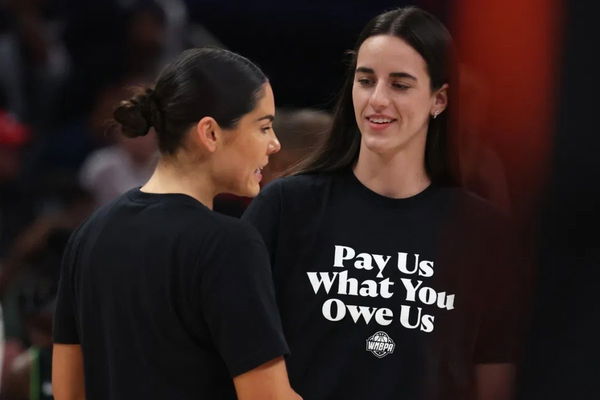
“Pay the Players” echoed throughout the night, a direct call to Cathy Engelbert and the league office to finalize the WNBA CBA so the season can begin on time. As things stand, both sides remain far apart. There is still no agreement in place. The league has reportedly given the union a March 10 deadline to reach a verbal deal and avoid losing games. But that outcome appears unlikely.
The league submitted a fresh CBA proposal on Sunday night. It includes a provision that would allow players on rookie scale contracts to earn max-level salaries starting in Year 4, provided they make All WNBA First or Second Team. However, the salary cap has only been marginally increased to $5.75 million.

The revenue-sharing structure remains unchanged from the previous offer.
Right now, the league is proposing to give players more than 70 percent of net revenue. The union, however, is asking for an average of 26 percent of gross revenue before expenses over the life of the deal. That gap has become the biggest sticking point in negotiations so far. And the differences do not end there.
Franchises could face a major revenue allocation problem under the current WNBA CBA proposal. With the league allowing players eligible for max contracts to earn more than $1 million, contenders are likely to have more than one player seeking a max deal. That would make it difficult for teams to build and maintain a competitive roster under the proposed salary cap.
Which is exactly why the union is demanding a salary cap closer to $9.5 million. Unless both parties come to a common ground, it is highly unlikely that we will see a deal agreed upon anytime soon.
The urgency to get this deal done cannot be overstated. Two new teams are joining the league, and no expansion draft has taken place yet. On top of that, free agency still needs to be addressed, with more than 80 percent of the league currently set to hit the market. If a WNBA CBA is not finalized soon, we could be looking at a scenario where the league enters a lockout.
The players, however, remain determined to get the deal over the line. “I want to play, and players want to play,” Kelsey Plum said. “And so obviously we’re going to continue to negotiate and do everything we possibly can to get this done in a timely fashion. But obviously, a strike would be the worst thing for both sides, because we are in a revenue (sharing system), so no revenue, no revenue to share.”
For now, it is a waiting game to see who is willing to be flexible. The union has already shown signs of compromise by lowering its revenue-sharing demand. Now, we wait to see whether the league is prepared to move as well.
Shifting focus to Unrivaled, the New York stop proved to be another big win.
Unrivaled Sets the Standard Amid WNBA CBA Tensions
Monday’s semifinal games not only welcomed a sellout crowd of 18,261, but they also drew plenty of star power. Among those in attendance were two-time Olympic gold medalist Hilary Knight, Hall of Famer Carmelo Anthony, soccer icon Alex Morgan, and actors Ashton Kutcher and Issa Rae.
The Philadelphia stop proved to be a financial win for Unrivaled, generating close to $2 million in revenue. More than $1 million came from ticket sales, with another $400,000 from merchandise. And the momentum did not slow down. According to fresh reports from Just Women’s Sports, the New York event brought in $1 million from ticket sales alone.
We hope that for a league that not only pays its players significantly more than the WNBA but also offers them equity, Cathy Engelbert is taking notes. Unrivaled has shown just how successful a player-first model can be when it comes to generating revenue. With women’s basketball continuing to grow beyond the WNBA, we can only hope that a WNBA CBA finally reaches its conclusion.
Related Newsletters