
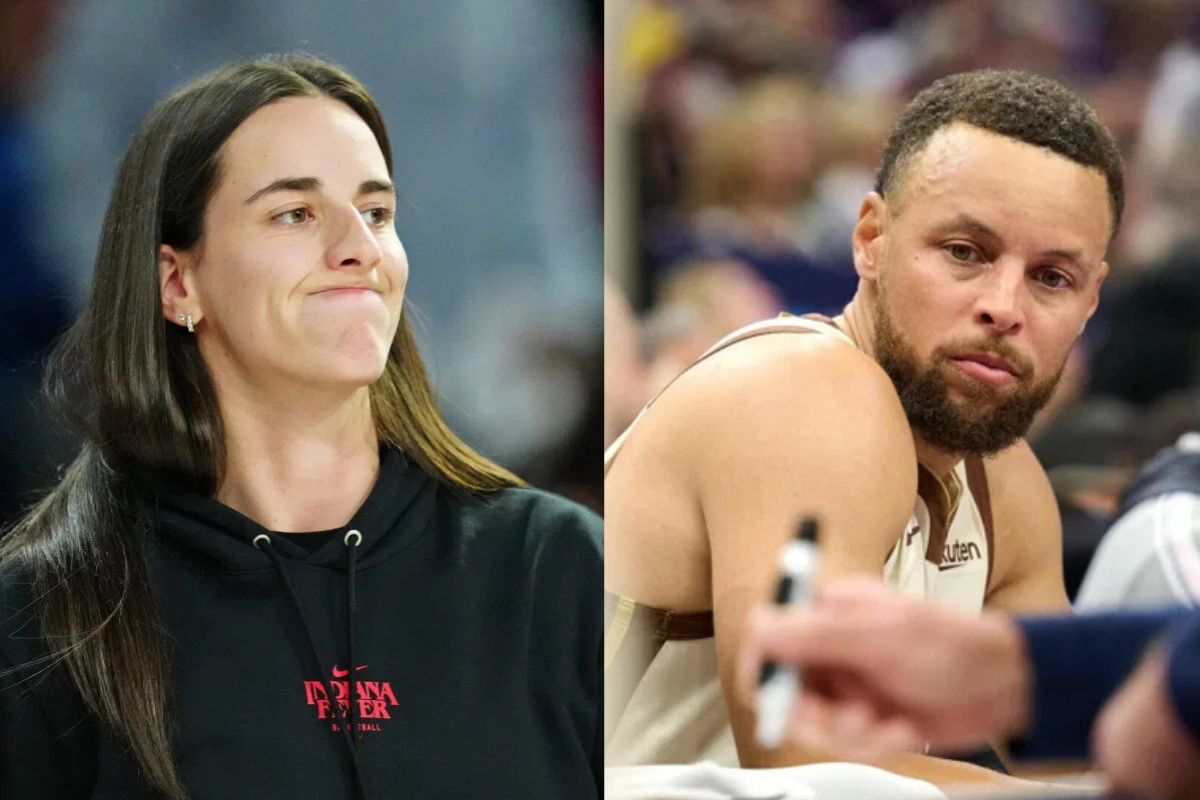
Ever since Caitlin Clark started dominating during her college days, her deep threes became one of the signature elements of her game. The logo shots, the quick pull-ups, and the fearless shooting confidence naturally made fans call her the Stephen Curry of the WNBA. But according to Clark, the modern obsession with shooting may also be hurting one important part of the game: the fundamentals, which are becoming a ‘lost art’ day by day.
Watch What’s Trending Now!
During a recent conversation with John Mallory, global co-head of Wealth Management, Clark opened up about the skills she still prioritizes in practice even after becoming one of the biggest stars in basketball.
“I think if you go and watch any professional basketball player workout, they always start with the fundamentals,” she explained. “Like, it’s form shooting. It’s the same thing I did when I first started playing basketball. You start with the simple things.”
However, Clark was quick to credit Curry rather than herself which she made pretty clear. She implied how the younger generation’s obsession with shooting is hurting the development of the basics.
“I think ball handling is a really lost art. I always tell kids, be able to dribble. Be able to pass. Everybody’s so worried about shooting threes. Which is probably, you know, Steph Curry’s fault. It’s not my fault. But everybody wants to be able to do that,” she added.
“But I think it’s all the little things that kind of get lost. And just doing the little things can get you a long way. Because it’s not something that people really want to spend time on anymore.”
The Steph Curry effect has already become a well-known conversation in basketball circles over the last decade. Trainers constantly warn young players against obsessing over difficult perimeter shots before mastering basic footwork, passing, and ball control. But ironically, much like Curry, Caitlin Clark has inspired an entire generation of young players to start launching deep threes long before they fully develop the rest of their game.
However, let’s take a look at how Curry changed the sport. Back during Curry’s first NBA season in 2009-10, teams averaged just over 18 three-point attempts per game. Today, most NBA teams heavily lean on a three-pointer so the attempts from beyond the arc have bumped up to 35 and 40 every night.
But what often gets overlooked is that players like Curry and Clark built their shooting ability on top of elite fundamentals first.
Despite all the viral highlights fans see online, elite players usually spend the beginning of workouts doing the simplest drills imaginable. One-handed form shooting near the rim, stationary ball-handling, footwork repetition, and short-range touch shots remain the foundation of almost every NBA and WNBA training session.
And honestly, that was probably the biggest point Clark was trying to make. The flashy part of basketball may grab attention now more than ever, but the players who actually survive at the highest level still rely on the fundamentals most young athletes are starting to ignore.
But that’s where the debate begins.
The Three-Point Era Still Has Basketball Divided
For years now, basketball legends and analysts have argued over one simple question: has the three-point revolution actually made the game better?
If you were to ask Charles Barkley, the answer would be a hard “No”. Just like Caitlin Clark, Barkley has repeatedly called out younger players for trying to copy elite shooters without first developing the rest of their game.
“Steph Curry and Klay Thompson ruined the NBA because everybody thinks they’re Steph and Klay,” Barkley said back in February. “Y’all are not them. Stop jacking up threes.”
But what’s even more interesting is that even Steve Kerr – the coach who helped build the Golden State dynasty around shooting – has admitted the analytics movement may have pushed things too far.
Kerr admitted that the modern game has almost erased the mid-range shot, turning it into what he called a “no man’s land.” He even joked that he would consider removing the three-point line entirely just to diversify the way basketball gets played again.
Yet at the same time, there are supporters of this revolution, too.
By forcing defenses to guard players far beyond the arc, modern spacing opened driving lanes and created opportunities for smaller, highly skilled guards to dominate the sport. Players like Stephen Curry, Caitlin Clark, and Sabrina Ionescu became proof that elite skill and shooting could overpower pure size and physicality.
So, considering the debate around this topic, Clark’s comments probably land somewhere right in the middle.
She is not criticizing shooting threes themselves. After all, her own shooting skills made her one of the greats. She is more focused on what young players skip while trying to reach those highlights too quickly. Because behind every three-pointer that makes the fans jump out of their seats, there are still years of basic ball-handling, passing drills, and repetitive fundamentals that made those shots possible in the first place.
But what are your thoughts? Let us know in the comments!