
The WNBA has hardly had a moment to catch its breath. Officiating controversies have kept the league in the headlines, but Sophie Cunningham’s July 21 ESPN interview opened an entirely different front. Her comments about protecting young girls from biological males competing in women’s sports ignited a national debate and, in the process, forced fresh questions about the WNBA’s own eligibility rules. And now, as the league continues to navigate the controversy, it is facing a new challenge from a source it likely never expected.
Watch What’s Trending Now!
That challenge comes from Project B, the new women’s basketball league set to launch next January. While the WNBA is still working through questions surrounding its own eligibility framework, Project B and founder Alana Beard have already made their position clear, choosing a path that could put the two leagues on opposite sides of one of women’s basketball’s most contentious debates.
Project B and Beard released a statement aligning the league with the latest guidelines from the Fédération Internationale de Basketball (FIBA) and the International Olympic Committee (IOC), effectively barring transgender athletes from competing in Project B. Beard also criticized the WNBA for failing to take a firm position on the highly polarizing issue, according to Front Office Sports reporter Colin Salao.
“Where’s the accountability, the integrity, the intentionality? All of it is needed right now, in what could become one of the most defining moments in the history of the sport.”
These statements from Project B come at a critical juncture for WNBA eligibility rules. The league has come under heavy fire after two former NBA players, Enes Kanter Freedom and Royce White, declared themselves eligible for the 2027 WNBA Draft. Identifying as women, they state that there is no specific clause in the current rules that bars them from doing the same.
The IOC’s new policy effectively banned transgender women from competing in female categories at the Olympics. The decision was explained in a March 2026 article published by the IOC.
“Eligibility for any female category event at the Olympic Games or any other IOC event, including individual and team sports, is now limited to biological females, determined on the basis of a one‑time SRY gene screening.”
Under those guidelines, players like Kanter and White would not meet the eligibility requirements for women’s competitions. In addition to this, FIBA also announced in April that it would replicate and abide by the IOC’s policy.
“Following the issuance of the IOC policy on the protection of the female category, the Central Board confirmed that FIBA will follow the IOC policy for Olympic Games and the Youth Olympic Games, awaiting further guidance from the IOC on the practical, legal, and operational aspects of implementation.”
The debate isn’t limited to basketball either. Much like FIBA, the WTA Tour is also moving toward genetic sex testing for players. As FOS reports, star Jessica Pegula revealed that the testing is expected to begin this week at the Cincinnati Open.
With the inaugural season of Project B set to tip off in January 2027, the six-team, five-on-five league is positioning itself around what Beard described as “creating joy and delivering the highest quality of basketball.” And by aligning its eligibility rules with the existing IOC and FIBA standards, Project B is positioning itself outside the media storm currently surrounding the WNBA.
Unlike the WNBA, the new league is built around an equity-based, player-first model supported by prominent executives and sports investors, including WNBA legends such as Cheryl Miller, Candace Parker, and Lauren Jackson.
And Project B isn’t short on WNBA talent either. Sophie Cunningham is already under contract, while Azzi Fudd, Nneka Ogwumike, and Jonquel Jones have also signed up for the league.
With 15 players already officially announced, the player pool is expected to grow significantly in the coming months, with more signings anticipated from basketball markets such as South Korea, Serbia, and Belgium. The league has yet to reveal the final size of its women’s division, although its original plans called for a 66-player league.
While Project B is completely distancing itself from the debate around transgender athletes, the WNBA and Commissioner Cathy Engelbert have a different way of dealing with the issue.
How Is the WNBA Tackling the Transgender Athletes Issue?
In the WNBA, unlike the other major leagues like the NFL, MLB, etc., the player eligibility rules are determined by collective negotiations between the league and the players. The latest collective bargaining agreement mentions that “only players who are women are eligible to play in the WNBA.”
However, there is no specific clause or rule that specifically addresses gender identity or sex assigned at birth. This ambiguity is the source of varied definitions and interpretations by all the stakeholders.
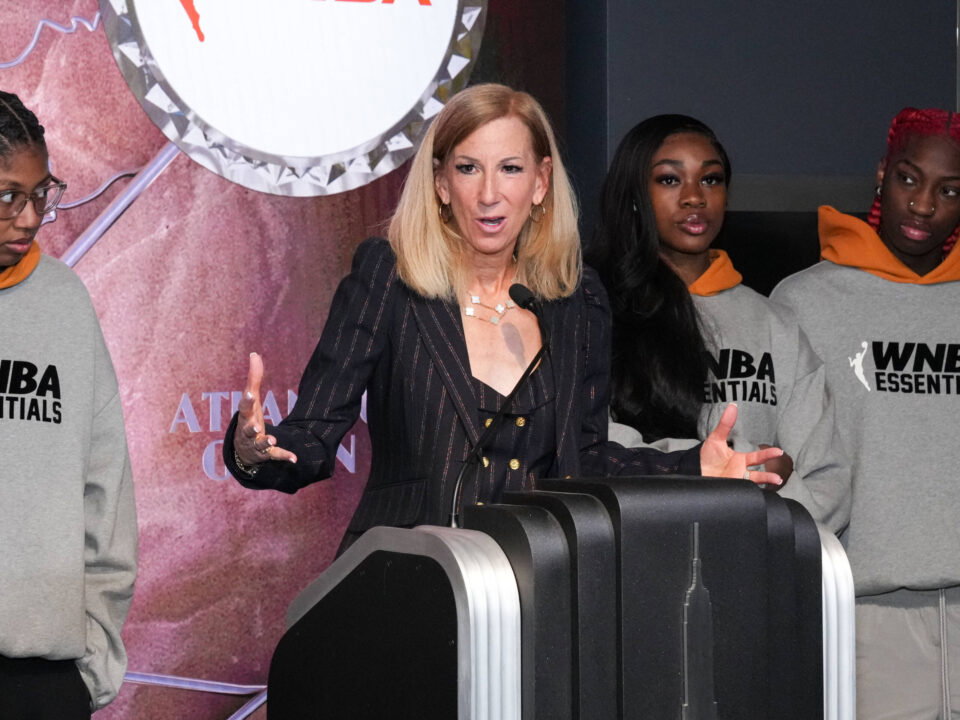
Imago
WNBA, Basketball Damen, USA Draftees Light The Empire State Building WNBA Commissioner Cathy Engelbert visits the Empire State Building in New York City, United States, on April 14, 2025. New York United States PUBLICATIONxNOTxINxFRA Copyright: xEditorialxWirex originalFilename:editorialwire-wnbadraf250414_npDk3.jpg
Earlier in the week, Commissioner Cathy Engelbert called for a discussion on this issue, according to a memo obtained by the Associated Press. Engelbert has indicated that the issue will be discussed by the GMs and presidents of all the teams. However, any change to the current policy framework can only come through agreement and negotiation between players and the league.
“We recognize that this is a complex and nuanced topic, and we will continue to have important conversations with all of you and the Players Association in the weeks and months ahead. We also plan to convene additional discussions and offer listening sessions for any team leaders who would like to participate. Your perspectives and feedback are invaluable, and I appreciate those who have already reached out to share their thoughts.”
The outcome of this discussion will determine the course of the issue in the years to come. With Project B, the IOC and FIBA explicitly stating that they will not entertain transgender athletes, the WNBA is still attempting to, through collective bargaining, figure out a solution that keeps their players happy.