
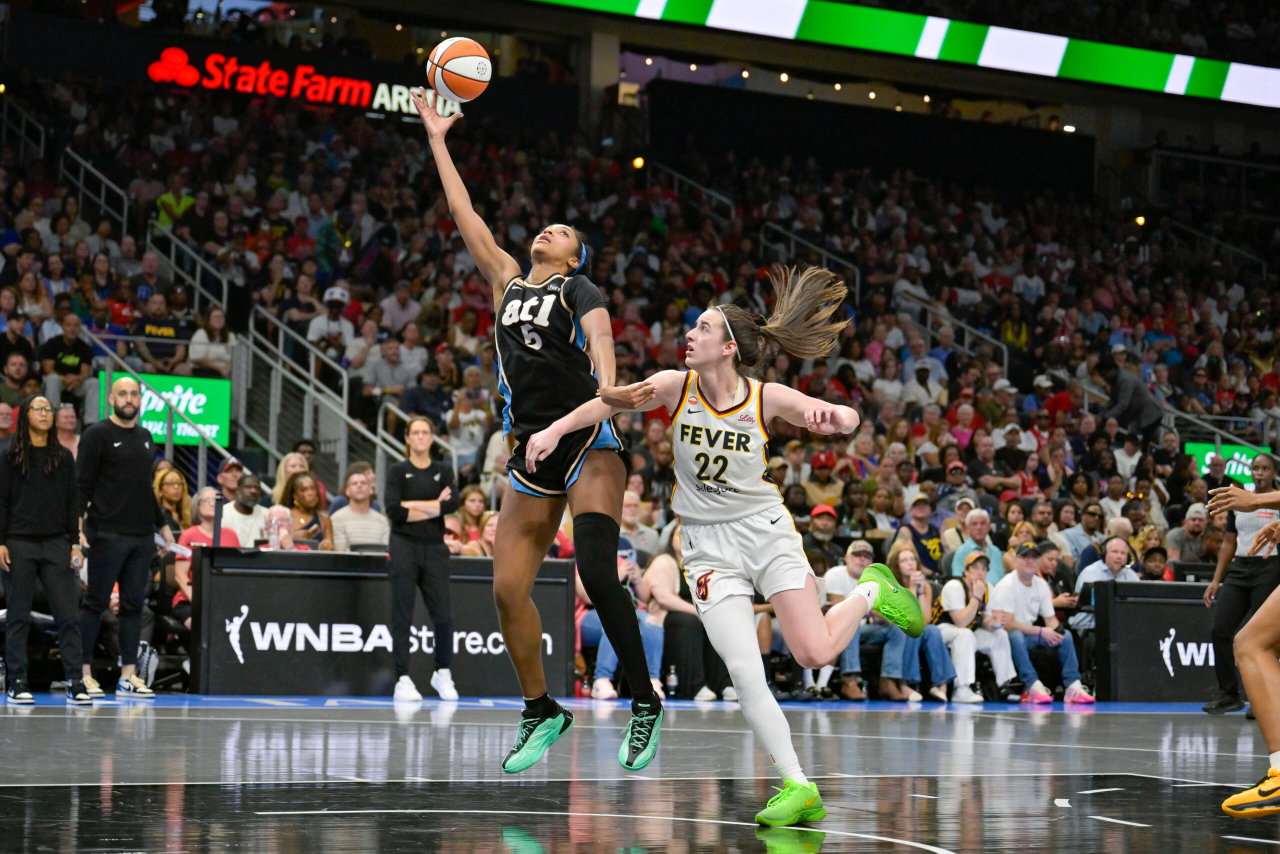
“It’s a balance,” WNBA Commissioner Cathy Engelbert said back in 2024, when Caitlin Clark and Angel Reese entered the league and helped usher in an unprecedented wave of attention around the WNBA. Their college rivalry followed them to the pros, with both quickly becoming major draws, but three years later, the question of who has truly driven that growth remains.
Watch What’s Trending Now!
While Reese’s name has stayed closely attached to Clark, author of ON HER GAME: Caitlin Clark and the Revolution in Women’s Sports, Christine Brennan believes the 2026 playoffs have offered another clear indication of which star continues to move the needle most.
“No matter how critical I’ve been of Cathy Engelbert’s repeated & erroneous attempts to favorably compare Angel Reese to Caitlin Clark’s drawing power, this is a surprise: Curtains up because only 9,745 came to NY-ATL playoff. But two Clark regular-season games? 17,044 both times,” Brennan wrote on X.
Brennan was specifically pointing to the stark difference between the attendance for Game 1 of the WNBA semifinals between the New York Liberty and Atlanta Dream and two Indiana Fever regular-season games against the Dream.
On Sunday, just 9,745 fans attended State Farm Arena to watch Angel Reese take on Breanna Stewart & Co. in their Game 1 of a five-match semifinals series, which is well below the arena’s more than 17,000-seat capacity. Curtains were reportedly used to cover sections of empty seats.
However, the Fever filled the same arena with 17,044 fans for both of their regular-season meetings with Atlanta – on June 20 and August 16. And for Brennan, the contrast offers another reason to question attempts to put Reese’s drawing power on the same level as Caitlin Clark’s.
There is no doubt that Angel Reese is one of the biggest players in the WNBA right now, with a massive fan base that wants to see her play. But the question is: does her following really match the level of Caitlin Clark’s? The 2026 regular season may have already provided an answer.
As per Across the Timeline, the WNBA recorded a 20.5% increase in attendance from the 2025 season, with 3.79 million fans coming to witness the WNBA across its 330 games. Reese’s arrival in Atlanta played a major role in the Dream’s attendance surge, with the team averaging nearly 7,000 fans per game compared to 4,480 last season, according to Front Office Sports.
The demand was strong enough that the Dream had to move six of their games from the Gateway Center, which holds roughly 4,000 fans, to the much larger State Farm Arena. Yet even that jump in attendance does not quite compare to the level Clark and the Fever reached throughout the season.
Clark and the Fever continued to be the league’s biggest draw on the road, averaging 15,116 fans in opposing arenas. That gap is hard to ignore, particularly when Brennan’s criticism centers on whether Reese’s drawing power can truly be compared to Clark’s.
But for all the attention Clark and the Fever generated throughout the regular season, that popularity did not help them go any further in the playoffs. Indiana’s postseason ended in the first round after the Fever dropped their best-of-three series against the Las Vegas Aces, losing 2-1. This was the second season in a row when the Aces have ended the Fever’s playoff hopes early.
Atlanta, meanwhile, has continued to add to the story. The Dream swept the Washington Mystics in the first round to book their place in the semifinals, and then opened their best-of-five series against the New York Liberty with an impressive 92-82 victory on Sunday. In that statement win, Reese dropped 17 points and seven rebounds to go with her four steals, as Atlanta immediately put the Liberty on the back foot in Game 1.
So while the numbers may suggest a clear difference in drawing power between Caitlin Clark and Angel Reese, attendance alone cannot determine how far a player or team will go once the postseason begins. Clark may have remained the league’s biggest regular-season attraction, but Reese has helped turn Atlanta into a team capable of making noise when the stakes are highest.