
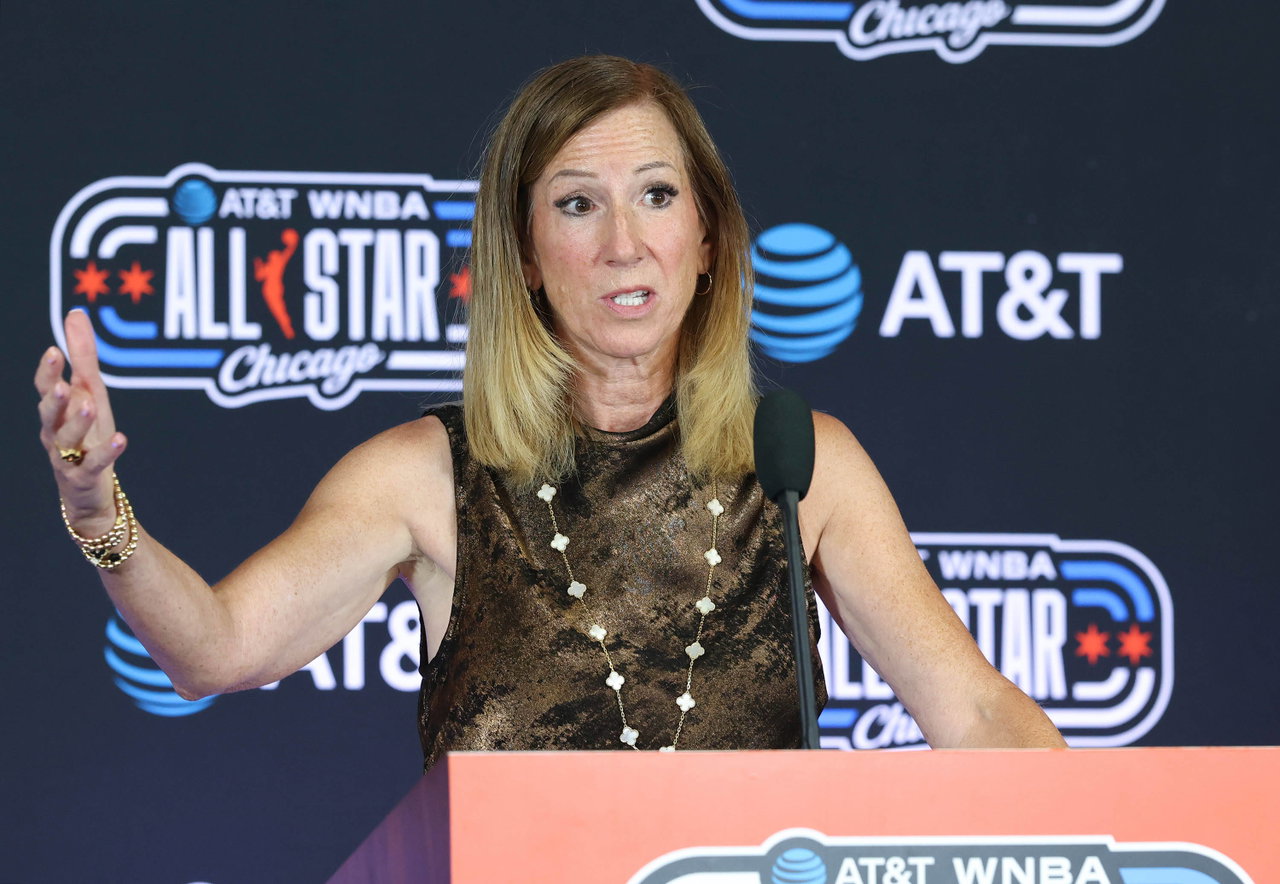
Cathy Engelbert’s tenure as WNBA commissioner has seen its fair share of ups and downs throughout the last seven years. While Engelbert has been lauded for her decisions like the league’s expansion and two CBAs, The Athletic’s Annie Costabile believes this one decision made by Engelbert back in 2022 could have been avoided, that being Engelbert’s decision to raise $75 million in capital by selling a 16% equity stake in the league.
Watch What’s Trending Now!
“In the moment, that ($75 million capital raise) was looked at as this transformational stabilising decision. Transformational is the word that gets used for everything.” Costabile said in the latest episode of the No Offseason podcast.
“But when we look back at that, there are serious questions about why there wasn’t a future thought of the impact of these players coming in, Caitlin Clark, Angel Reese, Paige Bueckers, and the impact they were going to have. And now you’ve given up 16% of the league for 75 million, and diluted the ownership structure even more.”
Fresh off the pandemic season and its effects, it was clear that the WNBA needed money. In February 2022, Cathy Engelbert made up her mind to lead the largest-ever investment round in women’s sports, as the $75 million fund was earmarked for “brand elevation, marketing, and the globalization of the WNBA,” among many infrastructure improvements.
Following the influx of capital, the WNBA’s new valuation came out close to $475 million, according to Front Office Sports. 30 NBA owners had control of 50% of the league before Engelbert’s decision, while WNBA owners had control of the rest. After the commissioner’s decision, however, the WNBA owners’ percentage dropped from 50% to 42%.
Costabile raises this as an issue because the WNBA does not even own half of its own league now. She hinted that Cathy Engelbert’s decision may harm the league in the long run, as the people with the most influence aren’t necessarily the people most invested in the WNBA itself. This aligns with what Stanford economics professor Roger G. Noll told FOS.
“The NBA has always viewed the WNBA as a sideline. They’ve never thought of it as a standalone line of business that they’re trying to maximize the value of. It was a way to use the arenas in the summer when they’re not being used. That’s always been the conceptualization.”
“The question is, now that it’s clear everybody that is sentient knows women’s basketball has arrived, is it possible for the WNBA to continue to exist in that environment? Or will someone take it away from them?”
And almost four years after Engelbert’s $75 million deal was finalized, the WNBA was exploring buying back the 16% equity stake it sold back in January, multiple sources with direct knowledge of the league’s business told Front Office Sports. However, the WNBA declined to put out any comments.
A lot has changed after Cathy Engelbert rolled the dice on selling a 16% equity stake in the league four years ago. The average WNBA franchise is valued at $427 million, with the Golden State Valkyries becoming the first to reach the ten-figure mark. The Connecticut Sun was the latest franchise to be sold, acquired by Houston Rockets owner Tilman Fertitta for $300 million.
Apart from this decision, Engelbert has been under constant scrutiny this year, mainly due to her communication style. The league’s biggest stakeholders have expressed reservations about her interpersonal dynamics, with players strongly reinforcing those opinions. Most famously, Minnesota Lynx star Napheesa Collier said the WNBA had the “worst leadership” last year when negotiations for the new CBA stalled.
On paper, Cathy Engelbert is the most successful commissioner in WNBA history. But opinions around her say otherwise, and the $75 million decision, which now makes the league’s decisions influenced by stakeholders, could create a complicated scenario for the next person taking up the mantle of commissioner.