
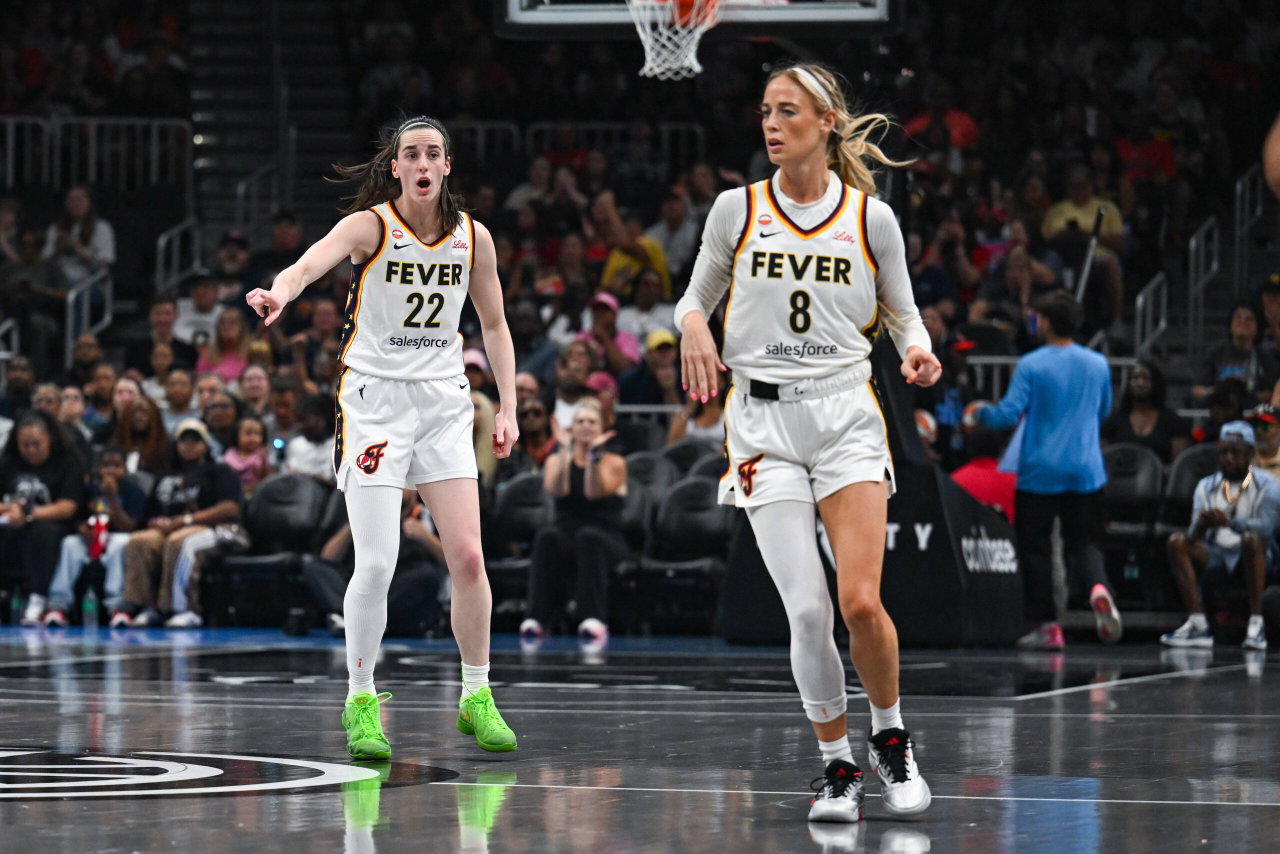
The growing popularity of the WNBA has brought more attention to its players, but the reasons behind that visibility have continued to spark debate. While some voices around the league argue that the biggest stars benefit from their appearance as much as their performance, others argue that claims like this overlook personality, ability, and a variety of other factors that help players build their profiles.
Watch What’s Trending Now!
Former WNBA star Angel McCoughtry recently made the former argument during an appearance on the Get TO the Point podcast to single out the Indiana Fever’s Caitlin Clark and Sophie Cunningham, something that analyst Robing Lundberg harshly disagreed with.
“What point are you making? Again, it’s just shade after shade after shade, day after day after day, when it comes to the WNBA media and the attention that’s come with Caitlin Clark,” Lundberg said on his YouTube channel.
It all started when McCoughtry brought up an incident when she had a conversation with a few Fever fans, all of whom loved Clark but had no idea who Kelsey Mitchell was. McCoughtry thought it was surprising given that, in her opinion, Mitchell was “the best player on the team.”
“Kelsey Mitchell is so much more well-known now than she was before,” Lundberg fired back. “Anyone saying otherwise is out of their minds. If you would go and ask people if they knew who Kelsey Mitchell was before she played with Caitlin Clark, a lot fewer of them are going to know.”
He questioned the implication behind McCoughtry’s example, asking if she was suggesting that Clark was attractive while Mitchell was not. For Lundberg, her comparison did little to establish a connection between appearance and popularity.
McCoughtry had also turned to Cunningham as another example of how attractiveness could influence a WNBA player’s commercial appeal. She pointed to the Fever’s Cunningham, highlighting that despite her average of just 7.9 points per game, she landed a shoe deal with Adidas, suggesting that other players who perform better usually receive such opportunities. Lundberg didn’t fully agree.
“Does people finding Sophie Cunningham attractive, boost her popularity? Sure,” he conceded.
“With Sophie, it’s beyond just that. she came to the defense of Caitlin Clark. She did the finger-pointing meme. People like her attitude, what she represents, the fact that she shoots from the hip, all those things, right?… It’s not as if Kelsey Mitchell don’t have the Puma deal. It’s not as if other players don’t have shoe deals.”
Cunningham partnered with Adidas in July 2026 to drop her first Player Exclusive colorway, the “Unicorn” adidas Crazy Energy PE. The pink and white shoe, which was priced at $120, sold out within hours on both Adidas’ website and Dick’s Sporting Goods, which Cunningham posted about on her social media accounts.
“you guys really showed up! nothing but genuine love for yall💕,” she wrote back then.
This makes sense, given just how much her profile grew in 2026. According to a report from Covers, which tracked 17 WNBA players’ social media growth, Cunningham was the biggest grower in that group. They found that she had gained approximately 5.8 million followers across Instagram and TikTok, going from 3.1 million to 8.9 million. She Cunningham online growth has been so unprecedented that she has crossed NBA stars in followers on Instagram.
A lot of that attention was also from the finger-pointing incident Lundberg mentioned. As many fans might remember, Cunningham went viral early in the 2026 WNBA season for continuously pointing at DeWanna Bonner after the then-Phoenix Mercury forward was fouled by Caitlin Clark. The incident went viral on social media, even earning an acknowledgment from the White House’s X account.
Ultimately, the repeated focus on appearance-based explanations overlooks the many reasons players like Cunningham and Clark have become prominent figures. While McCoughtry’s argument can lead to a broader discussion on marketability, Lundberg believes reducing their popularity to pretty privilege does them and their games a disservice.