
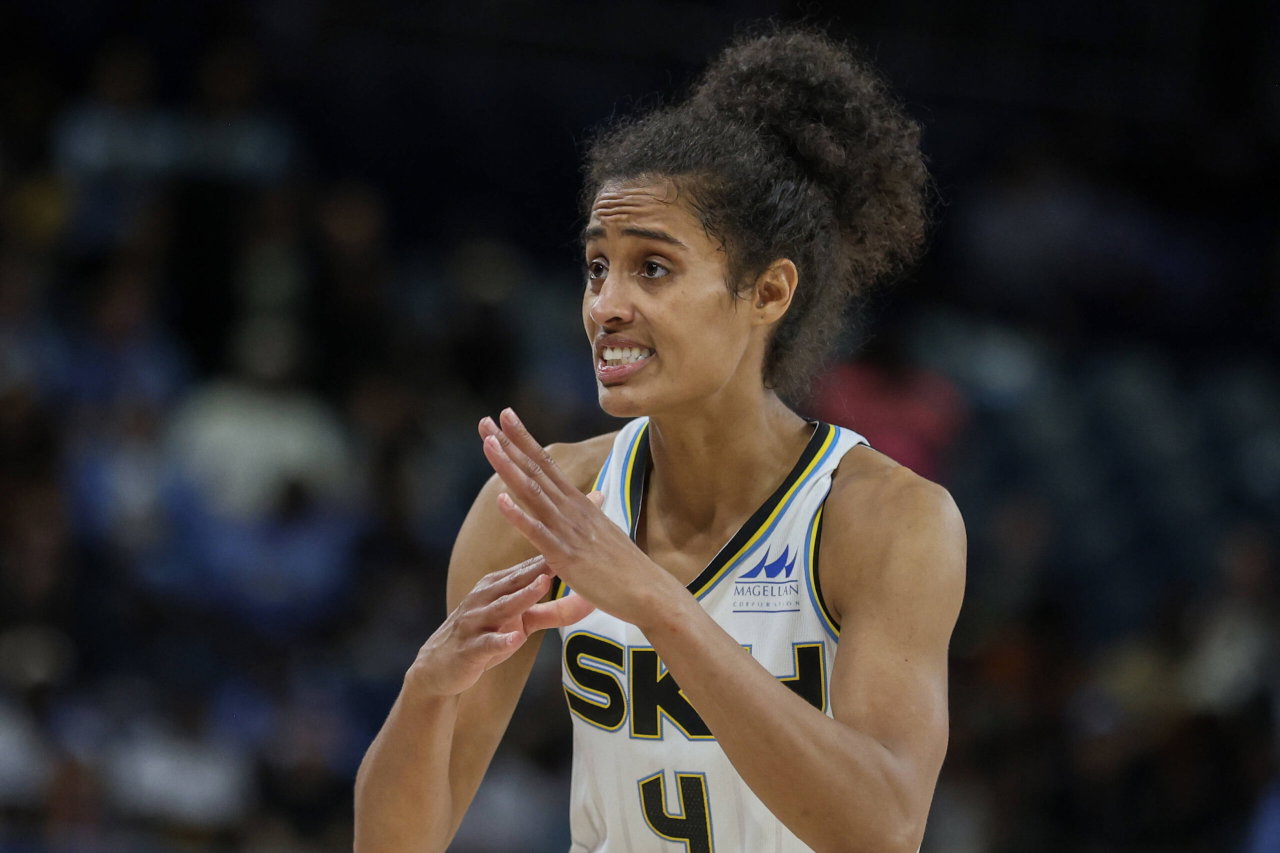
Chicago was supposed to be a fresh start. At 35, Skylar Diggins wasn’t arriving there as part of some experiment with her career. The seven-time All-Star had already spent more than a decade in the WNBA and knew exactly what she could bring to a new team. And well, she had 19 starts and then… nothing.
Watch What’s Trending Now!
Her first season with the Sky quickly became one spent fighting to stay on the floor. A knee issue kept Diggins out from July 3 onward, and with Chicago’s playoff hopes gone, there was little reason to rush her back. As the Sky announced she would miss the rest of the season, she addressed the situation at a press conference, too. But as Diggins looked back on a season that had clearly not unfolded the way she imagined, her biggest frustration came from somewhere else entirely.
“Diggins said that she shared with the team that her “biggest frustration” was the team not moving to their practice facility this year,” Front Office Sports’ Colin Salao shared on X. Diggins reportedly said, “I think a lot of us were promised that. We thought that was going to be the case.”
For Diggins, though, the problem went beyond the building itself. What she said she missed most was having a “home base.” The Sky spent the season moving among different locations, and that came with limits on how long players could stay, a detail that mattered when she was trying to manage a surgically repaired knee.
“Sometimes, we have limits or restrictions on how many hours we could be there,” Diggins said. “And that affects everything when you’re trying to be a pro and get in what you need.”
That frustration had actually been building for months.
In July, when she was dealing with pain related to the meniscus surgery she underwent the previous October, Diggins said she had been “sacrificing” her body for Chicago and questioned whether she should continue doing so without the resources needed to play at an elite level. So Tuesday’s comments weren’t simply about a delayed construction project.
The Sky’s new $60 million practice facility was supposed to be ready before the season, but the timeline was pushed back multiple times due to weather and project expansions. The project had originally been expected to open by the end of 2025, before the timeline shifted again to the start of the 2026 season and later to “late spring.”
The facility’s cost has grown from an original estimate of about $38 million to more than $60 million as its footprint expanded and construction was delayed. The delays mattered even more because free agents had been told the facility would be ready for the season. That facility was one of the reasons Diggins signed a $1.86 million deal with the team.
In July, according to a report from the Chicago Sun-Times, team CEO Adam Fox had previously projected that the facility would be operational by “late spring,” a timeline he later described as “aspirational.” However, with construction still ongoing, the Sky moved the target opening to November and decided not to move in during the 2026 season. Until then, the Sky are expected to practice primarily at Wintrust Arena, where the team plays its home games.
According to Fox, the team would be “ahead of many, many teams in this league that don’t have” an updated training facility, but unlike those teams, the Sky have spent the season rotating among temporary practice sites. That distinction is at the heart of Diggins’ complaint. Chicago hasn’t been without a gym; it has lacked one permanent, team-controlled base where basketball, treatment and recovery could happen under the same roof.
According to a report from FOS, the team even paid $160,000 to the University of Illinois in Chicago to use their facilities between April and May this year. The Sky also rotated through other sites, including Loyola and Wintrust Arena, before settling primarily at their home arena for the remainder of the season.
“When I went to Seattle, we were in the process of building a practice facility. Same with Phoenix,” Diggins added.
“I understand how those things go as far as delays or whatever the case may be… So it’s hard to say what I would have done if I knew, and to speculate, I’m sure we could sit here and play hypotheticals. But I’ll be looking forward to it next year. It is something that we need… No shade, but you know we need resources. Leading the league in injuries, I think it’s not coincidental.” That was a notable distinction, too.
Diggins didn’t claim that the facility delay had caused her knee injury. She entered the season already dealing with the effects of her October meniscus surgery and later reaggravated the knee. Her argument was about the environment around recovery, and whether constantly changing practice locations and limited access to resources made it harder for players to get what they needed.
Diggins was pointing to a real team-wide problem when she mentioned injuries. According to The IX Basketball’s injury tracker, the Sky had led the league in games missed because of injury at that point in the season. But that number alone does not establish that the facility situation caused those injuries.
The Sky’s injury list also went well beyond Diggins. Courtney Vandersloot returned from an ACL injury, while Rickea Jackson’s season was derailed by an ACL tear just four games in. DiJonai Carrington also dealt with an injury, and the Chicago Tribune reported that her recovery process had been complicated by the lack of a singular training site. That doesn’t prove the facility was responsible for Chicago’s injury problems, but it does explain why Diggins’ comments about a “home base” landed differently after a season in which so many players had spent time trying to get healthy.
Diggins and the team are expected to tour the Bedford Park facility next week to see how much progress has been made.
“I expect that next year, we won’t lead the league in games missed to injuries,” Diggins said. “And we’ll be able to put together the full vision of what we wanted it to look like with all those resources.”
For Diggins, 2027 is still very much part of the conversation. She is under contract through next season and said she has not expressed any desire to leave or asked for a trade.
“I haven’t expressed any desire to not talk about me in a Chicago Sky jersey next year,” she said. But that is not quite the same as declaring the situation settled. Her season included a surprise move out of the starting lineup, questions about communication and repeated concerns about resources, leaving both Diggins and the Sky with an offseason to figure out whether the version of the partnership they imagined in April still looks the same now.
The Bedford Park facility could finally give Chicago the home base Diggins thought she was signing up for. Whether that alone is enough to turn around a first season that ended with her on the sidelines, and so many frustrations still hanging over the organization, is the bigger question heading into 2027.