
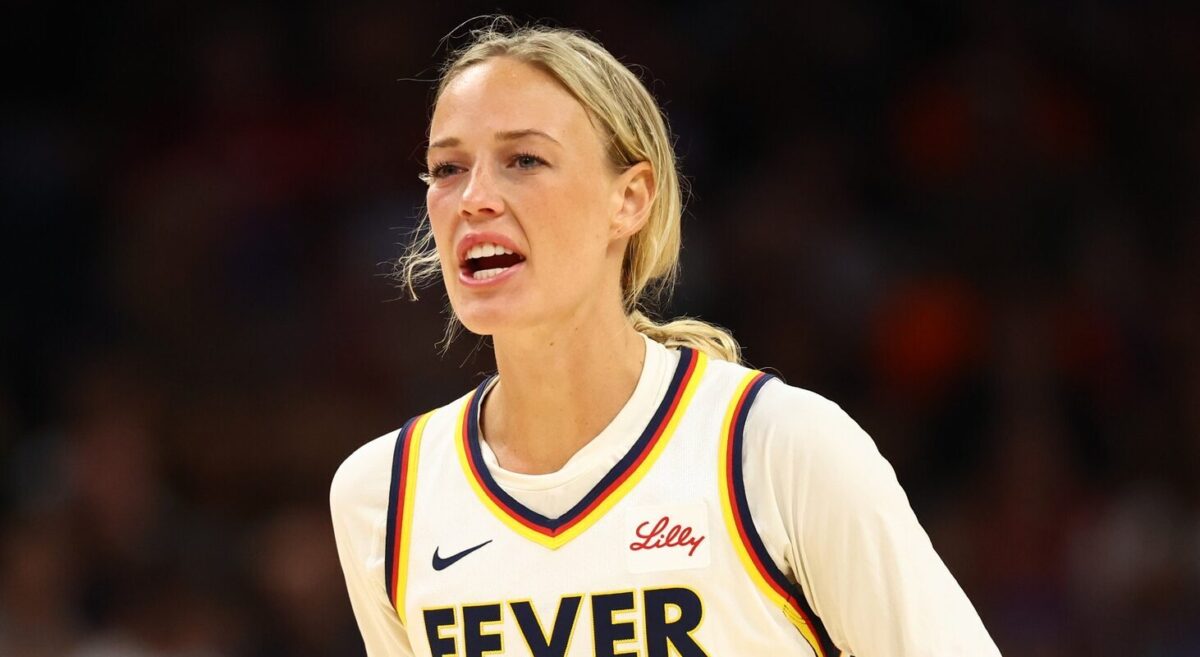
It’s safe to say Alex Sarama outcoached Stephanie White. You see, the Indiana Fever is overflowing with talents like Caitlin Clark, Aliyah Boston, and Kelsey Mitchell, along with Lexie Hull and Sophie Cunningham. The expansion team, Portland Fire, on the other hand, has players who largely rode the bench last year. On paper, the Fever should’ve beaten the Fire. Unfortunately for them, they couldn’t bring the theory to life.
Watch What’s Trending Now!
The Fever failed to find its footing from the first quarter itself and was dominated on both sides of the ball. The Fire even limited Caitlin Clark to just 6 points and got her into foul and turnover trouble in the 16-point defeat. And after two consecutive losses that should’ve been wins, Sophie Cunningham is revealing what’s really stopping the team.
“Something that’s hurting us right now is we’re only playing one defensive scheme,” Cunningham told the media. In this league, teams are too good. You can’t do that because people are going to pick us apart.
We have to dial in. We have to focus. Your IQ has to be on point. You have to know what schemes we’re running, and if you can’t do that, then you can’t play. That’s the point we’re at right now.”
With defensive talents like Aliyah Boston and Lexie Hull, and high basketball IQ players like Clark and Kelsey Mitchell, the Fever proved in the last couple of years that they are contenders in the WNBA. But the league is growing, and Indiana seems to be stuck in the same neutral mode.
In fact, they are dangerously close to falling into a four-game skid. They face Atlanta next, who are 5-2, after which they travel to New York, who are on a two-game winning streak. Cunningham and Co. need to turn this around. And the team already knows it.
“We had a long meeting yesterday,” Cunningham added. “It was a really good meeting. Hopefully, we’ve turned the page, and everyone is on the same page now. Hopefully, on Thursday, you guys will notice that.
That team meeting was especially needed after the Clark-White fiasco on social media. But on the court, one thing stood out for Cunningham that they are aiming to correct.
The scheme she is talking about is their constant switching. The Fever team switches one through five, which the Fire used to go after Caitlin Clark in isolation. Alex Sarama himself said they focused and improved on their spacing, so Clark did not have much help on defense. And it was not only her.
The entire team struggled defensively as the Fire played off a pick-and-roll with quick passes to create advantages. Raven Johnson, who never struggled with fouls in college, fouled out by the end of the game. Megan Gustafson never let Aliyah Boston get comfortable.
Sarama cracked the code, and Stephanie White had no answer. However, Cunningham did not blame White; she admitted they had ten schemes last year but pointed to their execution as the issue.
“This team really does have to focus. We have a lot of young guns. We have a lot of people that are very talented. But at the same time you have to dial in and know what we’re doing, otherwise it just won’t work,” she added.
The team is still figuring out its chemistry with multiple new players like Johnson and Monique Billings. They are even changing Clark’s role to more of an off-ball secondary ball handler, which has an adjustment period as well.
But everything is not about the tactical change. According to Stephanie White, the Fire game was an aberration that they need to forget and move on from.
Stephanie White, Sophie Cunningham Call for Reset After Tough Portland Fire Loss
The Indiana Fever had a dismal day against the Fire. Even with the counter tactics from the Fire, the Fever got plenty of open looks early. They had an 8-2 lead when Clark, Hull, and Aliyah Boston were substituted. Since then, nothing worked. The shots were not falling, and the Fire ran away with their momentum. As Sophie Cunningham said, they are working on improving their defensive execution. But beyond the X’s and O’s, Cunningham had a simple call-out to her teammates.
“That was just not it. We can’t be playing like that. We’re too good,” she said. “We needed that meeting, and like I said, I think everyone is refreshed and ready to get going.”
Cunningham isn’t wrong. The Fever led the league in points per game with 92.8 at one point this season. Despite an offensive slump, they are still among the top names. And if you look at the three losses, barring the Fire defeat, they were all one-possession misses.
In an alternate world, if the Fever had capitalized on the late-game scenarios, they would have had just one loss. The Fire game was an aberration where almost everybody had a bad day, and White wants to forget it as soon as possible.
“Sometimes there are games where you just need to flush it. I think you see that in every pro sports league — there are a handful of games every year where it’s like, ‘Okay, we just need to flush that one and move on.’ Sometimes you have those days,” White said. “After this trip, and particularly after that game, I felt like the details of the X’s and O’s weren’t going to help us move forward in the way we needed to.”
They had a four-day period between games, which has allowed them to recover and reset. The Fever have expectations on them, unlike last year, and unless they improve, the Fever will remain a mediocre team with enough potential, yet not realizing it.