
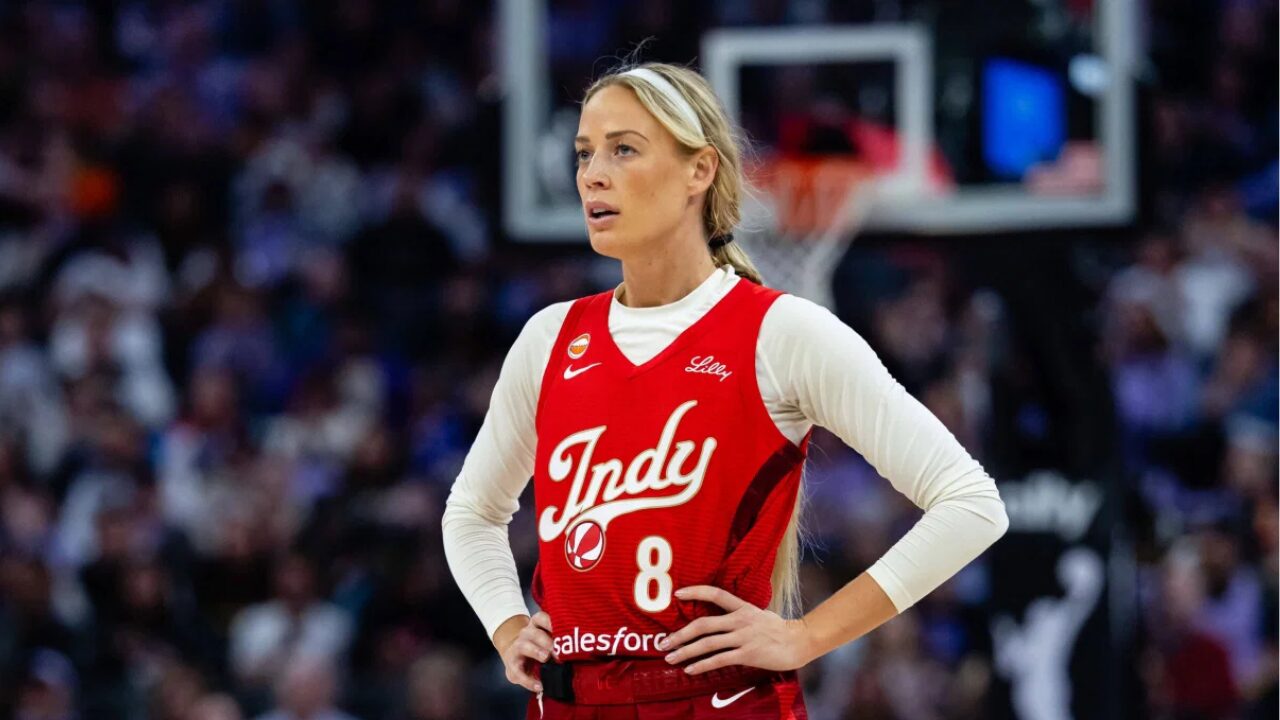
Sophie Cunningham, who is now also known as ‘MAGA Barbie’, is only one episode into her new podcast, but she already has a job in mind if the WNBA ever comes calling. After jokingly putting herself forward as the league’s next commissioner, the Indiana Fever guard wasted no time identifying the first change she would make.
Watch What’s Trending Now!
Here’s the thing: Cunningham has officially parted ways with her high school ride-or-die friend and former co-host West Wilson, with Show Me Something now rebranded as the No Hesitation Show. Alongside basketball trainer and Pure Sweat Basketball CEO Drew Hanlen, Cunningham launched the first episode of the new show after the podcast had been quiet for nearly two months.
The debut episode covered plenty of ground, but the conversation around the WNBA’s next commissioner quickly stood out. With Cathy Engelbert set to step down from her role at the end of 2026, the question of who could take over has naturally become a topic of discussion.
“I think I should be the commissioner. I think I could. I could get this s— on the right track,” Cunningham said on the podcast before revealing her hypothetical agenda. “Honestly, the first thing I would do is make sure that every team legit has a functional practice facility. We are the best league in the entire world, but there are people practicing at, like, YMCAs.”
“They’re sharing a court by a curtain when there’s like, YMCA youth camps going on one side and a team practicing on the other. Like, is that not insane? A couple of teams don’t even have a weight room. Is that weird?”
Her comments highlight a reality that has continued to exist alongside the WNBA’s unprecedented growth. The league has enjoyed record-breaking viewership, new franchises and major corporate partnerships, while its players have also seen their earning potential rise significantly. Yet the infrastructure surrounding some teams has not matched that progress.
The issue is not entirely new. While some teams have announced plans to build dedicated practice facilities, several projects have faced delays, while others are still not fully operational.
New York Liberty is one of the best examples. In 2025, they announced plans to build an $80 million practice facility in Greenpoint, Brooklyn, with 2027 set as the target to complete the project. But the lack of progress has raised questions about whether the facility will be ready in time.
The Liberty currently practice at a small court located just off the main entrance inside Barclays Center in Brooklyn, while their planned facility remains under development.
The Los Angeles Sparks have also undertaken a project to build a 64,000-square-foot performance center for the team in El Segundo, California, which is supposed to open in 2027.
The project is a $150 million undertaking and has promised to include facilities such as two regulation courts, hydrotherapy, locker rooms, and much more, per an official release by the Sparks.
Soon-to-retire Sparks legend and WNBPA President, Nneka Ogwumike, was present at a ceremony to celebrate the facility and elaborated on the importance of such training centers. Sophie Cunningham believes these facilities are essential.
“The tides are turning. But I will say there are a lot of owners who are still being very cheap and not giving us professional athletes what we need,” Sophie Cunningham further added.
For the Fever guard, becoming commissioner may have been a tongue-in-cheek suggestion. Her first priority, however, is anything but a joke. As the WNBA continues to grow, she believes the league’s infrastructure needs to grow with it.
It will lead to more financial opportunities
Sports Business Journal reported in July that the lease agreements WNBA teams sign with arenas and stadiums for practice facilities can significantly restrict their access to sponsorship categories and premium revenue.
If women’s teams continue operating as tenants, securing more favorable carve-outs in both areas will be crucial to achieving long-term financial stability.
“Do you have a [building] GM that wants to work with you and be helpful to you, or not? And some of that’s terms,” Sparks President Stacy Johns said. “I think it’s going to take a lot of time and there is not a magic bullet to this.”
That helps explain why so many women’s professional teams, not just in the WNBA, are looking to lock in long-term leases for their arenas and stadiums. Beyond securing a home, those agreements can provide a sense of stability for the organizations, their fans, and most importantly, their sponsors.