
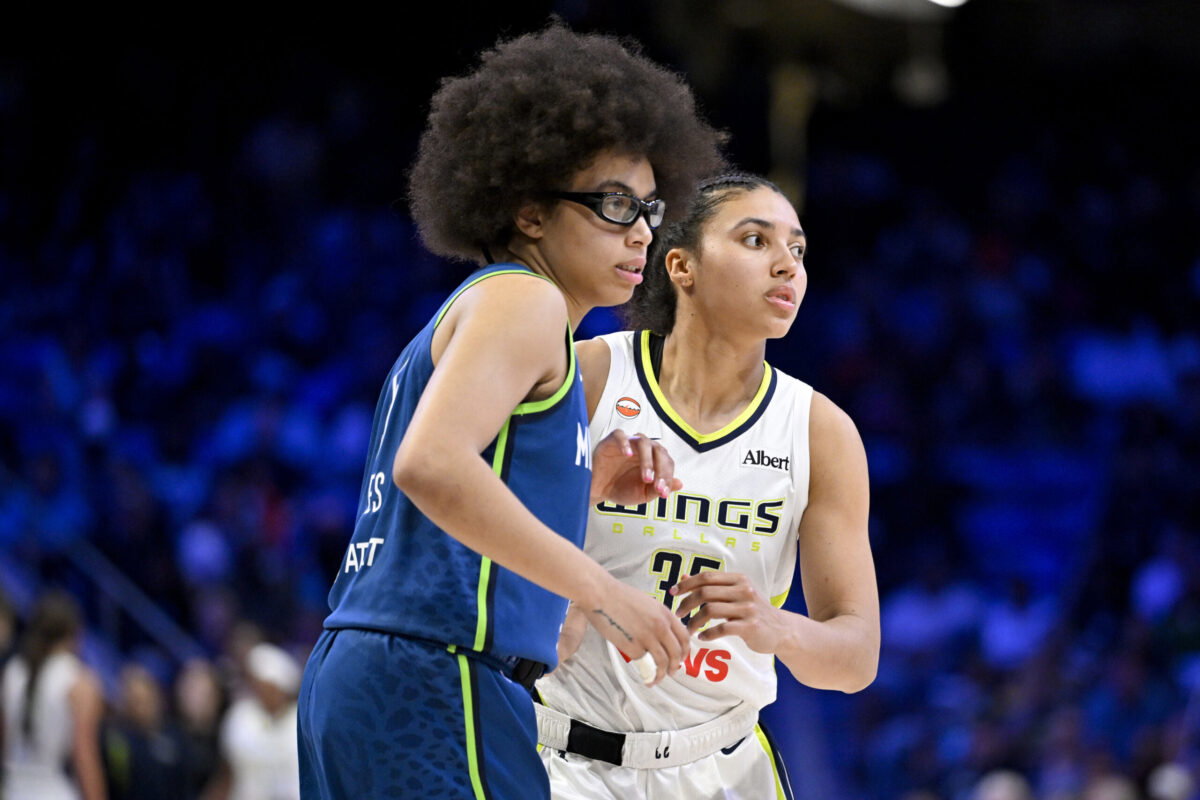
Tuesday night’s Lynx-Wings game featured one of the most intriguing storylines of the WNBA season so far: No. 1 overall pick Azzi Fudd facing No. 2 pick Olivia Miles. But it wasn’t the matchup itself that sparked debate. Instead, it was a routine in-arena graphic comparing the two rookies’ statistics that drew criticism from some fans, with many questioning why the comparison was necessary in the first place.
Watch What’s Trending Now!
That kind of fan behavior prompted analysts Jemele Hill and Cari Champion to weigh in on what they see as a growing sensitivity around player comparisons in women’s basketball.
“The level of fragility surrounding some of these players doesn’t make sense. At the end of the game, the Lynx put up the stats, and it was Olivia versus Azzi, and there was all this uproar about how classless it was. People were legitimately upset by the comparisons. Is this not sport?” Cari Champion questioned on the latest episode of the podcast Flagrant and Funny.
“(The comparison) is a part of the normal environment of sports when they react so sensitively, they don’t understand how much they’re sucking the life out of their own sport,” Hill replied to that.
The stats, for what it’s worth, tell a clear story right now. Olivia Miles has been exceptional all season. She’s averaging 17.8 points, 6.3 assists, and 5.2 rebounds per game, being among the most impactful rookies the league has seen in years. Azzi Fudd, by comparison, is averaging 11.9 points, 1.4 rebounds, and 1.4 assists.
Tuesday’s head-to-head meeting only intensified those discussions. Minnesota rolled to a 100-76 victory over Dallas, with Miles turning in one of her strongest performances of the season. The Lynx rookie finished with 24 points, seven rebounds and six assists, while Fudd was held to six points on 2-of-12 shooting. Given the draft history between the two players, comparisons were inevitable.
There is a meaningful gap between them at this stage of the season. And as Champion pointed out, a storyline built around the No. 1 pick versus the No. 2 pick was always going to attract narrative and comparison. That is simply what sports do. The fact that fans were offended by a basic stats graphic left her genuinely bewildered. “Is this not sports?” she said.
Their concern is that when ordinary basketball discussions are interpreted as personal attacks, analysis becomes less honest. Questions such as who is playing better, who deserves awards, or which rookie has had the stronger season are fundamental parts of sports coverage. If those conversations become off-limits, coverage risks becoming less substantive and less credible.
“We’re going to have to remove the fragility if we want this sport to grow,” Champion answered.
Of course, fans being protective of their favorite players is nothing new in sports. But as Hill and Champion made abundantly clear, competitive sports thrive on comparison, rivalry, and honest narrative. A fanbase that reacts to a stats board as though it were an act of aggression is one that, whether it realizes it or not, is working against the very sport it claims to love.
Still speaking on Flagrant and Funny, Jemele Hill offered a thoughtful explanation for why some WNBA fans can be intensely protective of the league and its players.
Jamelle Hill Explains Why Some WNBA Fans Can Be Extremely Protective Of Players
For Hill, it traces back to the years when the WNBA received little mainstream attention. “The fans who were there, the day ones, were truly invested,” she said. With limited media coverage, those early supporters became the league’s own advocates — fighting for respect when nobody else would. And as Hill pointed out, that battle leaves a mark. “When you spend a whole lot of time fighting for respect, you stay in that mode.”
Now, as the league explodes in popularity and newer fans and media figures flood in, some longtime supporters have grown naturally skeptical of the newcomers. “They like, ‘Oh, you ain’t been here that long. What are your credentials? Who you know? Why you here?'” Hill said.
For Hill, this history helps explain why discussions around women’s basketball can sometimes carry “some combativeness” and “some tension.” It doesn’t excuse the fragility she and Champion called out. But it does provide honest context for where it comes from.