
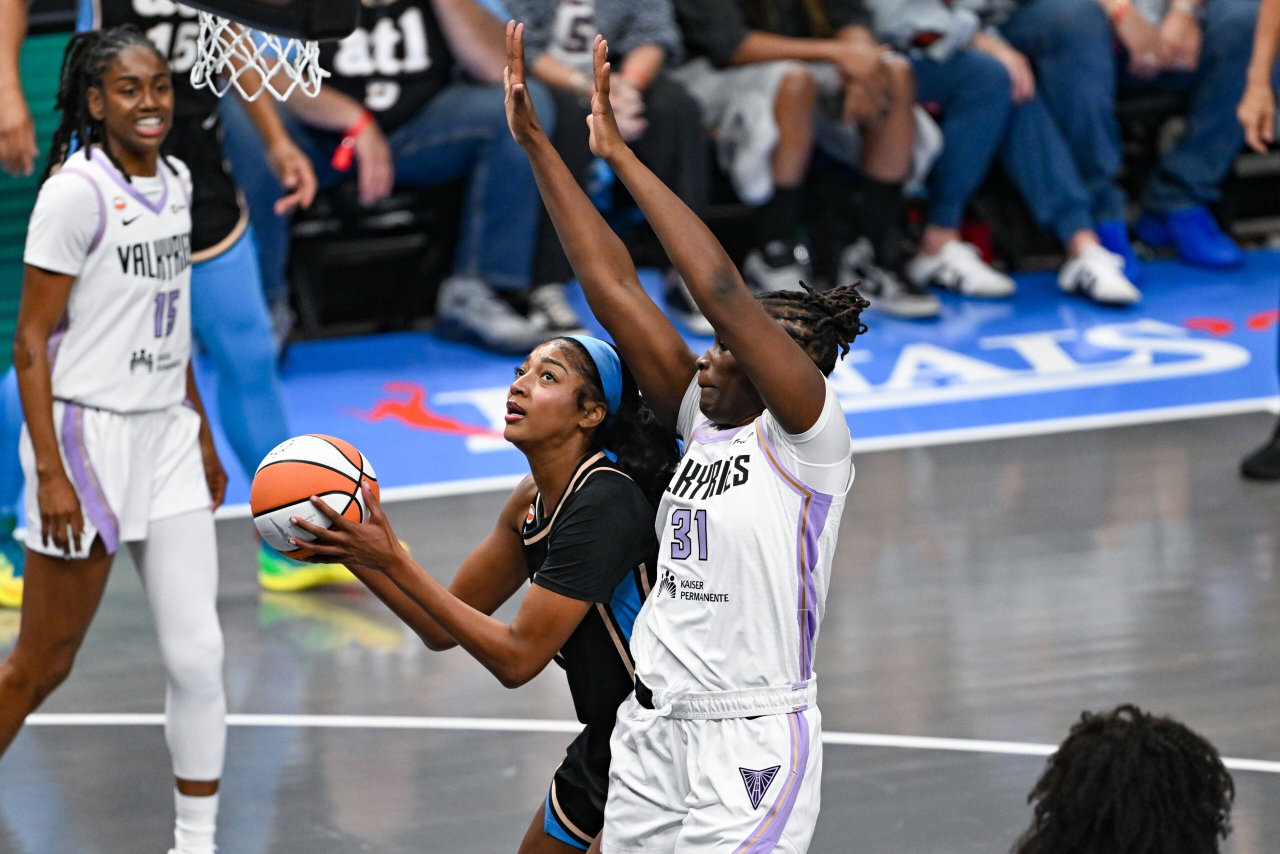
For the WNBA Finals Game 4, the Atlanta Dream reached a compromise with the Atlanta Hawks and had to start the WNBA game at 1:00 p.m. ET. Things got even worse for Game 6, because the fact that it was a potential series closer meant that the celebration ceremony would’ve been jeopardized. The 12:30 p.m. tipoff sparked a rare moment of unity. Multiple voices, from NBA stars to WNBA players, all pointed to the same culprit.
Watch What’s Trending Now!
Four-time NBA champion and Golden State Warriors star Draymond Green, Lexie Hull, and even Tiffany Hayes’ father revealed who they thought was responsible for the WNBA having to compromise.
“That is ridiculous. However, what you all should know is that the Hawks Arena [State Farm] is owned by the Atlanta Hawks owners. The Hawks owners do not own the Atlanta Dream… If the Atlanta Hawks owners owned the Dream, I’m sure they’d make the Hawks play at 12:30 and have the Dream play later,” the NBA star said on The Draymond Green Show.
While Lexie Hull didn’t directly take names, she expressed that the league should have made the Atlanta Hawks host the Cleveland Cavaliers at 12:30 instead of the women’s game having to sacrifice the primetime slot.
“I think that they should have switched to the seven o’clock game and made the Hawks play at 12:30, if it were me. But I think at the end of the day, there are thousands of people that are excited about coming to watch the game. So it’s great that they were able to figure out a way to play in front of all of those people at 12:30 p.m. ET,” Hull told Sportico.
9:30 a.m. PT game is a little brutal, but I’m sure they’re going to come out. They’re going to be ready. It’s going to be a fun game, and definitely be tuned to”
Meanwhile, OutKick managed to land an interview with the Valkyries guard Tiffany Hayes’ father, Renard Hayes, right ahead of the game in Atlanta and asked him the same question.
“I think it’s the league’s fault. It’s the league’s fault, and pretty much the Atlanta organization,” said Renard Hayes. “Last year, when we made the playoffs, our second game had to be moved to a different arena, but it was almost the same size. Instead, it was in San Jose instead of San Francisco, but we were prepared for that.”
Hayes was talking about Game 2 of the Valkyries first-round series against the Minnesota Lynx, which they had to move to SAP Center in San Jose, over 40 miles away from Ballhalla. That’s because Chase Center was already booked to host the Laver Cup men’s tennis tournament.
However, the most scathing critique of the situation and the compromise that the Atlanta Dream had to make by sacrificing primetime TV to secure the nearly 17,000-seat State Farm Arena came from former Connecticut Sun center and WNBA legend Tina Charles.
“The more things change, the more they stay the same. During the 2015 WNBA playoffs, while playing for the NY Liberty, we were forced to play back-to-back playoff games against Washington and Indiana,” Charles wrote on X.
Fast forward to 2026, Game 6 of the WNBA Finals is being played at 12:30 p.m. on a Thursday to accommodate an NBA regular-season game. Different circumstances, same underlying issue. At what point do we address the structural s***** embedded in women’s sports?”
The change Charles was talking about was the exponential growth of the WNBA. Today the league is quite different than how it was in 2015. In the last two years, the league has broken nearly all its old live audience and viewership benchmarks.
The league just completed its landmark 30th season, and ESPN delivered its most-watched WNBA regular season ever. The viewership average climbed 32% from 2025 to 1.24 million viewers. Meanwhile, the Atlanta Dream–Indiana Fever matchup on August 16, 2026 became the most-watched regular-season game ever, averaging 2.6 million viewers.
So the WNBA still having to compromise despite making such breakthroughs didn’t sit well with Charles.
The Atlanta Dream did win Game 6, 80-69, tying the series 3-3 and setting up Game 7 at Chase Center in San Francisco. However, that won’t change the fact that the Dream fumbled the ball when it came to avoiding a scheduling conflict.