
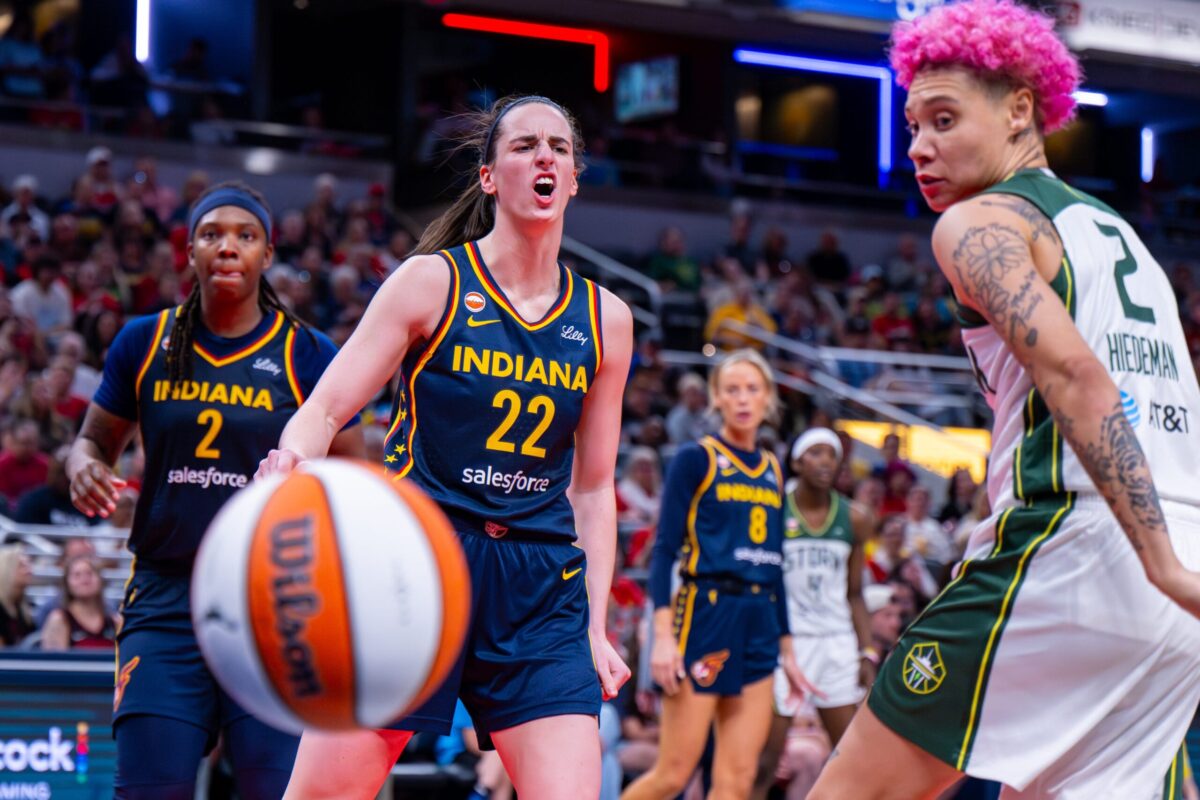
Whenever Caitlin Clark steps on the court, the conversations around her games have rarely stayed limited to basketball itself. Almost every major matchup involving Clark somehow turns into a debate about rivalries, tension, or player drama. And while those storylines draw massive attention, the 24-year-old has made it clear that she believes some narratives push far beyond reality.
Watch What’s Trending Now!
During a recent conversation with John Mallory, global co-head of Wealth Management, Clark opened up about rivalries in sports and explained why she actually enjoys them when they happen naturally.
“There are always going to be rivals. And I think that’s a really positive thing,” she explained. “I think the best thing you can do is, like, let it occur naturally.”
But while discussing the topic, the Indiana Fever star also admitted she believes the WNBA media ecosystem sometimes pushes certain storylines too aggressively.
“I think at times, that’s kind of the problem with the WNBA, is the media wants to create something that’s probably not 110 percent real,” she added. “You don’t always see that in men’s sports. That’s what makes sports interesting; that’s why people want to tune in. That’s what keeps people coming back for more.”
“I wasn’t allowed to own anything orange because that’s the color of my rival high school. Rivalries just get up a little extra. And I think it’s a good thing, especially when it’s organic,” Caitlin Clark further added.
The biggest example of what she said, of course, remains her rivalry with Angel Reese. Their competitive history exploded during the 2023 NCAA championship game when Reese famously hit Clark with the “you can’t see me” gesture after the LSU Tigers defeated the Iowa Hawkeyes.
Ever since then, media coverage has consistently framed every Clark vs. Reese matchup as a deeply personal feud.
However, Clark operates as a high-usage point guard who controls offenses from the perimeter, while Reese primarily dominates games inside as a forward and rebounder. The two rarely spend large portions of games directly guarding each other, which makes the one-on-one rivalry angle feel far more media-driven than tactical.
But that does not mean the competition itself is fake.
The games between them also naturally attracted more attention because of geography, especially when Angel Reese still played for the Chicago Sky before her move to the Atlanta Dream ahead of the 2026 season. The Indiana Fever and Sky are separated by just a short trip, allowing both fan bases to easily travel to opposing arenas and naturally intensify the atmosphere around those matchups.
Caitlin Clark and Angel Reese have also shown public respect toward each other multiple times. And the two eventually shared the floor with USA Basketball, where they openly supported one another as teammates.
So, Caitlin Clark is clearly not against rivalries. In fact, she seems to love them! But for Clark, the best sports rivalries grow naturally through competition, history, geography, and meaningful games, and not just because somebody behind a desk decided the league needed more drama.
But is Clark actually right when she says, fans don’t see this in men’s sports?
Caitlin Clark’s Comments Reveal the Double Standard Between Men’s and Women’s Sports
While the NBA media also creates its fair share of manufactured rivalries and media-driven storylines, it still widely markets trash talk, physical play, and intense competition as pure entertainment. Players like Draymond Green, Luka Dončić, or Patrick Beverley constantly taunt opponents or stir controversy, and fans often embrace it as part of their competitive identity.
But in the WNBA, those same moments often turn into conversations about character, sportsmanship, or personal drama.
That is exactly why some WNBA rivalries feel far more emotionally charged online than many NBA rivalries. Instead of simply debating basketball schemes or matchups, the conversations quickly become about morality, fan wars, or choosing sides between players.
And again, you can take the Caitlin Clark and Angel Reese example for that.
Male superstars regularly celebrate themselves, demand attention, or confidently embrace being the face of a league. Fans usually call that confidence. But women athletes often face criticism for showing the same edge or swagger on the court. The most recent example of this is Sophie Cunningham, who recently faced massive backlash from fans for just celebrating her block during one of the Fever’s recent matchups.
At the end of the day, Caitlin Clark emphasizes something simple – rivalries and emotion don’t need to be manufactured. The game already provides enough of both when you let it unfold naturally.