
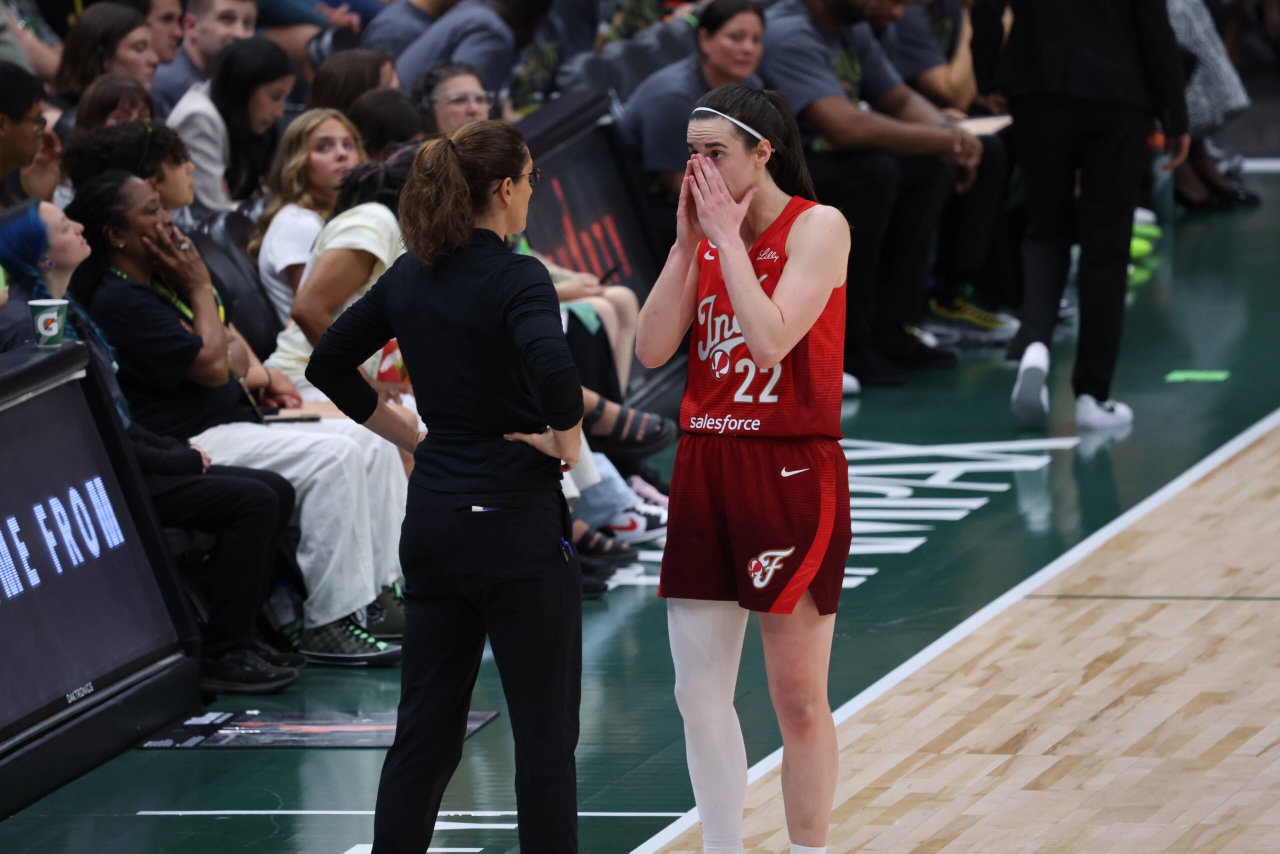
Caitlin Clark’s didn’t hide her frustration when coach Stephanie White pulled her from Game 1 early in the third quarter against the Las Vegas Aces. Clark was visibly displeased, throwing her hands up as Lexie Hull was checked in to replace her. For WNBA broadcaster Robin Lundberg, the moment raised a bigger question about how White is handling her young superstar.
Watch What’s Trending Now!
In his view, it is not the right approach for a player of Clark’s caliber and White may not have made the right move.
“Clark was pulled from the game and clearly not happy about being pulled from the game just a few minutes into the third quarter,” Lundberg said in his postgame reaction video on Sunday.
“And to me, one of the things that always made it the most difficult to play with the most confidence is when you had to look over to the sideline. When you knew that if you missed a shot or you made a mistake, you might get pulled. And that’s not the way to coach a superstar player in my mind.”
While substitutions are a normal part of any basketball game, Lundberg believes the dynamic becomes particularly counterproductive.
“You have a superstar player who thrives off of confidence and playing like a freewheeling style, a wild card, a gunslinger, as they used to call Brett Favre back in the day. That’s the thing that you don’t want to mute or take away or harness,” he added.
Clark did ultimately play the most minutes of any Fever player on the night, 34 out of a possible 40. She contributed 15 points, 10 assists, and three rebounds, but it was far from her best performance.
She shot 35.3 percent from the field on 6-of-17 attempts, went 3-of-10 from three-point range, committed six turnovers, and accumulated five personal fouls. On a night when the Fever desperately needed her to be at her most decisive, Clark was uncharacteristically hesitant.
In the postgame press conference, Stephanie White actually zeroed in on the turnover problem, a comment Lundberg interpreted as carrying an indirect message about Clark’s performance.
“I think a lot of it was our turnovers,” White said. “You know, I think they had 18 points off of turnovers. And a lot of them came in that second quarter, and then when you get some easy ones, the basket looks really big, and then they started hitting some threes.”
It is important to note, however, that there was a collective failure on the night rather than a Clark-specific one. The Fever recorded 17 turnovers as a team, which the Aces converted into 28 direct points.
The defensive breakdown that allowed Las Vegas to shoot 59.4 percent from the field, with A’ja Wilson going 15-of-19 for 38 points, was also a team-wide problem that no individual performance could fully counteract.
While a player like Aliyah Boston did contribute with 18 points and eight rebounds, she couldn’t contain A’ja Wilson the way experts like Lundberg and Rachel DeMita had thought.
Ahead of the game, Lundberg himself had said that Boston was the designated player who had the potential to guard the 2025 WNBA MVP.
“You’ve got Aliyah Boston, who guards A’ja Wilson better than any player in the league… And the Aces aren’t really equipped to go after the Fever’s biggest weaknesses on the boards or perimeter defense.”
However, the Aces were able to prove Lundberg wrong in Game 1. Game 2 is on Tuesday, and a loss ends the Fever’s season.
Indiana will need more from their defense, fewer turnovers, and maybe a more liberated Caitlin Clark if they are going to force a decisive third game. Whether the approach changes on the sideline will be just as closely watched as what happens on the floor.