
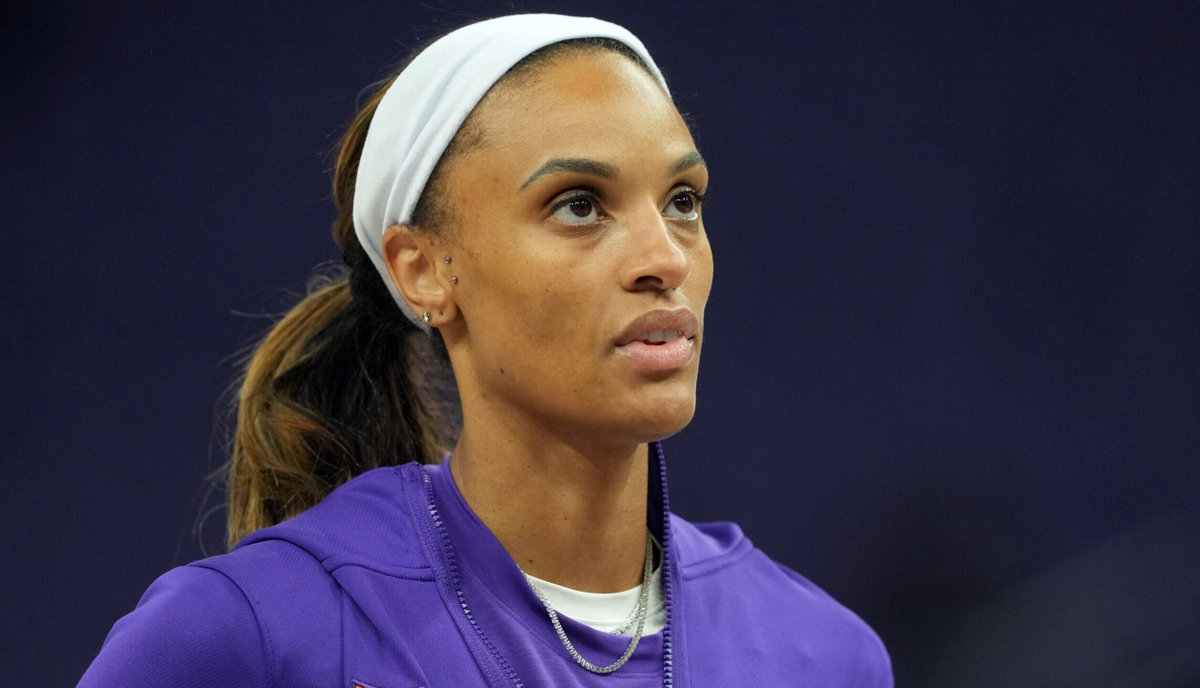
DeWanna Bonner did not sugarcoat her role in the CBA negotiations. She said, “I got thrown into the fire. I was kind of on top of it.” This description was about as straightforward as she gets. The struggle was long, the uncertainty was real, and the stakes were enormous. But when the result finally came through and the reality of what they had achieved began to sink in, Bonner found herself almost unable to believe it.
Watch What’s Trending Now!
The moment it truly hit her was when the million-dollar contracts started being announced one by one. She had to document it. “I think Jackie was the first one to get a million and I’m like, this is so humbling, this is so great. That was like the coolest moment for me. I think I actually took a screenshot of it, cos I’m like, wow,” she said, speaking on the iHeart podcast with Sarah Spain. The emotion in her recollection was palpable. “It was just so humbling. So emotional to see that such and such have a million-dollar contract in the WNBA,” she added.
And with every new contract announcement that followed, the weight of the achievement grew. “And it just kept rattling off, over and over, every other day. I’m like, we’re here. We are here. Like, this is so great, this is so amazing,” she said. And being among the first women to actually fight for this kind of financial recognition and live to see it happen carried its own profound significance. “To be like one of the first women to actually fight for this and it happens, it just says a lot,” she added.
Dewanna Bonner‘s emotional response becomes even more understandable when you remember just how close the whole thing came to falling apart. The CBA negotiations dragged on for a painfully long time, and the possibility of there being no 2026 WNBA season at all was not hypothetical. In fact, at certain points, it felt more likely than not. For months, the two sides were in a bitter impasse.
In fact, the original CBA expired in late 2025, and two major deadlines, January 9 and March 10, passed with no deal in place. The league even openly warned that missing the March deadline could delay or compromise the entire schedule. And the specter of a full lockout or player strike loomed large over the sport. What finally broke the deadlock was a grueling, seven-day stretch of around-the-clock bargaining that pushed everyone to their limit before an agreement was finally reached.
For Bonner, the outcome of that collective effort speaks to what is possible when players stand together with a shared purpose. “It just shows how we can come together as a collective and make this happen,” she said. And even though Bonner’s own contract when she signed came in at $500,000 rather than the million-dollar figures that captured the headlines, the significance of that number is not lost in comparison. Under the previous CBA, she would have been earning approximately $221,450.
What they fought for, and won, changed the financial reality of this league for everyone. Million-dollar contracts or not, that is a victory that belongs to all of them.
DeWanna Bonner Played Key Advocacy Role for Retired Players in WNBA’s CBA Talks
As a 16-year veteran and one of the league’s longest-tenured players, DeWanna Bonner served as a vital leadership voice during the CBA negotiations. And while she took part in multiple aspects of the talks, there was one area in particular where she made her presence felt most forcefully. That is advocating for veteran protections and the players who came before.
As the second-oldest active player in the league, Bonner’s focus fell heavily on securing benefits for players transitioning out of the game, including those who had already left it long before this moment arrived. “I was always in the meetings. I tried to stay in the loop and just, being one of the old ones, I wanted everybody, the retired players, to get something out of this as well,” she said. For Bonner, those who built the league in its earlier, far less financially rewarding years had earned their share of the breakthrough just as much as anyone still active. “It was time. They deserved it,” she said.
And of course, her advocacy did yield concrete, groundbreaking results. The final agreement didn’t just transform the financial landscape for current players, it reached back to honor the trailblazers who laid the foundation for everything the league has become today. Specifically, players with 12 or more years in the league received a $100,000 payout. Those with 8 to 11 years received $50,000, and players with 5 to 7 years of service received $30,000.
Beyond the one-time payments, the league also significantly increased team-matching and baseline contributions into player retirement accounts. Expanded life insurance plans were also formally codified into the baseline benefits package.
DeWanna Bonner, herself, actually spent most of her career in the WNBA era, which was less financially rewarding. And it’s quite understandable, and as well good to see her actually be a part of the forces that made sure that generation didn’t get left behind in this good times.