
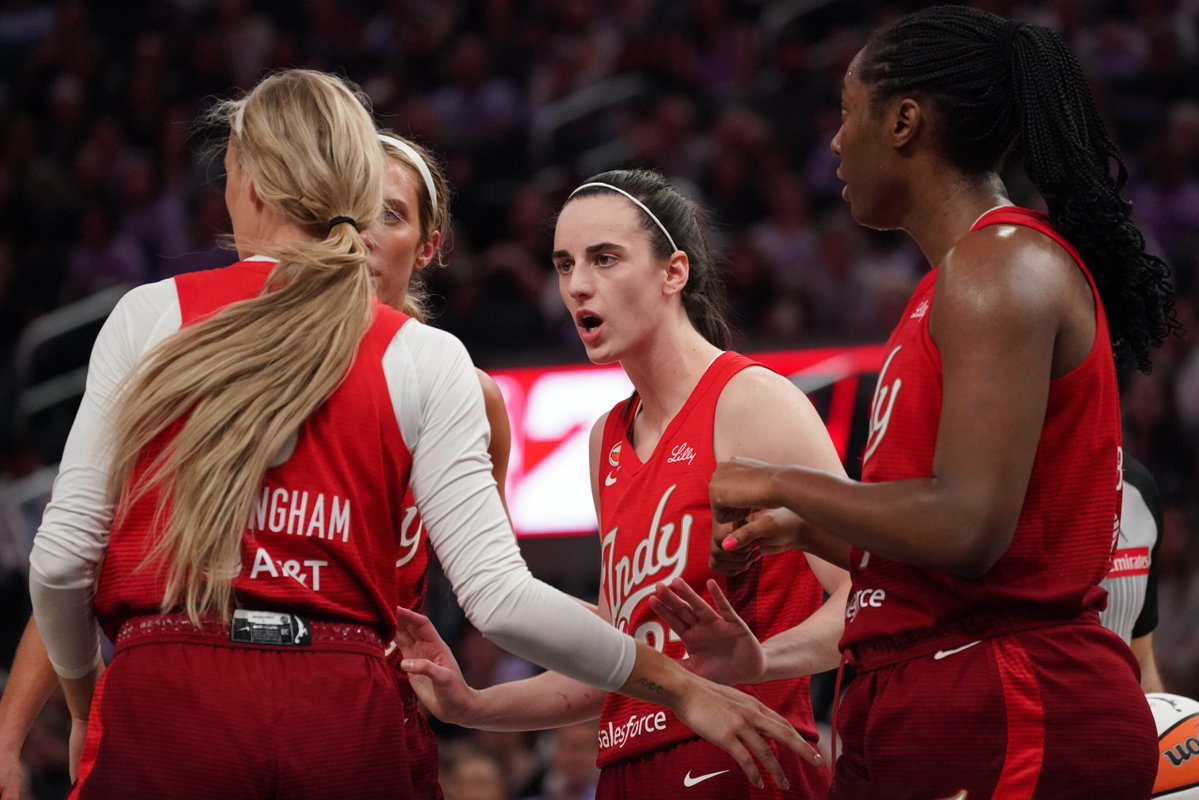
The Indiana Fever boast the WNBA’s most dominant offense, powered by Caitlin Clark, Kelsey Mitchell, and Aliyah Boston under coach Stephanie White. Indiana leads the league with a historic 115.7 offensive rating and would surpass the Las Vegas Aces’ 2023 record of 113.0 if it sustains that pace through the regular season.
Watch What’s Trending Now!
Still, the Fever have faced scrutiny over their defensive shortcomings and lack of depth. Lexie Hull, however, remains confident in the system and believes the offense naturally revolves around Clark’s singular ability to create plays.
Speaking after Saturday’s loss to the New York Liberty, Hull identified an issue that she believes occasionally undermines Indiana’s offensive efficiency: a tendency to get locked in on a specific play or a specific player, even when a cleaner opportunity exists elsewhere on the floor.
“Yeah, I think there are times where we get tunnel vision,” Hull said, as shared on X by Indiana Fever writer Robin Lundberg. “I think there’s times where there’s better shots available, but again, it’s so many threats. But for us, it’s finding the easiest shot, the most open shot.”
The shot distribution numbers from the Liberty game seem to support Hull’s observation. Of Indiana’s 70 total field goal attempts, 47 were taken by Clark, Boston, or Mitchell. And of the 26 three-point attempts, those same three players accounted for 16. In fact, Hull specifically acknowledged that she herself does not average a high volume of shot attempts per game, a reflection of how heavily the Fever’s offensive load is concentrated in a small number of hands.
It is only natural for Indiana’s three primary offensive weapons to carry most of the scoring load and take the bulk of the shots. Still, when the offense becomes too concentrated in the hands of Clark, Mitchell and Boston, elite opponents such as the New York Liberty can more easily shape their defensive game plan. When a defense can anticipate who will shoot and where those attempts are likely to come from, it can limit options and force tougher looks.
Even so, it would be too simplistic to blame the Liberty loss solely on the tunnel vision Hull identified. Stephanie White’s postgame comments pointed to a broader set of issues, including collective lapses across several areas of the game.
“There were lapses,” White said. “Lapses that caused fouls that went to free throws, lapses that allowed offensive rebounds, lapses that allowed soft switches into cuts, lapses on the offensive end where we didn’t know the ball, we didn’t find the right play, didn’t find the right pass.”
Hopefully, as playoff basketball approaches, the Fever’s coaching staff and players will find time to address these individual and collective breakdowns in a way that the current schedule has not fully allowed. Because in the postseason, against elite opponents in one-and-done situations, they simply cannot afford to sleepwalk, tunnel vision, or lapse their way through games the way they have in their last two losses.
The goal, as it has been from the start of the season, is a championship. And that goal demands a higher standard.