
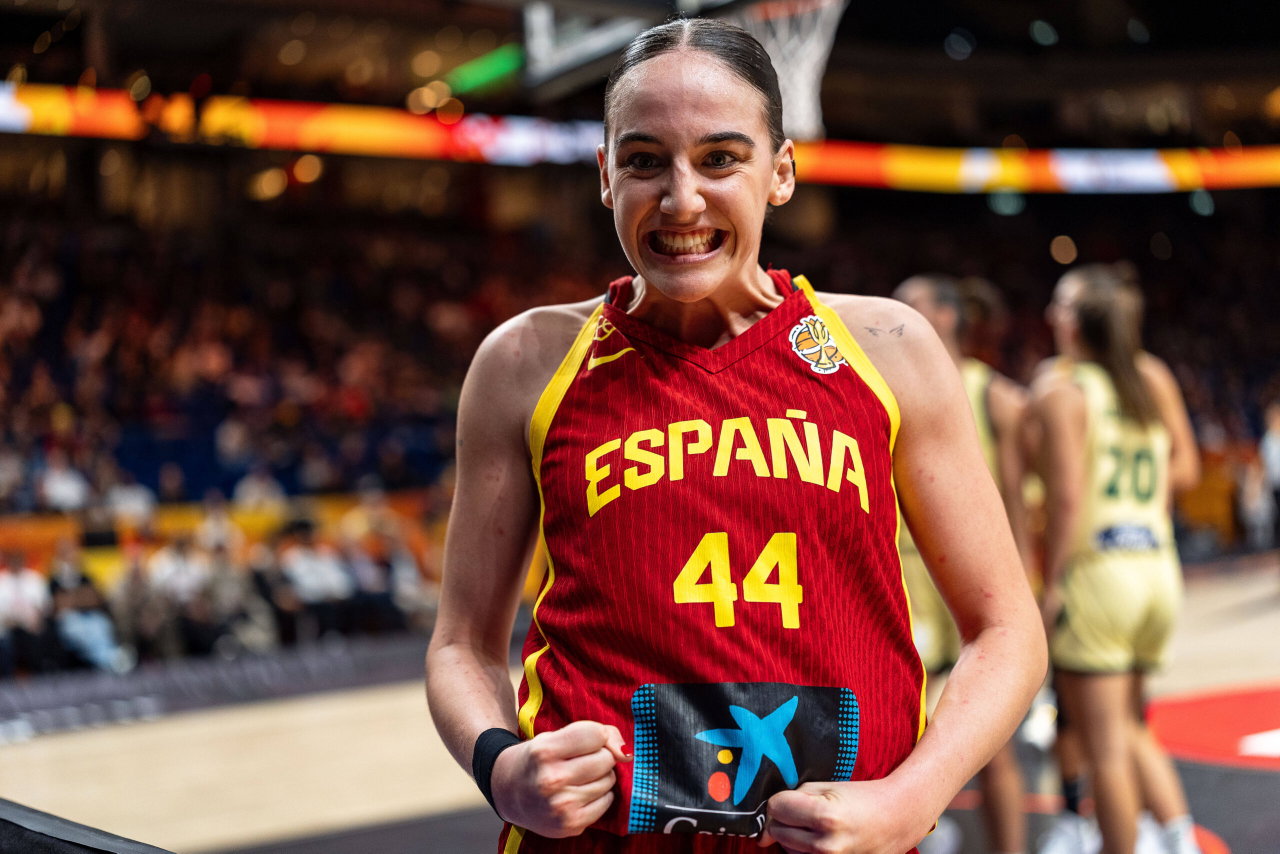
Spain continues to be one of the most impressive teams in the FIBA Women’s World Cup, and after claiming their fourth World Cup medal in five editions, that further solidifies their case. The Spanish had a comprehensive victory against the host nation, Germany, as they won the bronze medal in what is their third third-place finish in the tournament after 2010 and 2018. Spain’s attack was led by none other than 20-year-old Iyana Martin, who signed off her stellar tournament debut with another fantastic performance. Meanwhile, on the other side, tears were shed at the Berlin Arena as Germany failed to secure its first medal on its second appearance as a unified country, including its last time as host in 1998.
Watch What’s Trending Now!
As the eventful bronze medal game between Spain and Germany concludes, we take a deep dive into how it played out.
Spanish gem Iyana Martin inspires a third-place finish
Iyana Martin has officially announced herself to the world after a highly inspirational World Cup campaign that saw her produce three 20-point games in the competition, the most by any player aged under 21 years old this century.
Martin was the Player of the Game after recording 22 points, 9 assists, and 4 rebounds. In terms of performance efficiency, Martin’s valued at 28. With this, she also became the third-youngest player in history to hit the 100-point milestone over the last two decades. Only Candace Parker and Liz Cambage have reached this historic landmark earlier than the Spaniard.
The most effective lineup for Spain featured Maite Cazorla, Maria Conde, Megan Gustafson, Iyana Martin, and Awa Fam. That group played 7 minutes and 5 seconds together, recording a +12 plus-minus as part of the collective effort to build and maintain the lead.
Apart from Martin, another youngster had an efficient outing as Awa Fam controlled the paint with 10 points, 9 rebounds, and 3 assists, also finishing with a solid efficiency rating of 20.
Their teammate, Raquel Carrera, also made an impact, scoring a competition-best 15 points, while adding 5 rebounds for a 21 efficiency rating. And while Martin was the engine of the Spanish side, Carrera provided a crucial boost when she scored 8 points between 7:18 and 5:27 in the third quarter, knocking down three straight two-pointers and draining two free throws.
“I think all of that we passed all tournament; we lost one game, we were competitive all the rest of the games,” said Carrera. “I think we improved during all the tournament. We have amazing players. We have 12 players that are always going to the court, giving all the effort.”
The New York Liberty center, who is just 24 herself, also took the time to spread some kind words regarding Martin.
“She’s amazing,” said Carrera. “She’s a very young player, but she always makes plays like amazing. For us, she’s not young. She’s like a veteran player.”
Spain’s third-place finish also helped captain Alba Torrens join an exclusive club. Torrens became only the third player in history to secure four World Cup medals, along with USA duo Sue Bird and Breanna Stewart.
“I am so happy and this happiness goes beyond me,” explained Torrens.
“It goes for the team and for Miguel [Mendez] and the staff, for Elisa [Aguilar] the President and the Federation. “I am so proud of this team. I have no more words. It’s a real team and I am so thankful to be so proud at this moment.”
The captain also spared some high words of appreciation towards the youngsters Martin and Fam, who are the leaders of this new generation.
“They showed up already on the court and showed their talent,” added Torrens.
“They showed their character and a maturity that is not common. They also showed how to play as a team. I think that they are shining right now and they will keep doing it, and I am just so happy to see it and to be enjoying it with them,” the veteran concluded.
With players like Martin, Fam, Carrera, Alicia Flórez, Elena Buenavida, and Helena Pueyo, the future looks very bright for this Spanish squad, and they will surely aim for the gold medal next time around.
Host Nation defied as Germany’s growth continues
It was not to be for Germany, but the host nation can still keep its head held high for finishing fourth despite not even being in FIBA’s Top 10 rankings.
Germany fell to the same team that defeated them in the first group stage game, as the 81-58 result showed the clear gap in quality between the two sides once again. Spain led for 37 minutes and 25 seconds throughout the game. Their largest lead was 23 points, achieved with 0:36 remaining in the final quarter.
It was Spain’s second victory over Germany after defeating the hosts by 30 points in their opening game, which was their biggest win over a European team and Germany’s heaviest defeat in the competition.
Regardless, after the first defeat against Spain, Germany showed a lot of promise and had increasingly impressive wins over Japan, Mali, South Korea, and even European champion Belgium in the quarterfinals. Moreover, Germany was the first team in the tournament to limit France, the most dominant team, to under 90 points with an 86-64 defeat in their semifinal.
“The growth has been very, very positive,” said Germany coach Olaf Lange, who had hailed German basketball’s “best day” after the win over Belgium.
“We’ve made good progress. Now we have to keep working on ourselves and use this as motivation for the future. We have EuroBasket coming up next year – we have to qualify first – and then the 2028 Olympics. We have to keep going. That’s our motto – keep going – and it doesn’t change today,” Lange said.
Only three players from Germany recorded double-digit points. Leonie Fiebich scored 10 points, 7 rebounds, and 2 assists, while Nyara Sabally and Alexis Peterson contributed 13 points each.
“We have to take the pain with us to be better as individual players and as a team,” Leonie Fiebich said.
Fiebich fought back tears while talking to reporters and reflecting on the importance of the game. She was not alone, as Frieda Bühner was also emotional while the Spanish players hugged and danced in celebration at the Berlin Arena.
“It’s unique, it happens only once in a career. I’m super thankful that we could be part of it, the team, the staff, the organization, everything all around it. It was one of the coolest experiences ever. I’ll be thinking of it for a long time,” Fiebich added.
In 1967, East Germany finished fourth as well, as the now-unified country’s search for a World Cup medal continues. For the near future, Lang’s side can look forward to a fruitful EuroBasket tournament after finishing fifth in last year’s edition.