Imago
via imago
Imago
via imago
These WNBA-WNBPA CBA negotiations are making fans and analysts accidental law experts. Every other week, the fans hear terms that they haven’t encountered and fall down the rabbit hole of understanding what’s actually happening. So, now they are reading law papers rather than drawing up basketball plays. The new term this time around is “moratorium.”
Watch What’s Trending Now!
The third CBA expiration deadline of January 9 passed, but there was no extension this time. However, there was no strike or lockout either, so we entered a “status quo.” Without an extension, both sides needed this moratorium agreement. But what exactly is it? Let’s examine.
What Is the WNBA Moratorium Agreement?
A moratorium agreement is a written deal where one party temporarily pauses (or agrees not to enforce) a specific obligation for a defined period, to give the other party time to stabilize or work out a solution. That is the legal definition.
In the case of the WNBA and the WNBPA, the two sides have agreed to pause the free agency, core designations, and qualifying offers until they agree upon a new CBA. Once the new CBA is formulated and ratified, the moratorium agreement will be lifted, and free agency will begin. The agreement allows other league business, like players’ access to club facilities, to continue.
How Does the Moratorium Affect Free Agency and Teams?


It essentially prevents players from being pushed into perilous decisions under the old CBA.
After the two sides failed to agree on another extension or a new CBA, they entered a status quo. It’s essentially “no unilateral changes while talks continue,” so day-to-day rules under the old CBA, which the players hate, stay the same unless both sides agree to a change.
The franchises now aren’t allowed to negotiate with players and pitch in qualifying offers under the old CBA, under which free agency would have begun on January 11. While that task would have been already futile, nonetheless, this is a legal seal that prevents it totally. It’s an advantageous agreement for the league and the franchises.
If a player had signed in this period under the outdated CBA, their contract would be misaligned with the rest of the league. That would have caused chaos under the new cap rules, making an administrative mess for the league office.
What Are the Key CBA Issues Still Being Negotiated?
The central topic of disagreement remains revenue share.
According to reports, the league is proposing 70% of net revenue to the players, while the players want 30% of gross revenue. Gross revenue is the “top-line” intake, revenue before subtracting expenses, and it’s the basis the union has pointed to when arguing for a revenue-share model tied to total money coming in. Net revenue is whatever remains after subtracting the operational costs.
According to ESPN, the WNBA is estimating a “$700 million in losses over the course of the agreement.”
WNBPA has denied these projections.
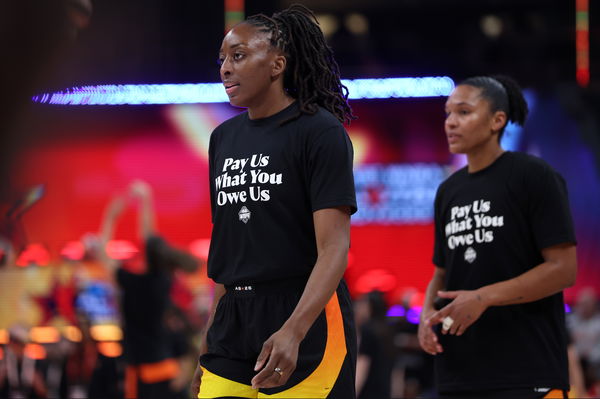
“The league and teams saying that they’re losing money is like saying their pockets are empty while you’re also holding the keys to a brand-new Ferrari,” Nneka Ogwumike said in an ESPN interview.
She has two arguments: the league is not factoring in the $250 million expansion fees coming in till 2030, and that based on the valuations skyrocketing this year, the league’s revenue projections are timid.
Imago
Jul 19, 2025; Indianapolis, IN, USA; Team Collier forward Nneka Ogwumike (3) looks on before the 2025 WNBA All Star Game at Gainbridge Fieldhouse. Mandatory Credit: Trevor Ruszkowski-Imagn Images
Another contentious point includes the core designation, which allows franchises to exercise an additional two years of team control over unrestricted free agents.
The WNBPA would like to remove it altogether. The WNBA has so far urged to continue with the same system as a team-building tool. The union would also like to shorten the length of rookie contracts from four years to three.
So far, the WNBPA has not indicated dissatisfaction with the reported salary figures, which would make the maximum salary around $1.3 million in Year 1 and the average salary around $530,000. There is some disparity in the salary cap, though, as the WNBA is proposing $5 million to the WNBPA’s $10.5 million.
What Happens Next and What Should Fans Expect?
Essentially, it’s the same as it was until now.
Fans will have to sit around and wait for good or bad news. The boardroom conversations will continue until they agree on a middle ground or one side caves in. However, as time wears on, the threat of a delayed or even canceled 2026 WNBA season increases.
The league needs some time to allocate for free agency, rookie, and expansion drafts. The free agency cannot be hush-hush, as around 80% of the league will sign new contracts. Meanwhile, the players can still strike and are keeping it in their ‘back pocket.’
Related Newsletters