
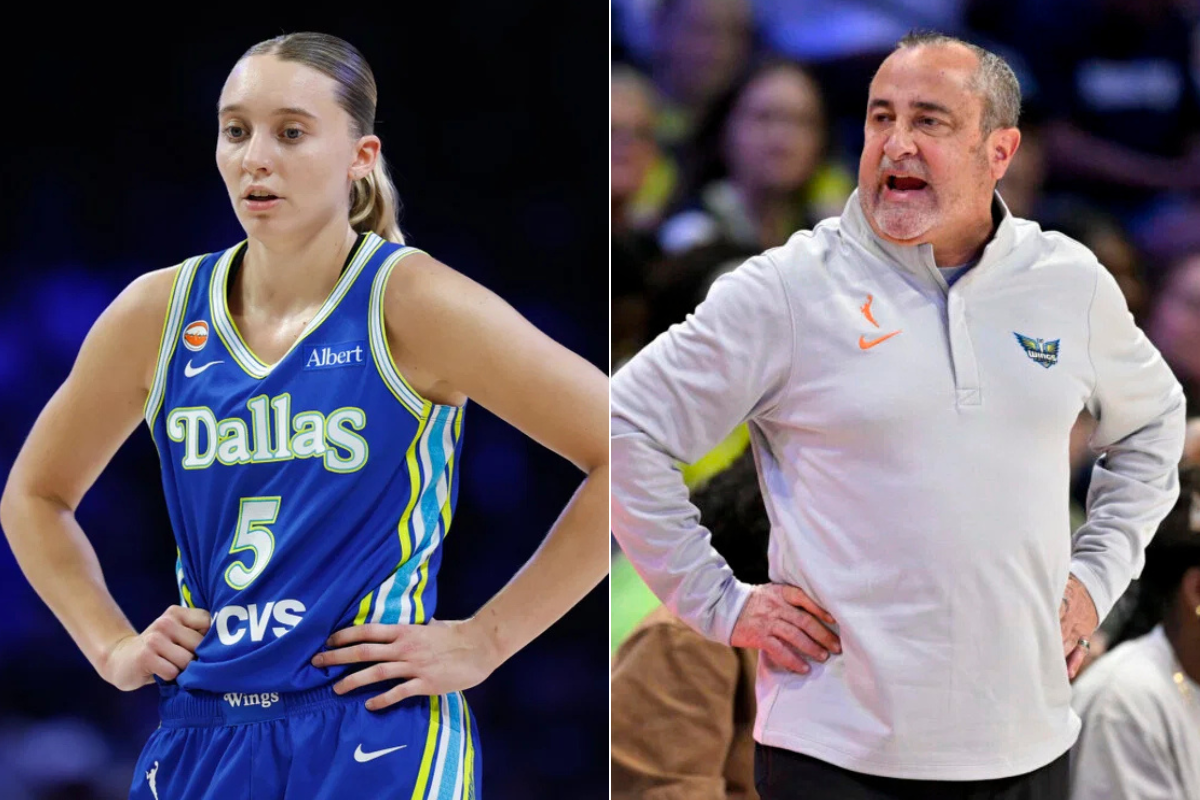
A year and a half after entering the league, Paige Bueckers finally looked out of place. Against the Atlanta Dream, she looked like she didn’t fit, missing open shots and struggling on the court. She scored only 7 points, her lowest ever, shooting just 3 out of 13. She did add 7 assists, but it wasn’t enough. For Jose Fernandez, the Wings’ coach, there was one thing his team could have changed to turn the game around.
Watch What’s Trending Now!
“There are going to be games like this where the ball doesn’t go in the basket. When you shoot 35, 36, 37 percent, you have to do a really good job on the defensive end and rebound,” Fernandez said after the game. “Maybe get to the rim more. We’ve got to put it behind us. When you look at 37, 25, and 50 from the floor, it’s going to be tough to win games that way, but they know it.”
The Dream clamped down early, racing to a 16-3 lead, while Dallas opened the night 1-of-17 from the field and did not get its first basket until Azzi Fudd hit a three more than six minutes into the game. Atlanta led 19-5 after the first quarter, and even though the Wings clawed back and took their only lead, 64-63, with 7:35 to play, the Dream closed with a 23-5 flourish to win it 86-69.
The Wings struggled around Bueckers as Arike Ogunbowale had only 2 points, and so did Alanna Smith, with the entire team shooting around 38% from the field and 25% from the three-point line. Awak Kuier led Dallas with 16 points off the bench, while Odyssey Sims added 14 and Jessica Shepard had 10, but the Wings’ two biggest offensive names never found a rhythm. Bueckers and Ogunbowale combined to shoot 4-of-24. For Fernandez, his team needed more shots from the paint rather than throwing up three-pointers.
The Wings had 28 shots from behind the arc. That is almost 5 more than their season average of 23.2. Even for Paige Bueckers, she attempted 6 3-pointers, which is almost twice her career average until this game (3.3). She could not find her rhythm throughout the game with a technical in the third quarter and a hard fall.
The technical came after Bueckers drove into the lane, drew contact, and then clapped after the whistle. She was visibly confused by the call, telling the official, “Are you serious? I clapped, just like that.” Fernandez, however, avoided getting drawn into the officiating debate afterward. “I’m not gonna comment on that because I don’t wanna get fined,” he said.
The primary reason behind the uptick was the size mismatch in the paint as the likes of Angel Reese, Rhyne Howard, and Naz Hillmon fiercely defended the basket. And on the flip side, the Wings struggled to protect it as well.
“They took some high-percentage shots right in the paint. They drove the ball and got to the free-throw line,” Fernandez said. “They were efficient, especially when they needed to respond after being down one in the fourth quarter.”
The Dream had a whopping 54 points in the paint while also shooting 40% from beyond the arc. Angel Reese had a field day on the boards, grabbing 9 rebounds as the Dream won the battle 35-26. She also added 15 points, while Allisha Gray chipped in 16. But the biggest difference-maker was Rhyne Howard, who returned after missing the previous game while in concussion protocol and immediately gave Atlanta control on both ends.
There was little Bueckers could do in this head-to-head battle. And it turns out there is a foe for Bueckers in this team, but it’s not Reese.
Paige Bueckers’ Boogey Man Emerges After Atlanta Loss
Paige Bueckers had been practically unguardable until this game. She averaged 20.8 points and 5.2 assists. Her efficiency was off the charts as well, shooting 57.6% from the field and 57.9% from the three-point line. However, the Atlanta Dream game came, and so did the one player that Bueckers struggles to guard against.
“Paige Bueckers in 5 career games vs. ATL w/ Rhyne Howard healthy: 12.2 PTS, 35.7% FG (and 2.2 FTA). That’s comfortably her worst numbers compared to any other opponent,” wrote Hunter Cruse.
Those numbers aren’t just a blip. When Howard plays, Bueckers’ game changes. She hesitates. She passes up open shots. She forces tougher attempts. It’s the kind of matchup that makes even star players question their rhythm. For Dallas, this isn’t about one player having a bad night. It’s about finding a way to win when their best player gets neutralized.
Howard shut down Bueckers with her defense. Her size and length proved too much for Bueckers. She also torched the Wings on the other end. She had 25 points, 4 rebounds,8 assists, 4 steals, and 2 blocks, giving Paige Bueckers a hard time on both ends. However, there seemed to be something off about Bueckers and her shots as well. In the second quarter, Azzi Fudd kicked the ball out to Bueckers, who was open for three.
But instead of going for it, she drove to the paint and missed a contested teardrop. Her decision-making seemed to be off. Fernandez knows this game will be studied. Not for the score, but for the choices. When Bueckers passed up that open three in the second quarter, it wasn’t just a bad decision but a sign of something bigger. The Wings need her to trust her shot again. Because when she does, Dallas wins. When she doesn’t, headlines like this one follow.