
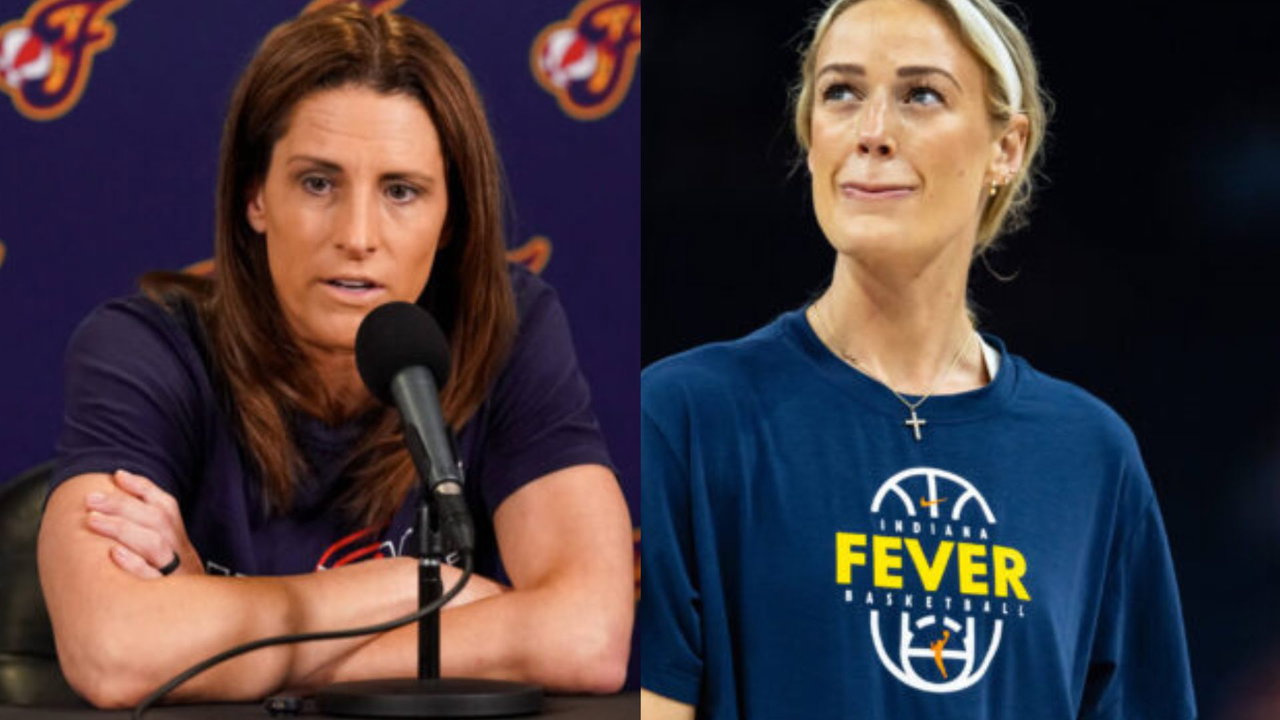
Ahead of their Portland Fire game on Friday, Indiana Fever head coach Stephanie White was asked directly whether she would welcome a biological male to play in the WNBA. The question came squarely in the context of the ongoing controversy sparked by Sophie Cunningham’s public stance on the exclusion of transgender women from women’s sports. White did answer, but she was far from definitive in her response. For WNBA analyst Rhodes Rants, however, that answer was far from acceptable.
Watch What’s Trending Now!
“What do you mean by science?” Rhodes said on Saturday’s episode of his podcast Black & White Sports Too. “He asked you point-blank, biological males should be allowed in the WNBA? Yes or no? You gave a b******* coward answer. A cowardly answer. It’s crazy. We want to grow, but we want to insulate. You can’t have both. If you’re going to allow people with differing views to watch your game, which you’ve already said you really don’t want, but it’s pretty clear. I think somebody told you, ‘Yeah, don’t go out there and tell fans you literally don’t want them to watch anymore.'”
This was in response to White’s comments on transgender individuals being allowed to play in the WNBA debate that has been widespread across the league.
“I would say that I’m educated enough from a scientific standpoint,” White said. “And I don’t ever believe that exclusion is an answer. I just don’t. There is a frustration, of course. Because we want to talk about basketball and we want to continue to work on our game. And we want to continue to grow as a team. But I also understand, it’s part of our growth edge as a league. And we have to be able to manage, we have to be able to insulate as much as we can.”
For Stephanie White, the frustration is evident; she would clearly rather be talking about basketball. However, the whole league has been talking about this, and White’s player is the reason why.
It has now been almost two weeks since this conversation first erupted publicly, ignited by Sophie Cunningham’s ESPN profile on July 21. When the backlash arrived, Sophie Cunningham doubled down, pushing back against accusations of hatred toward transgender individuals, stating she wants to “extend love” while maintaining that protecting biological women and young girls in sport is simply common sense.
Quite a number of people around the WNBA have touched on the topic since then, and as it appears, coach Stephanie White seems to be understandably approaching such a polarizing issue with some care.
It’s uncertain whether or not the controversy will die down anytime soon. Ahead of the Fever’s next game against the Lynx, there’s already another demonstration scheduled in support of Sophie Cunningham. There could also be counter-rallies similar to those seen during the Seattle Storm and Portland Fire games. Against this backdrop, Stephanie White will most likely face questions relating to transgender issues again, ahead of or after that game.
Cheryl Reeve weighs in on planned trans rally before Fever game
Minnesota Lynx head coach Cheryl Reeve, meanwhile, has already addressed the issue ahead of Sunday’s game against the Indiana Fever. Speaking to the press, Reeve acknowledged that everyone has a right to peaceful assembly. And based on what she has seen so far, these demonstrations have remained exactly that.
“I don’t think we should feel like our safe space is being threatened. That’s what I enjoy about the WNBA. I think we have to continue to safeguard that,” Reeve said. “I don’t think these demonstrators are not being peaceful. Not that I’ve seen. I haven’t seen all of it. I haven’t heard everything that’s happening, but everyone has a right to peacefully assemble, right?”
Reeve also took the opportunity to reiterate her previously stated position on the broader transgender athlete debate. She’s always been in favour of inclusion and a belief that the conversation is in a way that feels problematic.
“As I said last week, I come from a space of inclusion, and the narrative that I think is problematic is to suggest that, number one, transgender athletes are the biggest problem in women’s sports,” she said. “I think what’s bothersome is that there’s a faction of people in our country that are making this a massive issue. We have some issues. Number one, we need to protect trans kids. Every kid. To me, it’s a human rights issue. Every kid has a right to sports, regardless of gender diverse, transgender. Every kid has the right to access.” Reeve added.
The conversation surrounding transgender athletes in women’s sports shows no signs of fading ahead of what promises to be a high-profile matchup between two of the WNBA’s top teams.