Imago
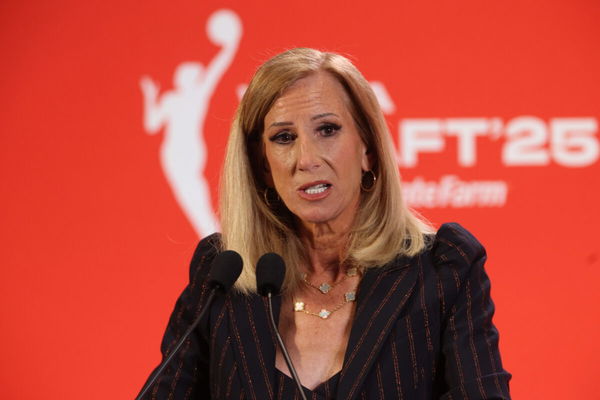
Apr 14, 2025; New York, New York, USA; WNBA commissioner Cathy Engelbert talks to the media before the 2025 WNBA Draft at The Shed at Hudson Yards. Mandatory Credit: Vincent Carchietta-Imagn Images
Imago
Apr 14, 2025; New York, New York, USA; WNBA commissioner Cathy Engelbert talks to the media before the 2025 WNBA Draft at The Shed at Hudson Yards. Mandatory Credit: Vincent Carchietta-Imagn Images
The WNBA is no longer fighting for survival. It may be preparing to fight for control. Just a few years after selling a minority stake in the league to stabilize its future, the league now finds itself at a very different crossroads. The WNBA and the WNBPA are now at a standstill, with the players demanding revenue sharing. But as the CBA talks remain uncertain, a far bigger move may be taking shape behind the scenes.
Watch What’s Trending Now!
In early 2022, commissioner Cathy Engelbert led a capital raise that led the league to sell a 16% stake in the league for $75 million. A deal that was widely framed as a lifeline after the pandemic season and valued the league and its teams at $1 billion. Those funds were designated for brand growth, marketing, and global expansion, at a time when the league was still emerging from a bad place.
However, fast forward to four years, i.e., 2026, and sources with direct knowledge of the league’s business have said that the WNBA is exploring whether it can reclaim that same stake. While the idea is still in its early stages, there is no clarity yet on how such a buyback would be financed or structured.
Since then, the league and the teams’ valuation have roughly quadrupled, according to Front Office Sports. As a result, the investment group, which includes Pau Gasol, Condoleezza Rice, Nike, and several NBA and WNBA owners, stands to earn several times their original investment.
The WNBA is exploring buying back the 16% stake sold for $75 mil in 2022, multiple sources told me.
The deal—valuing the league at roughly $1 billion—was celebrated as a transformative measure. The WNBA has roughly quadrupled in value since. https://t.co/H2FhFoF5TY
— Annie Costabile (@AnnieCostabile) January 16, 2026
Since the establishment of the WNBA in 1997, the league has been closely tethered to the NBA. While that relationship helped the league survive its formative years, it also created a layered ownership structure.


Adding to an already complex arrangement, before the capital raise, the NBA’s owners collectively held 50% of the league, with WNBA owners holding the other half. But the equity sale diluted both sides to 42% each, introducing outside investors to join the league.
However, experts have argued that this structure is becoming a liability at a moment when the league and its players are not seeing eye-to-eye.
Stanford economics professor Roger G. Noll has claimed that the WNBA was long viewed by the NBA as a supplementary asset rather than a standalone business. But the question now is whether the league can continue to grow, or will the next phase require a cleaner, more autonomous framework.
By 2030, the WNBA is expected to reach 18 teams, with recent expansion franchises (Cleveland, Detroit, and Philadelphia) paying $250 million each to join. While those figures alone suggest confidence, stability, and long-term belief in the product, many still believe it’s not in the place to support the gross revenue model that the players are seeking.
Why the WNBA and WNBPA remain far apart in CBA talks
The WNBA and the players’ union have been locked in CBA negotiations for over a year, and progress has stalled to the point that league operations are now paused.
Free agency, qualifying offers, core designations, and most transactional activity are now frozen under a moratorium agreed upon by both sides. While neither of them is opting for a strike or a lockout, the current stalemate has only heightened tensions.
Imago
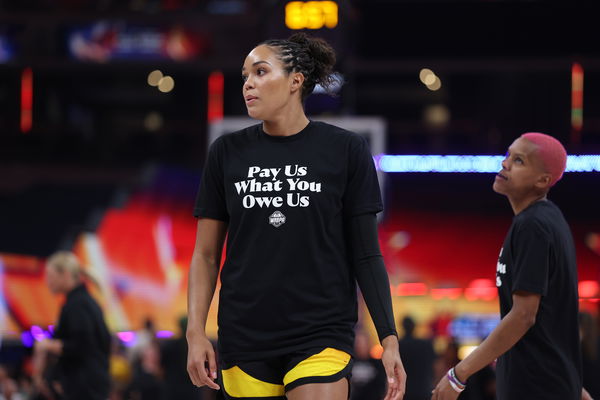
Jul 19, 2025; Indianapolis, IN, USA; Team Collier forward Napheesa Collier (24) looks on before the 2025 WNBA All Star Game at Gainbridge Fieldhouse. Mandatory Credit: Trevor Ruszkowski-Imagn Images
The union is pushing for a model that allocates roughly 30% of gross revenue to players, paired with a significantly higher team salary cap. The league, meanwhile, has proposed a system that gives players more than 70%. But that percentage is of net revenue, calculated after expenses such as travel, facilities, and medical care.
Under the league’s last proposal, maximum base salaries would rise sharply, potentially reaching $1 million in 2026 and $1.3 million through revenue sharing. And that’s where the difference lies. The players argue that net revenue calculations obscure the true value they bring to the table, while the league warns that adopting a gross-revenue model could result in losses approaching $700 million over the life of the deal.
So as the revenue debate drags on, the league’s exploratory ownership discussions add another layer to an already complicated negotiation. But whether a buyback ultimately materialises by the WNBA will depend on how CBA discussions unfold.
Related Newsletters