
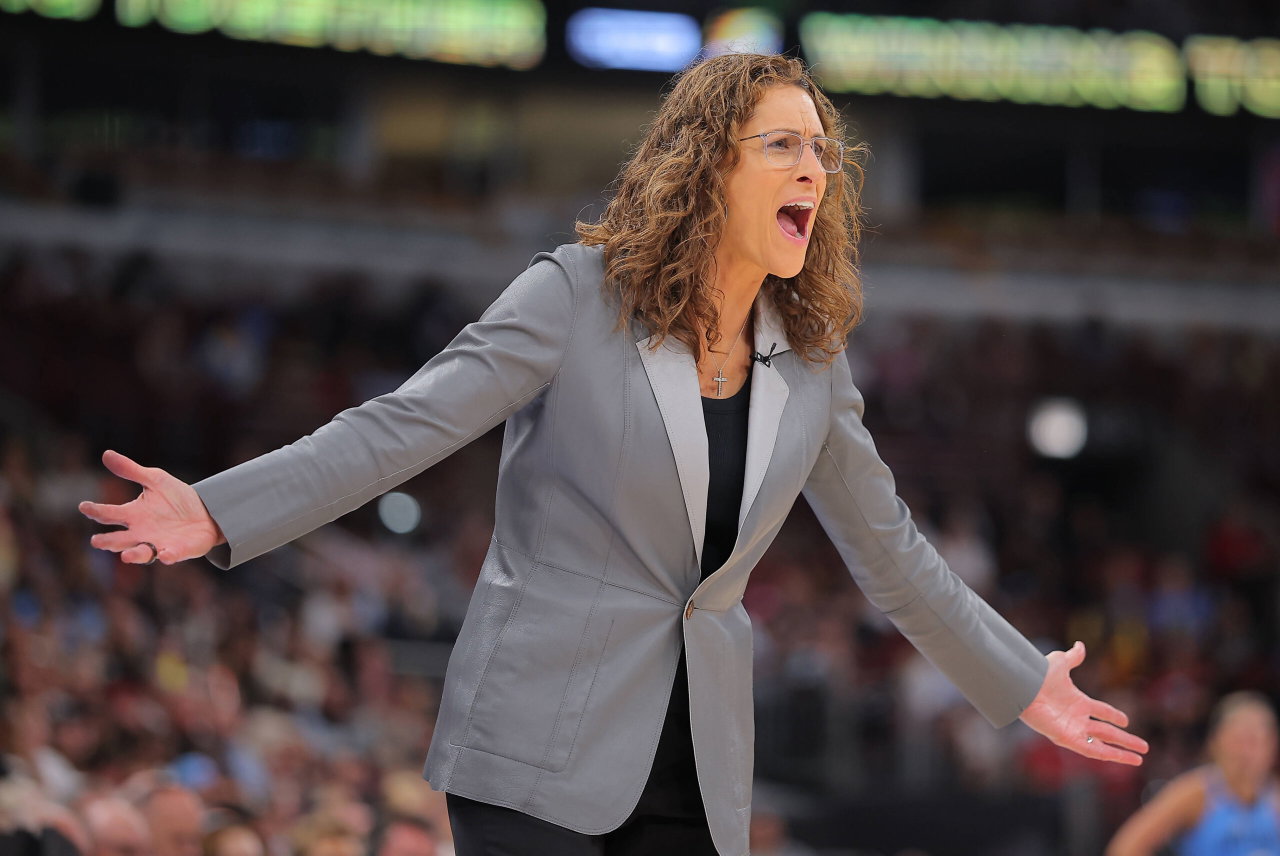
The Indiana Fever had just put together one of their better offensive nights of the season, but somehow, the conversation after the loss to the New York Liberty was not only about the 109 points they gave up.
Watch What’s Trending Now!
Instead, attention quickly turned to a few possessions involving Caitlin Clark, Kelsey Mitchell and the way Stephanie White’s offense was being run. For a section of Fever fans, those moments were enough to bring back a familiar question: Is Clark really being put in the best position to succeed?
Some fans went much further than simply questioning White’s play-calling, accusing the Fever coach of working against Clark and even hurting her MVP case. One fan, reacting to a possession where he believed Mitchell could have found Clark, wrote: “When the Fever finally realized that Caitlin Clark is in the MVP conversation, we are now back to the old Steph White system of offense tilted toward KM isolations and a slower, more deliberate motion and half-court style rather than the high-pace, Clark-driven two-man game.” Another fan, reacting to a separate possession, wrote: “Stephanie White is actively sabotaging Caitlin Clark’s career and we’re all just watching as if nothing’s happening….”
The numbers, however, make the accusation harder to prove. Clark finished with 21 points and 7 assists while shooting 9-of-18 from the field, and her 18 field-goal attempts were actually the most on the Fever. Mitchell took 15 shots and scored 25 points, while Aliyah Boston added 22 as Indiana’s three All-Stars each topped 20 points in the same game.
For those fans, the issue is bigger than one missed pass. They believe White’s offensive structure is giving Mitchell too much freedom to attack while taking Clark away from the high-pace, two-player actions that have made her such an important part of Indiana’s offense.
In fact, one fan, in agreement with a post claiming that Clark is being treated as the second or third option, went as far as suggesting that White is even more of an obstacle than the opposition, even accusing her of possibly wagering on games.
“When your own coach is fighting you harder than your opposition, you might check to see if she’s betting on the games…,” he said. Another fan, also in agreement with the notion that White’s offensive scheme is not set up in Clark’s favor, described the situation as poor coaching, saying: “Bad rotation. This is High school tactics. Rotate.
The other major complaint was not about shot selection at all. It was about accountability, with one fan arguing that White has been harder on Clark than she has been on other Fever players.
“At some point, we have to talk about the SELECTIVE ACCOUNTABILITY coming from Stephanie White,” the fan wrote. “Last game: Fever had 7 turnovers. Caitlin Clark had 3. Turnovers became a talking point. Tonight: Fever had 8 turnovers. Kelsey Mitchell had 4 — HALF the team’s total. Stephanie White: ‘No complaints’ about the turnovers. That’s the problem. You cannot coach one superstar under a microscope while everybody else gets graded on a curve.”
There is some context missing from that comparison, though. Indiana committed 14 turnovers in its August 20 loss to Dallas but only nine against New York, with the Liberty scoring just five points off those turnovers. Mitchell had four turnovers against New York, while Clark had two. White’s postgame focus was instead on the 29 free throws Indiana allowed and the 11 free throws the Fever missed.
The same criticism also extended to Lexie Hull and Monique Billings. Hull finished scoreless in 12:20, while Billings had four points and five fouls in 14:09. But the numbers do not clearly show that either player was being given a larger offensive role than Clark: Hull took only one shot, while Billings took three. White also did not single either player out publicly after the loss.
White’s own explanation after the game pointed in a different direction. Rather than criticizing Clark or Mitchell’s offensive decisions, she focused on Indiana’s defense, fouling and missed free throws.
“We’ve got to be better on the defensive end of the floor. We gave up 109 points tonight. You’re not going to win many games in this league giving up 109 points, regardless of how well you shoot the ball offensively,” White said.
She later added: “When you score 102 points on the road against a championship team, your offense is not the problem. You can’t miss 11 free throws and give up 109 points.”
And the box score does give White some support. Indiana shot 57.1% from the field and scored 102 points, while committing only nine turnovers. The bigger problems were at the free-throw line, where the Fever went 11-for-22, and defensively, where New York scored 52 points in the paint and attempted 29 free throws.
Even late in the game, Clark was still heavily involved. After Indiana erased a seven-point deficit and tied the game at 100, Clark drove toward the basket with 45 seconds left while the Fever trailed 101-100. Her contested running layup missed, and New York secured the rebound before pulling away.
The criticism is unlikely to disappear after one loss, especially with Clark’s MVP case now part of the wider conversation. But the numbers from New York tell a more complicated story than the social-media narrative: Clark led Indiana with 18 shot attempts, finished with 21 points and 7 assists, and the Fever scored 102 points while turning the ball over only nine times. Whether White’s decisions were perfect is a fair basketball debate. The claim that she deliberately worked against Clark, however, is not supported by what happened on the floor.