
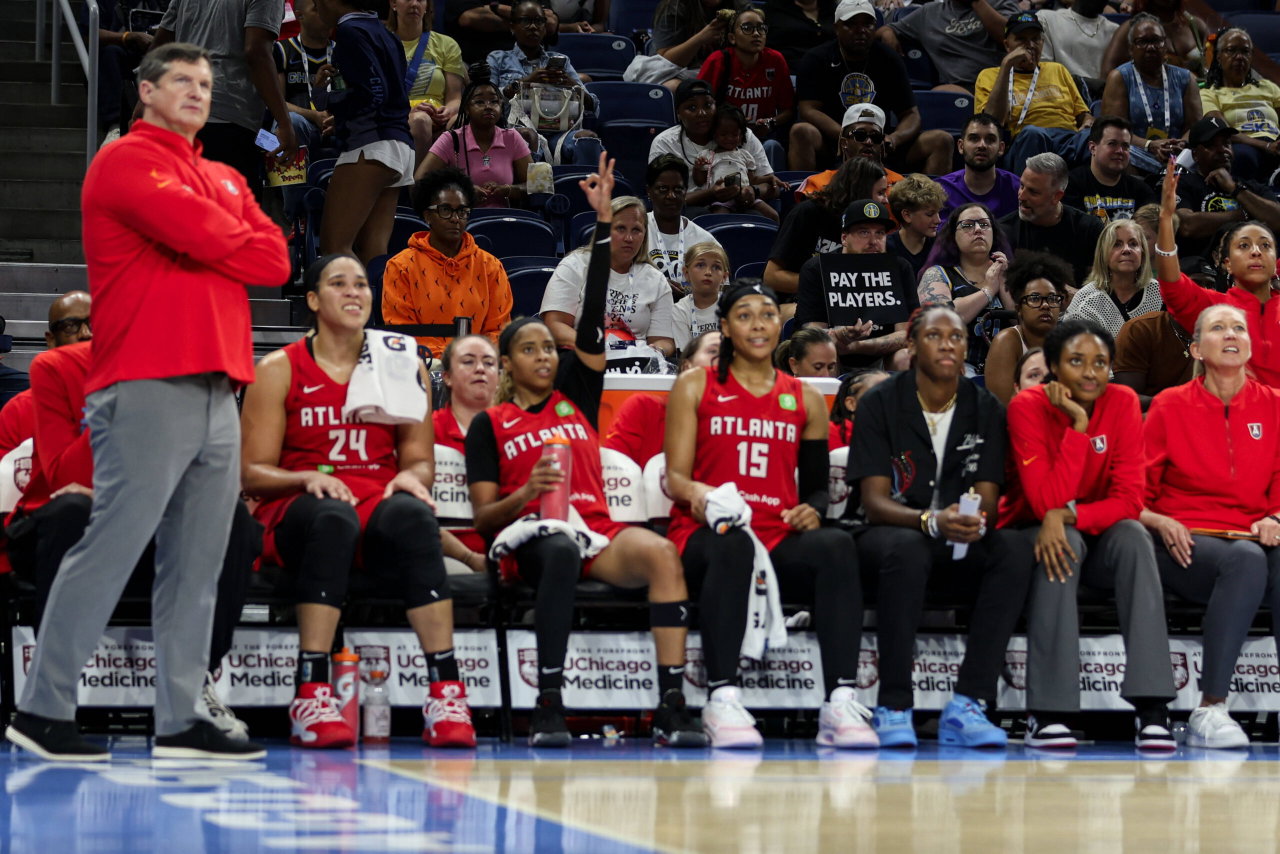
After the Game 5 win at Chase Center against the Atlanta Dream, Golden State Valkyries star Kiah Stokes echoed the team’s sentiment – they did not want to return for Game 7. The team intended to finish things with a Game 6 win, but the Dream’s Game 6 win at State Farm Arena forced both teams to return to Ballhalla. But things worked out for the Valkyries, who captured their first Championship in front of a packed 18,000+ home crowd. But the lack of support for the Dream led one fan to believe that a neutral location would be ideal.
Watch What’s Trending Now!
Instagram user coach_stephl wrote a comment about a possible neutral venue for such high-stakes WNBA events. The user had no idea the storm coming her way, as user @nosyone4 brought the debate to X by sharing a screenshot of the comment, mocking it. The original comment was a suggestion by the user coach_stephl.
“Games 7 should be played in a neutral place honestly. Atlanta had no support from the crowd, it was quite. WNBA needs to review this honestly. No one wants to lose home or away, so it should be neutral.”
Before their postseason clash, Golden State had already swept Atlanta 3-0 during the 2026 regular season. Two of those victories came at Chase Center, while the third was secured on the road at Atlanta’s Gateway Center Arena.
This regular-season dominance already established that the Valkyries could defeat the Dream at both venues. But the Finals are a different ballgame, with the brightest of lights and the loudest of fans. In such cases, a home crowd is always an advantage.
A neutral-site Game 7 could theoretically reduce the home-crowd imbalance, but it would also remove a significant benefit that teams earn through their regular-season performance and playoff seeding. Golden State secured the opportunity to host the deciding game through its regular-season position, while Atlanta faced the challenge of a winner-take-all road game.
But there are also other factors that have kept games in home stadiums.
The neutral-site debate ultimately ignores the fundamental structure of the WNBA Finals, which utilize a best-of-seven, 2-2-1-1-1 format. Under this system, the higher seed hosts Games 1, 2, 5, and 7. The lower seed hosts Games 3, 4, and 6.
Golden State entered the Finals as the No. 2 seed, while Atlanta entered as the No. 4 seed. Because of this seeding difference, Golden State earned home-court advantage for the decisive Game 7. Chase Center was the designated venue under the league’s existing format, not an arbitrary scheduling decision. And as Valkyries coach Natalie Nakase said previously in the season, Ballhalla served its purpose.
“Ballhalla is part of us. They’re our sixth man,” Nakase said late in September. “They roar when they’re supposed to roar, they’re hostile when they’re supposed to be hostile – almost to a point where we know we’re not going to be able to hear.”
The Golden State Valkyries, pushed on by their passionate fans, defeated the Atlanta Dream 68-63 at Chase Center in the league’s first-ever winner-take-all Finals Game 7. The historic victory was anchored by a phenomenal 30-point championship performance from Gabby Williams. But despite the home-court advantage, nothing could stop WNBA fans from flooding the comment section of the X post, mocking the neutral grounds suggestion.
Neutral venue debate draws strong reactions after Atlanta Dream loss
The X post received over 400K views, bringing further attention to the suggestion that future WNBA Finals Game 7s should be played at neutral venues. One can imagine the number of comments ready to tear the neutral venue debate to shreds.
One fan responded with heavy sarcasm regarding Atlanta’s venue history, writing, “😂🤣🤣🤣🤣🤣🤣🤣🤣🤣🤣🤣🤣 omg I’m howling. Win a few more reg season games ladies and you can have all the State Farm Arena scheduling conflicts you like.”
The commenter was suggesting that Atlanta needed to win more regular-season games to earn a higher seed and the corresponding home-court advantage. The reference to State Farm Arena also pointed to genuine scheduling complications during the Finals. Game 3 was moved from October 22 to October 21. Game 4’s tip-off was shifted from 3:30 p.m. to 1 p.m. to accommodate the Atlanta Hawks’ home opener, while Game 6 was moved from 8 p.m. to 12:30 p.m. to make room for the Hawks’ matchup against the Cleveland Cavaliers.
A second fan believed that this debate was happening only because the Dream lost, writing, “It’s funny because if Game 7 was in Atlanta & ATL wins, this would not be brought up 😂🤣.”
Another commenter took a sarcastic shot at the proposal, writing, “fairs let’s abolish playoff seeding advantages.”
The remark challenged the idea of removing home-court advantage from a decisive game while retaining the other benefits of regular-season seeding. The underlying argument was that hosting a potential championship-deciding game is one of the rewards teams earn by securing a better position in the standings.
This argument was supported by another fan, who wrote, “Lmfao that’s a coach? Does she want the regular season to be meaningless?”, pointing out that the original comment came from someone with ‘coach’ in their username.
Finally, one commentator seemed to sum up what the general consensus around the neutral venue debate was, as they wrote, “Where do people think the phrase ‘home field (court) advantage’ comes from? I’m dead.”
The home court advantage, coupled with some incredible performances, led to one of the most thrilling and close-fought WNBA finals. What began as a complaint about Atlanta’s crowd has now opened a wider debate over what a championship-deciding Game 7 should look like.