
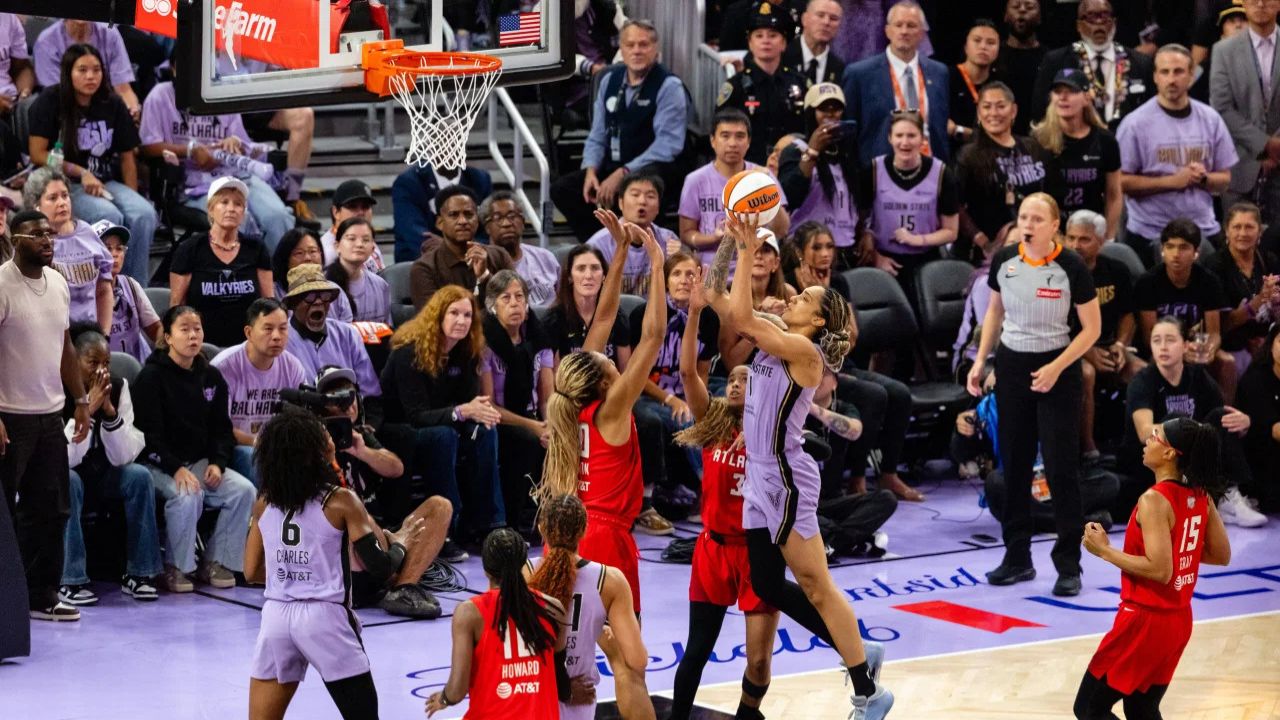
Questions lingered over how the league and the Atlanta Dream handled the logistics of the potentially title-deciding Game 6, with the venue and timing still undecided just a few hours before tip-off. However, the scheduling drama did little to dampen viewer interest, as Game 6 drew the fifth-largest audience in WNBA Finals cable history.
Watch What’s Trending Now!
Despite an unconventional 12:30 p.m. ET tip-off on Thursday, Game 6 still drew an average of 1.5 million viewers, according to Sports Media Watch. The viewership data, which includes Nielsen panel-only estimates from USA Network, E!, and SyFy, alongside Adobe Analytics streaming numbers from Peacock, ranks as the fifth-largest WNBA Finals audience in cable history.
Factoring in prime-time encore presentations on USA Network and CNBC, Thursday’s Game 6 averaged 1.7 million total viewers. This is only the second time USA Sports has hit 1.7 million for a rescheduled Finals game, matching the viewership from Game 3’s Wednesday night move.
To put that viewership into perspective, Game 6’s daytime average of 1.5 million viewers actually surpassed both Game 2, which drew 1.33 million in a prime-time slot on USA Network, and Game 5, which pulled in 1.43 million despite airing directly opposite a “Monday Night Football” broadcast and the World Series. This Game 6 viewership was also 4% higher than last year’s primetime, series-clinching Game 4 between Las Vegas and Phoenix.
A last-minute change to a daytime tip-off seemed like a sure way to kill the television momentum. Instead, Game 6 defied conventional broadcasting logic. The math didn’t favor daytime sports; Nielsen data provided to Front Office Sports showed that Thursday midday television audiences this month sat at just 40% of their primetime counterparts.
And it’s not just Game 6 that defied viewership expectations. A closer look at the television ratings for the WNBA Finals reveals a consistently strong audience pattern for all six games so far. Viewership peaked out of the gate with Game 1 drawing an average of 2.1 million viewers on NBC and Peacock.
The numbers dipped to 1.33 million for Game 2 (USA Network/Peacock), but rebounded to 1.71 million for Game 3 (USA Network/CNBC/Peacock), and then rose again for Game 4 with 1.895 million viewers tuning in across NBC and Peacock. Game 5 averaged 1.43 million across USA Network, CNBC, and Peacock.
Atlanta’s victory forced the first Game 7 in WNBA history. The winner-take-all matchup against Golden State tips off Saturday at 8 p.m. ET on USA Network and CNBC, with the Dream seeking their first championship.
All Signs Point To An Exciting Game 7 Matchup
When the Dream’s season hung in the balance on Thursday, Allisha Gray refused to let an injury write the final chapter. Playing through the pain of two dislocated fingers on her dominant shooting hand, the guard poured in a team-high 23 points to resuscitate her team’s championship hopes.
Before Game 6, Gray was mired in somewhat of an offensive rut, hitting just 28.1% of her shots and a frigid 19.2% from deep over the series’ first five games. But in Game 6, she buried 8 of her 12 attempts and matched her playoff career high with five crucial threes. Her individual resurgence breathed much-needed life into an Atlanta offense that had looked broken while scoring just 62 and 55 points over their previous two losses.
Gabby Williams had a night of two very different halves. A 1-for-9 start from the floor buried the Valkyries in an early hole, forcing Williams and Co. to play catch-up en route to her 26-point finish. But as Golden State packed their bags to leave Atlanta, Williams found a silver lining in the defeat: the grueling work they put in during the regular season guarantees they will have the ultimate edge, their home floor, when the championship is decided on Saturday.
“What’s great is we have another chance,” Williams said.
Atlanta’s late-game advantage put the Dream on the verge of forcing a Game 7, giving both teams one final shot at the championship.