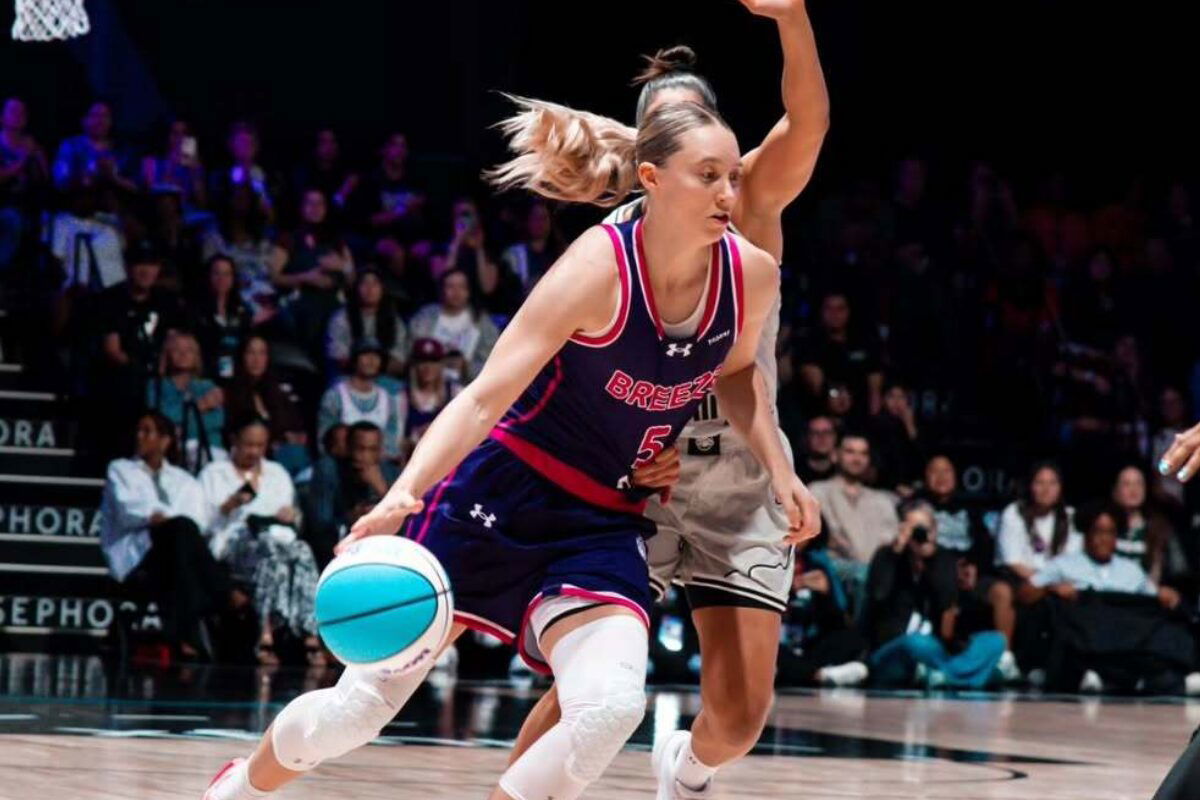
Imago
via @Breeze BC/Instagram
Imago
via @Breeze BC/Instagram
Imago
via @Breeze BC/Instagram
Imago
via @Breeze BC/Instagram
It always felt inevitable that Paige Bueckers would thrive in a 3v3 setting. With fewer defenders, her smooth handle, deadly mid-range touch, and pinpoint passing shine even brighter. Fresh off a Rookie of the Year season where she averaged 19.2 points, the offensive jump in Unrivaled was expected. What stood out instead was something else. Candace Parker came away most impressed by Bueckers’ defense.
Watch What’s Trending Now!
“You don’t know what you don’t know when you’re young, and that can be a good thing and a bad thing. I was very impressed defensively. I mean, Rickea is gonna play defense, but Paige Beckers…she stepped up and defended,” Parker said on the TNT Broadcast.
Paige Bueckers had a stellar debut, going up against Phantom BC. She had 24 points, 6 assists, and 5 rebounds to help the expansion Breeze to their first win in franchise history. Rickea Jackson added 16 points. Dominique Malonga had 15 points and 14 rebounds as they defeated the experienced trio of Aliyah Boston, Kelsey Plum, and Tiffany Hayes 69-62.
The youth of Bueckers and Co. actually helped them in a way, according to Parker. But Bueckers wasn’t a standout defender as a rookie in the W. She finished the season with a defensive rating of 107 and 0.055 defensive win shares, which fell in the middle of the pack. Those numbers were affected by the fact that the Dallas Wings as a team were the second-worst defensive team in the league.
Bueckers showed some resistance in Unrivaled against an experienced match-up like Plum. The Sparks guard went 5-17 from the field and 2-10 from the three-point line, totaling just 12 points. Note that Caitlin Clark struggled to guard the same Kelsey Plum at the Team USA Camp. The differences between the WNBA and Unrivaled become even clearer when the game slowed down to its most unforgiving area of the floor.


“I think the physicality. We all know that the W is physical, but Unrivaled, I feel like, is even more physical than that,” Bueckers said.
“Then not being able to have help side, like you’re basically on an island. So, at points, you’re gonna have to be okay with getting cooked. But that’s not to say like you’re not gonna wear defense with pride and try to just defend on the island and guard your yard and keep people in front of you.”
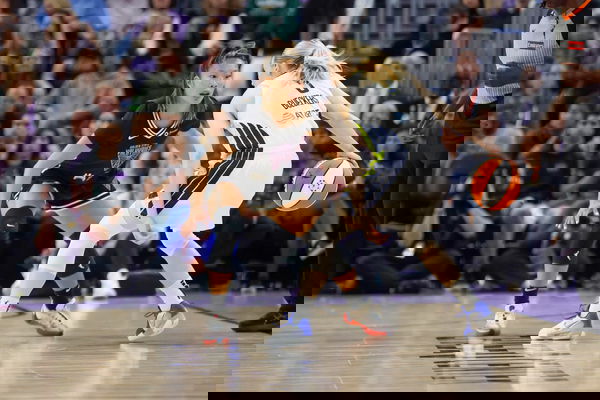
Imago
Shae Hammond/Bay Area News Group
While it might be counterintuitive that 3v3 ball in Unrivaled would be more physical than 5v5, the external conditions make it so.
Games are played on a condensed full court that’s 72-feet long and 49.2-feet wide. A WNBA court is 22 feet longer and less than a foot wider. And the 18-second shot clock is shorter than the WNBA’s 24-second shot clock. The tighter court and shorter clock lead to more physical play. There is not much time to think, so players often try to brute force their way to the basket.
You are more tired with more of the ball. A half-court set in a typical 5-on-5 game doesn’t always require every offensive player to be involved in the play. That’s not the case here.
Bueckers will often have the ball as the lead guard. Rickea Jackson might be setting a screen, or Dominique Malonga may be cutting to the basket. The physicality and spacing of Unrivaled didn’t just highlight Bueckers’ defense. But it once again exposed the one offensive skill defenders still haven’t solved.
Paige Bueckers Reveals the Key to Her Elite Midrange
Slowly but surely, the WNBA was moving away from the midrange much like the NBA. And analytically, it makes sense. If a player gets three points for making a 22-foot jump shot but only two points for a 22-foot jump shot, the three-point shot is undeniably the more efficient shot. However, Paige Bueckers operates exactly the opposite way.
As a rookie in the WNBA, Bueckers attempted 5.6 of her 15.1 shots per game from the midrange and shot 44.5% from that area. She made the second-most mid-range shots at 2.5 per game, with only Courtney Williams shooting 2.7. So what makes Bueckers master the shot that the rest of the world is moving away from?
“I think it’s going away from the game, so people don’t really know how to guard it because not many people shoot it. Not many people hunt mid-range shots. I think it’s the toughest shot in basketball to master,” she explained.
“So to try from a young age to get to the mid-range spot, make a lot of shots in that area, it’s just hard to guard. To be able to score at all three levels, it just makes you so much harder to guard. So, to be able to have that in my game, continue to keep working on it, finding different ways to get to that space, I think it’s tough.”
The bane of statistical efficiency moves away if you are just that good from the midrange. It assumes that one’s midrange accuracy is not as good as that from around the rim. At least, that is the average trend in basketball. Bueckers shoots 52% from the paint (non-restricted area), which is just a delta of 7.5%. Since it’s so rare, it’s also alien to defenders, which makes it a lethal weapon to possess.
Related Newsletters