
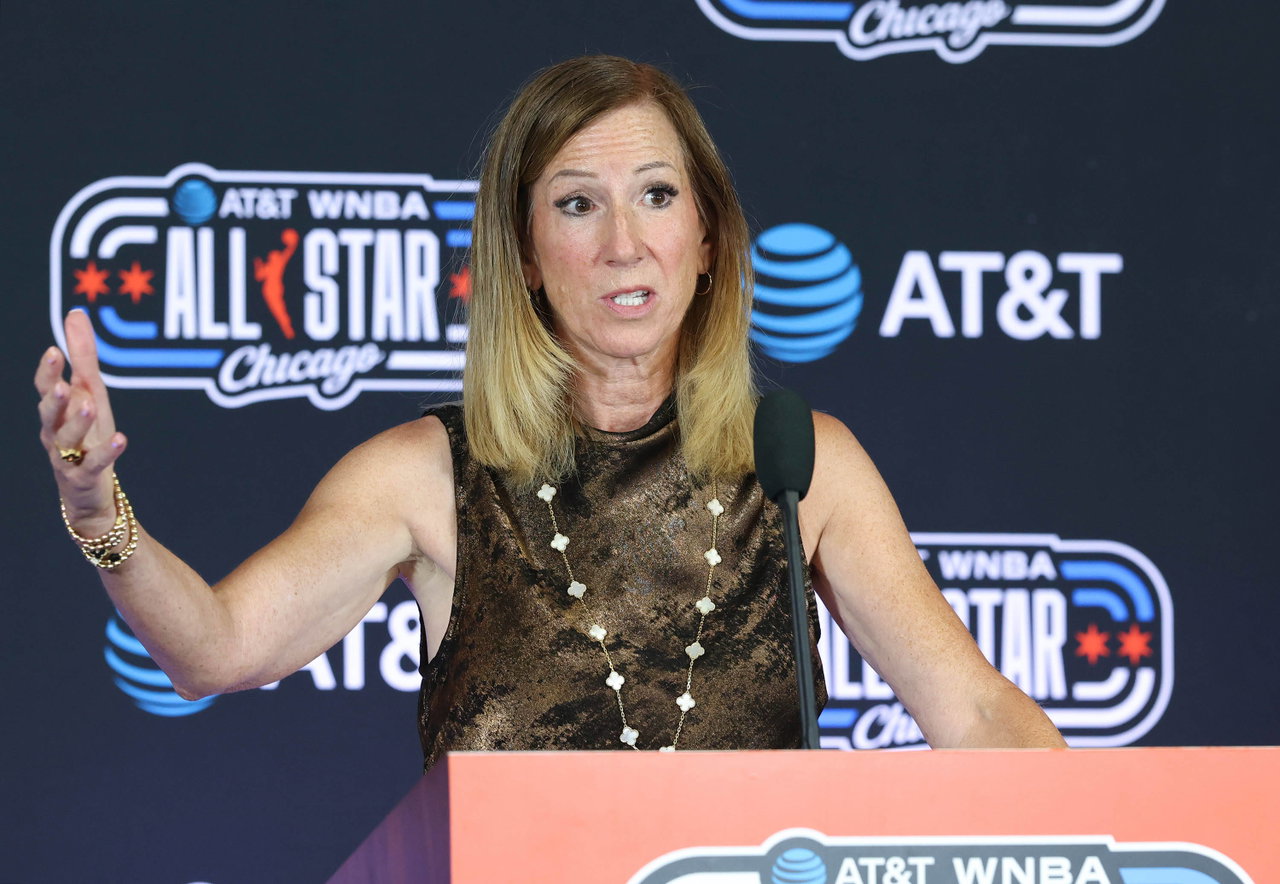
The fallout from Sophie Cunningham’s trans stance saw the WNBA embroiled in a huge saga amidst public debate and criticism. Protests erupted, and two former NBA players stated their intent to declare for the 2027 WNBA draft. The focus on this led to Commissioner Cathy Engelbert calling for a stakeholders meeting to address the issue.
Watch What’s Trending Now!
The task force, which comprised of team Presidents and GMs, met virtually Wednesday. They covered a range of issues, from online abuse directed at players to the question of transgender athlete participation, and shared the league’s stance on all matters to settle all the noise.
“Today’s meeting covered a wide range of topics, including ongoing discussions on transgender athletes and the continued hate and vitriol directed at players online,” the WNBA statement read, as shared by Cassandra Negley on X.
“We will continue to engage all league stakeholders in the coming weeks and months. We will approach these important conversations thoughtfully and in alignment with the values of our league.”
Beyond expressing the league’s willingness to keep engaging stakeholders, the statement made clear that the league sees no need to change its eligibility rules right now.
“There are no immediate eligibility matters affecting the WNBA, and we strongly denounce the bad-faith efforts to use these topics to demean or marginalize others,” concluded Wednesday’s statement.
The message showcases that the league sees its eligibility criteria under Article XIII as quite definitive. The exact line states that “only players who are women are eligible to play in the WNBA.”
Royce White and Enes Kanter Freedom aimed to counter this and declare for next year’s draft by stating that they identify as women, to force the league to either accept their draft declarations or clarify the eligibility criteria with greater detail.
No known transgender woman has ever played in the WNBA, though two known nonbinary athletes (Layshia Clarendon and AD Durr) have. This is a distinction that’s often lost in the broader debate but matters for understanding exactly what the league is and isn’t currently dealing with.
Over the last few weeks, prominent names have taken a stand, including Minnesota Lynx coach Cheryl Reeve.
Reeve has been one of the more visible voices on the inclusion side of the debate. She went as far as wearing a shirt reading “Trans Kids Belong” during the August 2 game against the Fever. It was quite a telling statement, as that was the first WNBA game that saw her in the same arena as Sophie Cunningham since July 21.
Both Cunningham and Reeve had a conversation ahead of the game. Later, in seperate media interactions, they explained that they appreciated the face-to-face interaction to share their point of view with each other.
It was a small but pointed sign of how far this debate has already traveled beyond the single July 21 ESPN interview.
Now, the league’s statement may have ended any debate for now, but the Commissioner added some more pointers in a memo.
Cathy Engelbert promised more discussion and debate
“We recognize that this is a complex and nuanced topic, and we will continue to have important conversations with all of you and the Players Association in the weeks and months ahead,” Engelbert said in the memo.
“We also plan to convene additional discussions and offer listening sessions for any team leaders who would like to participate. Your perspectives and feedback are invaluable, and I appreciate those who have already reached out to share their thoughts.”
Though the WNBA has come forward with a stance to silence the noise for now, the rulebook itself remains silent on the one unanswered point driving the debate.
What are the current eligibility rules in the WNBA?
Unlike leagues such as the NFL or MLB, the WNBA can’t set eligibility rules on its own. They’re negotiated through collective bargaining between the league and the players.
This could be why the league statement and Engelbert’s memo both dropped hints that this is not the end of the conversations among the stakeholders.
March 2026’s CBA does not have any further definition addressing gender identity or sex assigned at birth. Critics have pointed to that gap as a real flaw, arguing it leaves the league out of step with international sporting bodies and open to exactly the kind of ambiguity now playing out in public.
That gap looks starker next to what other governing bodies have already done.
In March 2026, the International Olympic Committee announced that eligibility for any female category event at the Olympics or other IOC events would be “limited to biological females, determined on the basis of a one-time SRY gene screening.”
The following month, FIBA, basketball’s global governing body, said it would adopt the same standard.
The WNBA, though, doesn’t have that option available unilaterally. Any change to its current standard has to go through negotiation with the Players Association, not a decision Engelbert or the task force can make on their own.
For now, the league’s position is that there’s nothing urgent to resolve, even as the conversation around it keeps building.