Imago
Trevor Ruszkowski-Imagn Images
Imago
Trevor Ruszkowski-Imagn Images
Labor negotiations are rarely predictable. But even by those standards, the ongoing CBA talks between the WNBPA and the WNBA have taken a turn that one veteran negotiator didn’t quite expect.
The league and the players’ union have spent months trying to hammer out a new collective bargaining agreement. Along the way, multiple internal deadlines were set to push the talks forward, but each one came and went without a solution. March 10 was supposed to be the moment everything came to a head, the final “do-or-die” date for a breakthrough. However, the negotiations have only intensified.
Watch What’s Trending Now!
Since that deadline passed, league officials and union representatives have remained locked in daily meetings, turning the talks into a marathon effort to finally bridge the gap between the two sides. By Monday, that stretch had reached its seventh straight day. And according to the union’s longtime outside counsel, Deborah R. Willig, the unusual length and intensity of the negotiations have stood out even in her decades of experience handling labor agreements.
“This has been an extraordinarily unusual set of labor negotiations, and I’ve been doing this for over 50 years,” Willig said as per FOS. “The why, frankly, is because the league underestimate seriously the resolve of the players and what they sought to achieve.”
WNBPA outside counsel, Deborah Willig expressed “hope” that a term sheet could be agreed to in the next 15-20 hours. But she also believed a deal would have been done by now.
The point: “This has been an extraordinarily unusual set of labor negotiations”…
— Annie Costabile (@AnnieCostabile) March 16, 2026
Willig has played a key role in major negotiations across women’s sports.
Alongside her partner Jessica Caggiano, she represented players during the most recent National Women’s Soccer League CBA negotiations. That agreement led to several landmark changes for the league and significant increases in player compensation, something they plan to achieve in the WNBA CBA negotiations as well.
And Willig believes the negotiations may be nearing a turning point. She remains hopeful that a term sheet can be agreed upon within the next 15 to 20 hours if discussions continue.
Revenue sharing remains the central point of contention in WNBA CBA talks
The current collective bargaining agreement between the league and the players officially expired on January 9 after two temporary extensions. The negotiation process began when the players voted to opt out of the agreement in October 2024, seeking a financial structure that better reflects the league’s rapid growth over the past two seasons.
As per a source familiar with the negotiations, the league has proposed a system in which revenue would be divided after expenses are deducted. Under that framework, the current projections would place the salary cap at roughly $6.2 million and allocate about 15.5 percent of gross league revenue to players.
However, the union has pushed for a different model, one that is based on gross revenue. Why? Because the players believe that approach would ensure they receive a larger share of the league’s financial growth, since they are the driving force behind it.
The union initially sought approximately 40 percent of gross revenue but has since lowered that demand to under 26 percent during the marathon talks that began last Tuesday. Meanwhile, the league’s latest proposal reportedly includes a share of net revenue that would, for the first time, exceed 15 percent of gross revenue.
For now, both sides remain at the negotiating table as discussions continue into another day.
Cathy Engelbert Signals Urgency as WNBA Faces Possible Schedule Disruptions
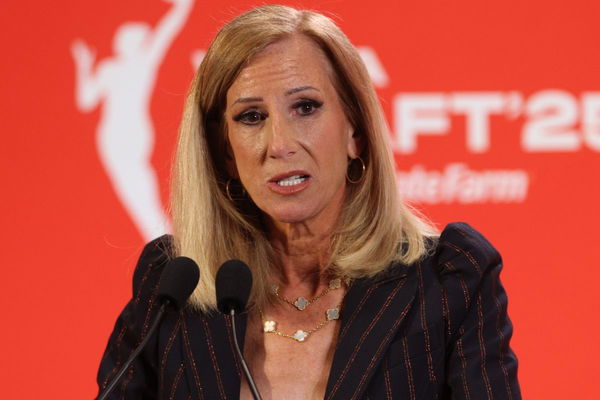
While the negotiations have stretched deep into the night in recent days, WNBA commissioner Cathy Engelbert has made it clear that time is becoming a factor as the 2026 season approaches.
During a break from Friday’s bargaining session, Engelbert indicated that the league needed a deal in place by Monday to avoid potential disruptions to the preseason schedule. She acknowledged that talks could stretch slightly beyond that window if necessary, but suggested there was little room for further delays.
Imago
Credits: Imagn
At the time, Engelbert said discussions might extend “24 to 48 hours,” but not much longer before the league would have to begin evaluating whether training camp could open on schedule.
However, by the end of Sunday’s session, uncertainty still lingered.
“I wish I knew the answer to that,” Engelbert said. “I do not know the answer to that. But you see us here, three in the morning, four in the morning, five in the morning. So that gives an indication both sides are motivated.”
But the potential ripple effects go beyond just training camp.
A delay in finalizing the new CBA could also complicate several key offseason milestones ahead of the 2026 season, including the expansion draft for incoming franchises in Toronto and Portland as well as free agency for more than 100 players across the league.
For now, the marathon negotiations continue with no official deal in place, with pressure mounting on both the WNBA and the WNBPA.
Related Newsletters