
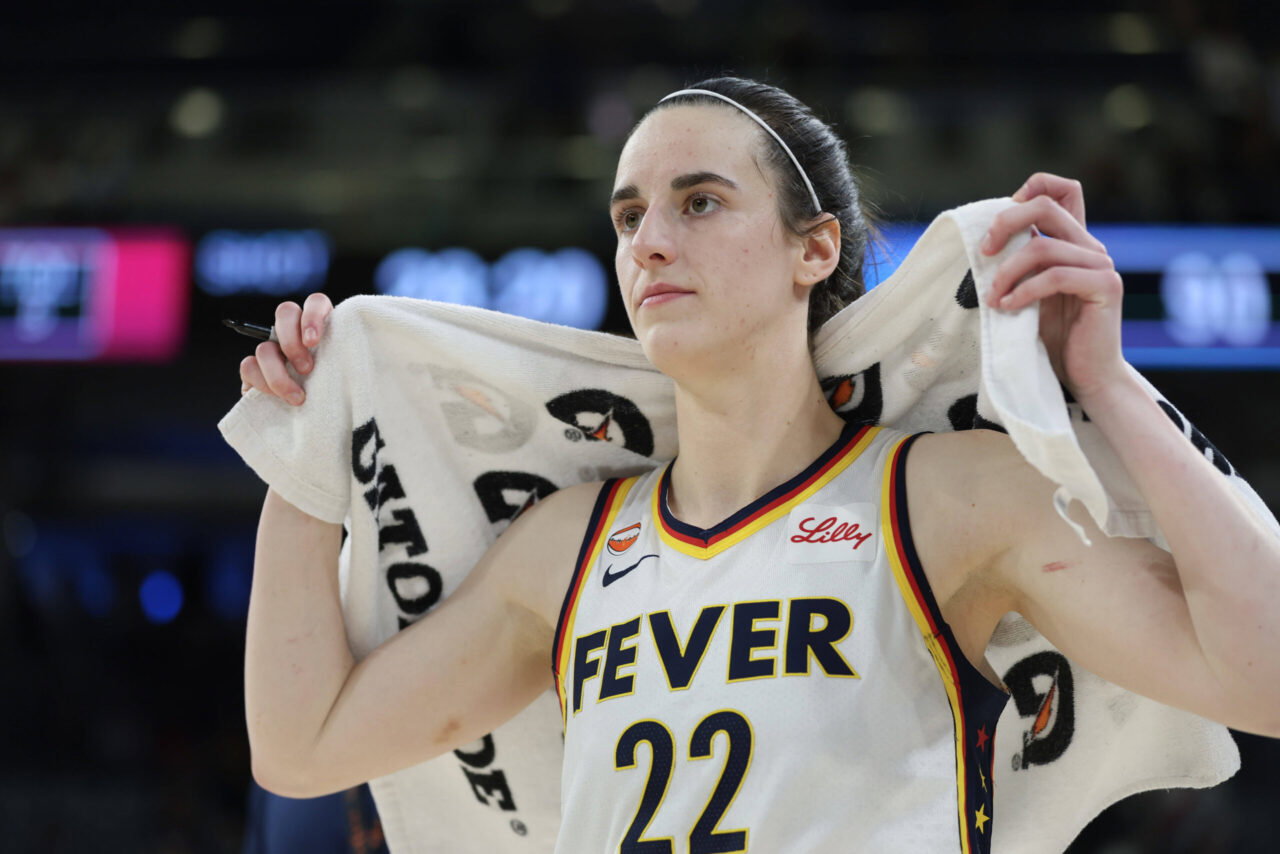
Caitlin Clark did not talk about scoring or spacing. On the latest New Heights episode, the Fever star pointed to the part of roster building most people skip: the end of the bench. After the 2026 CBA changed the rules, those spots are no longer salary filler, and Clark made clear that the teams treating them that way are the ones about to get caught.
Watch What’s Trending Now!
“A lot of that has changed because you have to carry 12 (players) now. So you can’t just cut somebody to open up more cap space. So player development is a huge, huge part of it,” Clark said.
The league and players saw many changes in this year’s collective bargaining agreement. One was that teams must carry a minimum roster of 12 players, marking a change from previous rules that occasionally allowed teams to carry 11 players to save money or manage top-heavy salary caps. In addition to the 12 standard roster slots, teams now carry two additional developmental player spots, which do not count against the team’s salary and could help add depth during injuries.
With teams needing 12 players, the WNBA draft becomes even more important, which Clark gave insight into for the Kelce brothers.
“Drafting is really important now. And also just like the development of your young players while they’re on their rookie deals, because they’re cheaper contracts. So, you want to get a lot out of them while they’re not as expensive. I mean, it’s the same in every professional sport,” Clark said.
With Clark’s comments on rookie players, there’s another financial angle here. The latest CBA introduced a new rookie salary scale, with the No. 1 overall pick earning a base salary of $500,000 (Azzi Fudd). This is a gigantic leap compared to what the top pick earned previously, between $78,831 and $85,873.
Meanwhile, the salary cap now stands at $7 million, up from $1.5 million last season, with maximum salaries reaching $1.4 million. Clark’s teammate, Kelsey Mitchell, had a one-year, $1.4 million supermax contract thanks to the latest CBA.
As we can see, the difference in rookie salaries compared to established stars means that even though rookie contracts are significantly more lucrative under the new agreement, productive young players can provide better value for teams that might run tight on the salary cap after the 12-player change.
In the 2026 WNBA season, no rookie was a better example than Olivia Miles. The former TCU Horned Frogs guard surprised everyone, winning Rookie of the Year and coming second in MVP voting, only behind A’ja Wilson after averaging close to 20 points, six assists, and 4.7 rebounds.
Roster building aside, Clark also talked about the Fever’s playoff collapse and what kind of player she wishes for the team to sign for next season.
“I think just continuing to construct the roster. Our third year was great, like we had the most talented offense in the league, but we really struggled defensively. So I think that’s our next step, getting a really good perimeter defender. I think that could help us go far,” the 24-year-old said.
Aliyah Boston is currently the only sure-shot defender the Fever have. However, they might be in luck with the upcoming free agency. While the future of one of their own in Mitchell is up in the air as an unrestricted free agent herself, the Fever could look for options like Napheesa Collier, a former Defensive Player of the Year who could immediately elevate the Fever’s sometimes non-existent frontcourt.