
Imago
Image Credits- IMAGN
Imago
Image Credits- IMAGN
Rivalries are a staple of any sport. Tom Brady vs. Peyton Manning, Larry Bird vs. Magic Johnson, Muhammad Ali vs. Joe Frazier, and so many more have improved the essence of their respective sports. For the WNBA to rise in 2024, Caitlin Clark vs. Angel Reese played a major part as well. And as 2025 came, another comparison involving Clark began making waves.
Watch What’s Trending Now!
Caitlin Clark arrived in the WNBA as the 2024 No. 1 draft pick, as the most popular college basketball star the league has probably seen. She broke multiple records in college and formed a particular identity because of her long-range shooting.
Then came the next No.1 pick, Paige Bueckers, also a point guard. She came off a national championship with UConn, the most decorated program in women’s basketball history, while being the undisputed best player in the country.
Following Caitlin Clark’s 2024 explosion in popularity and her immense impact, a much larger audience was eagerly waiting to watch what Paige Bueckers would do and whether she will be able to surpass Clark’s effect.
Still and all, while fans fight it out online and rivalries are said to be healthy, the real point gets lost in the noise.
Their College Journey Has Been Distinct
While the hype was similar, Caitlin Clark and Paige Bueckers had separate journeys as college basketball stars. Caitlin Clark joined an Iowa program under Lisa Bluder that is not traditionally a title contender. Paige Bueckers played for Geno Auriemma at UConn, which used to collect national championships like candies, but hadn’t for almost a decade.
Caitlin Clark absolutely dazzled for Iowa. In four years, she averaged 28.4 points, 8.4 assists, and 6.4 rebounds per game while breaking the Division I all-time points record, among a host of others. She also had her No. 21 jersey retired at the Carver-Hawkeye Arena and became an Iowa legend.
On the other hand, Paige Bueckers had a more bumpy road. After a historic freshman season in which she averaged 20 points, 5.8 assists, and 4.9 rebounds per game and became the first-ever freshman to be named AP National Player of the Year, she was hit with an injury crisis.

USA Today via Reuters
Apr 5, 2024; Cleveland, OH, USA; Iowa Hawkeyes guard Caitlin Clark (22) and Connecticut Huskies guard Paige Bueckers (5) react in the second quarter in the semifinals of the Final Four of the womens 2024 NCAA Tournament at Rocket Mortgage FieldHouse. Mandatory Credit: Kirby Lee-USA TODAY Sports
Injuries limited Bueckers to 17 games in her sophomore season. In April 2021, she underwent ankle surgery to repair an osteochondral defect, joint damage involving the bone and cartilage. She was cleared to play in October but suffered a tibial plateau fracture and a lateral meniscus tear again in December.
Bueckers had to work her way back, redshirting her junior season. However, she persevered and returned to the UConn squad, winning the title in her final season.
So, comparing the stats isn’t exactly apples-to-apples. UConn had more weapons and depth, while Iowa relied heavily on Clark to carry the load. Clark had more opportunities, and more responsibility, to put up big numbers, whereas Bueckers shared the spotlight with stars like Sarah Strong and Azzi Fudd.
The same goes for national titles. Clark led an Iowa program that had made one Final Four and played in back-to-back championship games. Bueckers, on the other hand, faced the pressure of expectations at UConn to win it all, and she delivered. Both players dealt with very different challenges during their college careers.
Caitlin Clark and Paige Bueckers Are Not the Same Point Guard
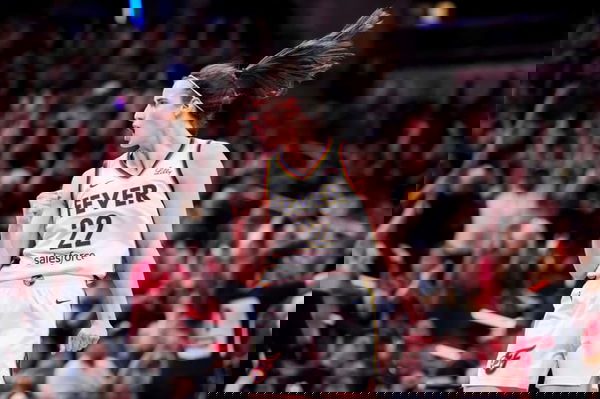
While being the floor generals of their respective teams, Clark and Bueckers don’t play the same game. Clark is a ball-heavy point guard who orchestrates the team, with much of her scoring volume coming from three-pointers.
For instance, she averaged 19.2 points, 5.7 rebounds, and 8.4 assists per game as a rookie while getting 47.3% of her points from beyond the three-point line. Her passing ability and vision are arguably the best in the league, and the gravity that her shooting range brings is unparalleled.
On the other hand, Paige Bueckers is the polar opposite. Her game is built more around efficiency, reads, and adaptable guard play. Bueckers can score on all three levels, but much of her volume comes from mid-range and paint play.
In her rookie season in the WNBA, she averaged 19.2 points, 5.4 assists, and 3.3 rebounds per game. She scored 63.4% of her points from within the arc and was second in the league in mid-range shots made per game (2.5).
Clearly, Bueckers does not need the ball in her hands to make an impact, as her off-ball play is elite as well. And going by her own words, she thinks teams don’t know how to guard mid-range shots, pushing her to develop her own style of lethal PG play.
USA Today via Reuters
Credit: Grace Smith/IndyStar / USA TODAY NETWORK via Imagn Images
As for their differences, Bueckers herself has made things clear.
“In all honesty, I don’t think me and Caitlin play at all alike,” she said.“But I understand growing up in the same class, the same generation, both guards… I don’t know, but I don’t think we play alike.”
Clark and Bueckers Entered Separate Team Timelines
Caitlin Clark was drafted No. 1 by a very lucky Indiana Fever, while Bueckers went to the Dallas Wings. Clark’s Fever was already on the verge of exploding after drafting Aliyah Boston in 2023. They also had veteran Kelsey Mitchell on the squad.
In her rookie season, Boston averaged 14.0 points per game, while Mitchell pitched in with 19. That’s not to say Clark didn’t level up this team, which won 13 games in 2023, but it was better set up than it was for Bueckers.
The Wings’ point guard had little to no support. The one player that could have paired up with Bueckers, Arike Ogunbowale, had a career-low season. Maddy Siegrist played only 26 games and was recovering from a major injury. The management was a mess, and Chris Koclanes, a first-time Head Coach, failed to deliver on expectations.
The Fever, though, dove in big-time and hired Stephanie White, the coach who had led the Indiana Fever to their last playoff appearance in 2016. So, there is a reason why the Indiana Fever reached the playoffs without Clark amid their injury crisis this season. The Fever’s management has made better roster decisions so far.
Bueckers and the Wings can improve from here. They have the No. 1 draft pick in 2026 and a chance to refresh in free agency.
It’s Unfair to Compare the Business Impact of Caitlin Clark and Paige Bueckers
Another point of comparison between the two is the massive cultural and business impact Caitlin Clark had as a rookie. The CC effect began in her college years, as she was announced the “GOAT of TV Ratings” by The Wall Street Journal.
The 2024 national championship game, where Clark played against South Carolina, again set the women’s college basketball viewership record with 18.9 million viewers. It was the most-watched basketball game since 2019.
Clark had a similar impact on the WNBA. Clark’s first WNBA game with the Indiana Fever drew about 2.13 million viewers, the highest WNBA TV audience since 2001 and the biggest ever on cable.
For Bueckers, also, the impact was there.
Dallas Wings CEO and Managing Partner Greg Bibb said that the organization “sold merchandise in all 50 states and 23 different countries since drafting Bueckers,” before Bueckers even debuted in a Wings shirt.
He added that the Wings “earned more revenue from individual ticket sales in the last month than the organization did all of last season, which was a record year for Dallas.” However, the impact was not as drastic as Clark’s.
Still, it is important to consider that Caitlin Clark did not have a competing superstar when she entered the league. The league instead needed a trigger, and Clark became that. Bueckers, though, of course came into a league that had already become a point of national conversations.
In conclusion, both players are impressive in their own ways, and it’s probably a matter of preferences. Some prefer the flashy passing and shooting of Clark, while others prefer the clean, butter-like handles of Bueckers.
And the Caitlin Clark–Paige Bueckers debate says more about how fans consume sports than how either player actually performs. The WNBA doesn’t need one face or one style to grow, it needs contrast. Clark’s range and playmaking pull new audiences in, while Bueckers’ efficiency and versatility raise the basketball standard. Comparison is inevitable, but it’s their coexistence that truly pushes the league forward.
Written by

Edited by

Shreya Singh