
The quality of player that Caitlin Clark is has long since moved beyond debate. Her commercial force, however, is something that a certain segment of people have been slower to fully acknowledge, despite the market making the case louder and louder with every passing month.
Watch What’s Trending Now!
The viewership numbers, attendance figures, revenue streams, and merchandise sales all tell the same story: as far as the WNBA is concerned, nobody comes close to what Clark generates off the court. And increasingly, that dominance is no longer contained within the WNBA. It has crossed over into NBA territory in a way that would have seemed unthinkable just a few years ago.
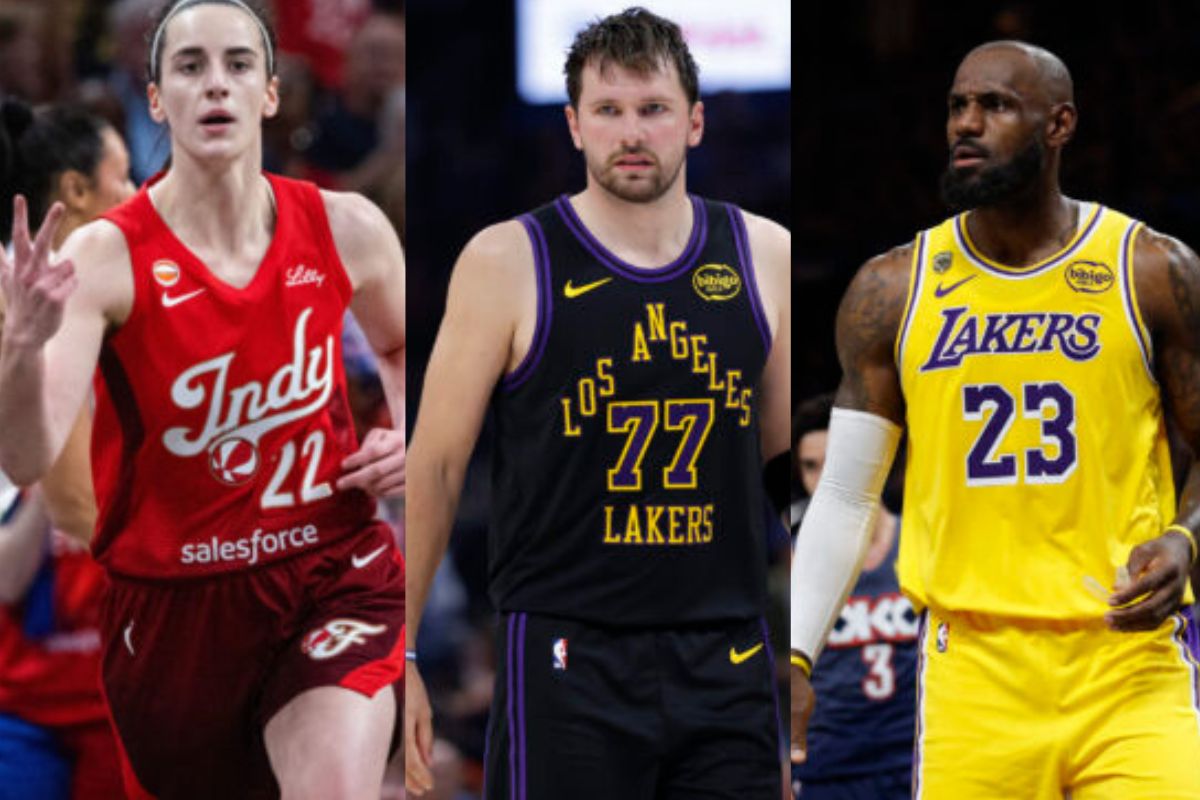
Data tracking total U.S. basketball jersey sales by Fanatics since 2024 reveals that Clark has officially surpassed LeBron James in merchandise sales. She sits in second place overall behind only Stephen Curry, with LeBron, Luka Doncic, and Victor Wembanyama rounding out third, fourth, and fifth, respectively.
And the evidence of what built that position is well documented. Caitlin Clark‘s Indiana Fever jersey sold out in less than an hour after she was selected first overall in April 2024. That was the fastest-selling draft-night jersey in Fanatics history across any sport.
Her limited-edition All-Star jerseys, priced at $130, also sold out in 15 minutes during her rookie season. And her individual sales catalyzed a staggering 1,000% year-over-year increase in WNBA player-specific merchandise, a number so large it almost reads as a typo until you look at the broader context around it.
The accumulated weight of all those milestones is what has produced her current position in the sales rankings. And it is not a small feat by any stretch of the imagination. LeBron James has spent over two decades constructing one of the most powerful global empires in the history of professional sports.
For a WNBA player, a league historically constrained by smaller broadcast footprints and limited retail reach, to surpass him in merchandise revenue is an unprecedented disruption of sports retail history. Nothing quite like it has happened before.
Simply put, Caitlin Clark is not just the most commercially powerful player in the WNBA. She is one of the most commercially powerful athletes in American sports, full stop. And given that she is still only in her third professional season, the full scope of what she will eventually represent economically may not yet be fully visible.
Caitlin Clark Is Driving Basketball Ratings to Levels That Rival the NBA
Caitlin Clark’s jersey sales are far from the first time her economic footprint has transcended women’s sports and eclipsed the men’s side of the game. Perhaps the most striking earlier example came during her college days, when for the first time in basketball history, the NCAA Women’s National Championship out-viewed the Men’s National Championship.
Driven by Clark, the women’s final averaged 18.9 million viewers and peaked at over 24 million, comfortably surpassing the men’s final between UConn and Purdue, which drew 14.8 million.
Right now, her most anticipated regular-season games routinely clear the 2 million viewer mark. This includes her highly publicized rookie matchups against the Chicago Sky, which drew 2.7 million. Also, the 2026 season-opening game against the Dallas Wings, which pulled in 2.49 million.
For context, standard non-marquee NBA national broadcasts on ESPN and TNT routinely average between 1.2 and 1.6 million viewers. This means Clark’s high-profile games are drawing roughly 30% to 50% more than standard NBA regular-season programming.
Another notable one was during regular-season broadcasts on NBA TV in 2025, matchups featuring Clark and the Indiana Fever averaged roughly 624,000 viewers.
This mark is 150% higher than the network’s standard NBA regular-season broadcast average, which trends at 249,000 viewers. That 624,000 baseline turned out to be the third most-watched WNBA game in the entire history of the NBA TV network.
Overall, Clark is not just lifting the WNBA. She is, in measurable and documented ways, driving basketball viewership to levels that rival, and in some cases exceed, the NBA’s regular-season standard. For a league that spent decades fighting for mainstream recognition, that is not a small achievement.