
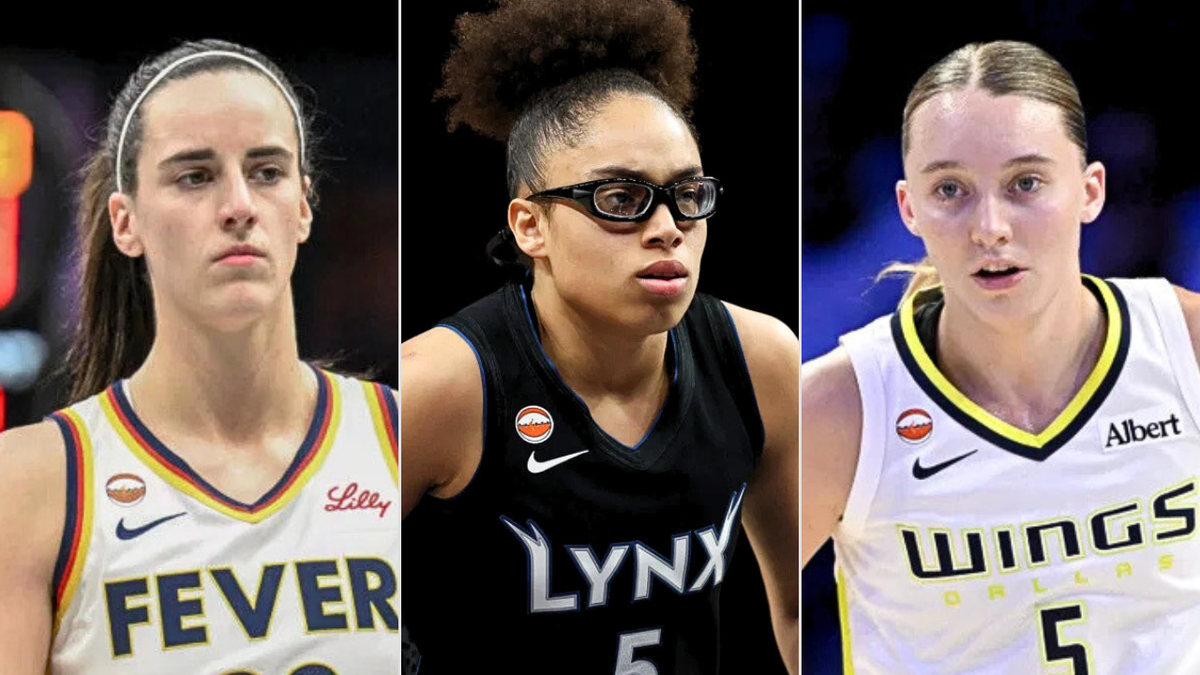
Sue Bird. Lindsay Whalen and Ticha Penicheiro. Three names that shaped the WNBA at one of its most vital positions. The trio of hall-of-famers carved their faces onto the Mount Rushmore of point guards during a period in the 2010s that’s considered a heyday for the 1 position.
Watch What’s Trending Now!
It turns out, they were simply laying the groundwork for a future generation that’s elevated guard play to another level. Welcome to the Golden Era of point guards, where on any given night in the WNBA, you can almost certainly find an elite-level floor general at work.
Their names on the backs of their jerseys are becoming household names, from Caitlin Clark, Paige Bueckers and Sabrina Ionescu to Olivia Miles, Chelsea Gray and Kiki Rice.
And more are on the way.
THEN VS. NOW
Back in 2010, just one point guard in the entire WNBA averaged more than six assists per game (Penicheiro, 6.9 APG). Today, you’ll find seven players north of 6.0 APG, with three others close behind.
Bird’s 5.8 APG back then, for example, would currently tie her for eighth in WNBA this season with Paige Bueckers and Jessica Shepard of the Dallas Wings, as well as the Golden State Valkyries’ Veronica Burton.
Where Bird (5.8 APG), Whalen (5.6 APG) and Penicheiro (6.9 APG) excelled in distributing the ball, the point guard era of the time was defined by passing, rather than scoring. Together, that triumvirate of PGs combined for 18.3 APG.
To put that in perspective, it’s a month into the 2026 season and Clark, Miles and Bueckers are already averaging a combined 20.1 APG, meaning that three players within their first three seasons in the league are currently outpacing what was previously considered the gold standard for point guard play.
So About That Scoring Prowess
The scoring leap from 2010 to the present day parallels the assists margins. Clark leads point guards with 19.9 PPG, followed closely by Bueckers’ 18.3. PPG and Miles 15.0 PPG, earlier this month.
In 2010, not a single point guard posted an average of more than 15.0 points per contest, and not a single one finished among the top-10 in league scoring that season.
So what changed? What were the catalysts behind the evolution of the position in a WNBA where seven of its 15 teams (46.7 percent of the league) now boast an elite point guard?
EVOLUTION IN FRONT OF OUR EYES
The three-point shots began to fall, and so did the notion of the WNBA point guard as simply a ball distributor.
Guard play has become vital in a league that spreads the floor unlike ever before. Three-point attempts have nearly doubled since 2000, rising from 12.7 per game to 24.5 so far this season.
League pace is also up an average of 9.3 possessions per game to 79.0 possessions during that same timeframe.
But the starkest result of having nearly 10 more possessions per contest and a point guard who can both score and dish it out can be found in league scoring. It rose from 69.0 PPG at the turn of the century to a resounding 85.2 in 2026.
On the hardwood, the game evolved to be faster and thus more point guard-dependent.
The significant improvement in three-point shooting helped inside the arc, as well, creating driving lanes and a multitude of foul and free throw opportunities.
THE PIPELINE REVOLUTION
The evolution of the point guard position is taking place long before players hit the parquet of the WNBA. Or even the collegiate ranks, for that matter.
Stars such as Clark and Bueckers have been developing in modern WNBA-type systems since their early teens. By the time they’re ready for the pros, they’ve already bagged more experience than Bird or Dawn Staley were ever afforded.
INTERNATIONAL – Another pipeline that’s opened up by the WNBA’s new CBA is the one between the league and the international game. With the salaries now being comparable, the gates are open to an entirely new class of talent.
Look no further than Jovana Nogic of the Phoenix Mercury and the New York Liberty’s Pauline Astier, who have kicked down the door among the first wave of international players now flexing their skills in the WNBA. And many more are right behind them, getting their visas in order.
RULES SHIFT – It took some bumps and bruises, but the WNBA finally addressed its physicality issue this offseason by instituting a crackdown on rough play. These new interpretations of the rules have benefited scoring, particularly among playmakers such as point guards, who are discovering a newfound freedom.
There isn’t one sole reason for the dynamic improvement among point guard talent. But better development, combined with the emergence of an untapped international market and a game that’s been opened up, and you start to wonder just how well a player like Bird or Staley would have fared in today’s game.
THE SEVEN
Seven point guards are putting their stamp on the new era. Here’s a breakdown of their prowess.
Caitlin Clark, Indiana Fever – The face of the WNBA, Clark is living up to the hype. The Fever point guard became the fastest player in league history to reach 500 career assists, needing 59 games (23 fewer games than Bird’s 82, and 25 fewer than Ionescu’s).
Paige Bueckers, Dallas Wings – The Dallas Wings sit at 9-5 with Bueckers at the helm at one of the league’s most efficient offenses. Bueckers is averaging 18.3 PPG and cementing her legacy as the most complete two-way point guard among her draft class. It’s just Year 2 for the point guard, but her ceiling is nowhere in sight.
Sabrina Ionescu, New York Liberty – Ionescu is the pioneer of the modern era of WNBA point guards. The Liberty’s record-holder for made-three-pointers and the fastest player to 400 career three-pointers was among the first to prove that a point guard could be a franchise centerpiece in the post Bird era.
Olivia Miles, Minnesota Lynx – As crazy as it might sound, the Lynx landing Miles at No. 2 overall in 2026 might have been a steal. Miles became the first player since Bird and Candace Parker to post 10-plus points and 5-plus assists in each of their first three career games. In short, Miles loudly announced her arrival and dominance courtesy of 15.0 PPG and 6.2 APG.
Chelsea Gray, Las Vegas Aces – Chelsea Gray is the veteran of the new golden era. In 12 years of service and counting, Gray has earned the respect of the league, winning the GM vote for best point guard with 73 percent. She’s sitting at fourth in the league in assists with 6.8 per game and scoring 13.3 PPG, her highest average since posting 15.3 during her All-WNBA Second Team 2023 season.
Jordin Canada, Atlanta Dream – Canada might be the shortest in the new era of point guards, but she arguably packs one of the biggest resumes. Her 5-foot-six frame hasn’t deterred her from becoming a two-time league champion with the Seattle Storm and a menace on both ends of the court where she’s a two-time WNBA All-Defensive First Team honoree and league steals leader (2019, 2023). She’s an influential veteran in the new point guard era and is still putting up elite numbers in Year 9 with 11.6 PPG, 6.7 APG (No. 5 in WNBA) and 2.1 steals per game.
Kiki Rice, Toronto Tempo – Rice could be considered the sleeper of the 2026 Draft Class. She made the most of her debut with zero turnovers in the very first game with Toronto. Since then, Rice has gone on to shoot nearly 39.1 percent from three-point range during her first month in the league. Her ceiling is high, and she could easily become the face of the expansion Tempo.
THE COMING TSUNAMI
Clark, Bueckers, and company are just the first wave of talented point guards expected to flood the WNBA in the coming years.
Hannah Hidalgo might be among the best of all of them. The Notre Dame point guard is averaging 25.0 PPG, 5.2 APG, and 5.6 steals per contest as the No. 2 overall prospect in the 2027 WNBA.
Draft, should the junior declare. Her biggest impact, however, could be on the defensive end, where many argue that she could be one of the best defensive prospects of her generation.
Close on Hidalgo’s heels is one of the deepest point guard classes ever. The 2027 draft will also be a fight to see who can land the likes of Jaloni Cambridge (Ohio State), S’Mya Nichols (Kansas) and Mikaylah Williams (LSU). All three possess lottery-caliber talent.
As mentioned above, the international pipeline is also now wide open. Through the end of May, there were 32 Europeans from 15 countries who have suited up in at least one WNBA game this season. That’s 14.8 percent of all player appearances, which currently overshadows the previous international peaks of 12.3 and 12.0 percent in 1998 and 1999, respectively.
The wave of point guards is coming. For argument’s sake, should all four or more of the above prospects or international players pan out, that would give nearly a dozen of the league’s 15 teams an elite-level point guard.
THE LANDING
Sue Bird would have been Sue Bird in any generation. Same with Lindsay Whalen and Ticha Penicheiro.
They put the point guard position on the map in the WNBA.
And while their remarkable careers intertwined, they didn’t arc at the same time. Not like the new era of point guards who are revolutionizing how the position is utilized.
The scary notion is that this first wave might very well be the ground floor for the talent threshold of point guards, rather than the ceiling.