
Imagine a diehard fan fulfilling his lifelong dream when he meets his icon. But that excitement quickly turns to disappointment when the star, whose footsteps he hoped to follow so keenly, displays behavior that appears to contrast with his public image and persona.
Watch What’s Trending Now!
Tony Jeffries experienced something similar after winning a bronze medal at the 2008 Summer Olympics in Beijing. What was supposed to be a memorable meeting with Floyd Mayweather Jr., who dominated the boxing world at the time, turned into an encounter Jeffries still finds difficult to forget. In a recent interview, the former professional from England, who has since become one of the world’s biggest boxing influencers, recalled the experience that shaped his opinion of Mayweather.
“When I met Floyd Mayweather, I went to his gym in Vegas, and I was a big fan at the time, just after the Olympic Games, and someone invited me there to meet him,” Jeffries told The Content Cast. “And he came into the gym; I was there waiting, all nervous as a fan. Even though I was there, I had never had an Olympic medal, but I’d just won the Olympic medal, and people knew I was there. But he’d come in the gym and he’d walk around and he shook every person’s hand in the gym.
“And then he’d come to me, and he’d look me up and down, and he’d go, ‘Who the f–k’s this white boy?’ And I was like, ‘I’m Tony, Floyd. I won the Olympics, and I got a red medal, the same as you.’ And he just walked away. And I was thinking ‘You f–king prick. You absolute prick, mate.’ I just couldn’t get my head around what just happened there.”
Jeffries’s frustration stemmed from the fact that he was a young, impressionable fighter who, as a 23-year-old young man from Sunderland, England, had made his country proud by winning a bronze medal in the light heavyweight division. Given that achievement, receiving an opportunity to meet one of his idols was an unforgettable moment.

Imago
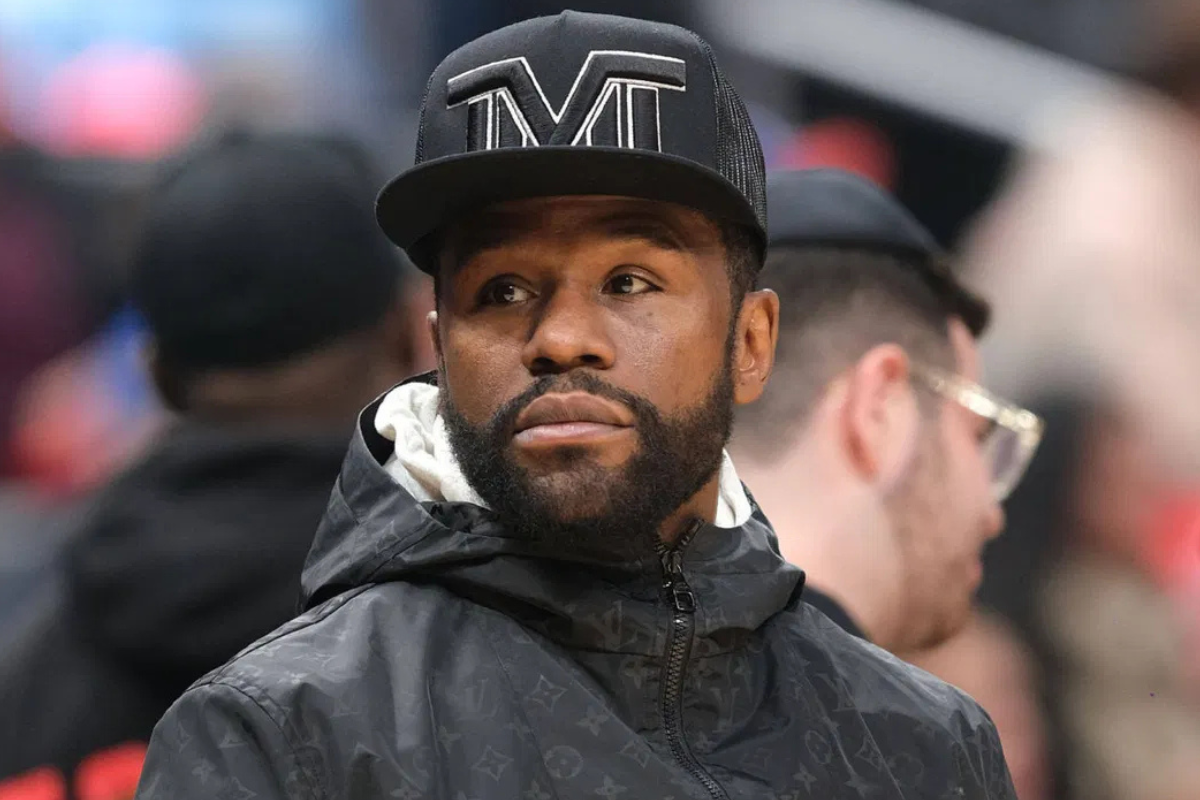
LOS ANGELES, CA – DECEMBER 21: Floyd Mayweather looks on before a NBA, Basketball Herren, USA game between the Charlotte Hornets and the Los Angeles Clippers on December 21, 2022 at Crypto.com Arena in Los Angeles, CA. Photo by Brian Rothmuller/Icon Sportswire NBA: DEC 21 Hornets at Clippers Icon221221058
A few words of encouragement from Mayweather, who himself had won the bronze in 1996, could have boosted his confidence and helped him in the professional journey that came to an end only two years after he made his debut because of recurring hand injuries.
A second career saw Jerries transition into coaching. He started operating a gym in Santa Monica before embarking on a journey that saw him train a string of prominent names, including former UFC fighter Brendan Schaub. More recently, he has been traveling around the world, offering an array of boxing courses for people interested in training and other fitness programs.
Yet, despite those achievements, he still finds it difficult to forget that meeting with Mayweather. Part of the reason for his disappointment lies in the way he later reflected on the encounter. Instead of Mayweather, he was greeting visitors inside the gym. Jeffries that he would likely have faced severe criticism if he, alongside a group of white men, had met Mayweather, an Olympic bronze medalist like himself, and asked, “Who the f–k’s this Black guy?”
Thinking about that hypothetical scenario further shaped his opinion of the boxing icon, who is also preparing for a comeback, including a proposed rematch with former opponent Manny Pacquiao.
Although Mayweather has previously said, “I’m not racist; I’m just saying racism still exists (in boxing),” some of his public comments have, over the years, attracted criticism for being racially insensitive.
The remarks that continue to shadow Floyd Mayweather Jr.
One of the most widely discussed examples occurred years ago when, as a host on the defunct Ustream, Mayweather directed racially charged remarks at Manny Pacquiao, whom he would eventually fight in 2015. He referred to Pacquiao as a “wh-re” and a “midget” and suggested that the Filipino star could be using performance-enhancing drugs and altered his surname to “Poochiao.” He also remarked that Pacquiao, despite not being Japanese, could make him a sushi roll and cook some rice.
The comments drew widespread criticism, after which Mayweather reportedly apologized.
Jefferies is not the only prominent figure to have criticized Mayweather over remarks related to race. UFC CEO Dana White also spoke publicly following Mayweather’s comments about New York Knicks point guard Jeremy Lin.
While acknowledging Lin, an Asian American Harvard graduate and a talented player, Mayweather suggested that Lin was getting all the attention and hype because he was “Asian.” In comparison, despite putting the same level of effort, Black athletes struggled to receive similar recognition, he argued in a tweet.
Responding to those comments, White said in an interview, “First of all, what (Mayweather) said, I think, is racist. He’s made a couple of racist comments. And yes, Floyd, you’re racist with the stuff that you’ve said.”
There have been numerous instances across sports in which prominent athletes have disappointed fans during personal encounters. However, taking Tony Jerries’ account into consideration, it is equally important to remember that this remains his personal account of the incident. No public clarification or response from Mayweather appears to have surfaced.
For that reason, it is appropriate to view Jeffries’ recollection as one person’s experience.