

Oleksandr Gvozdyk’s career seems to have run its course. Coming off defeats, which included losing his WBC light heavyweight title to Artur Beterbiev before David Benavidez crushed his attempt to secure an interim title, the Ukrainian hoped to gain momentum by joining Zuffa Boxing.
Watch What’s Trending Now!
But, as it happened, things really did not improve. After suffering a loss on his promotional debut, the Ukrainian, who won a bronze medal at the London Olympics, revealed that he had been cut from Dana White‘s boxing promotion.
“They terminated the contract in February after a loss,” Gvozdyk told popular Ukrainian MMA and boxing outlet vRinge. “That is, every promoter has the option that if a boxer loses, they have the right to terminate the contract. That’s exactly what they did.”
Those comments follow the fight that took place at the Zuffa Boxing 02 on February 1. Headlined by former title holder Jose Valenzuela and Diego Torres, the card, featuring Serheii Bohachuk vs. Radzhab Butaev in the co-main event, had Gvozdyk facing Serbian American fighter Radivoje Kalajdzic on the main card.
Taking control early, the Ukrainian dropped Kalajdzic with a left hook and straight-right combination. As the rounds progressed, Gvozdyk was ahead of the Serbian on the scorecards. But with barely ten seconds remaining, the situation quickly changed in the seventh round when Kalajdzic knocked out Gvozdyk with a powerful right.
Imago
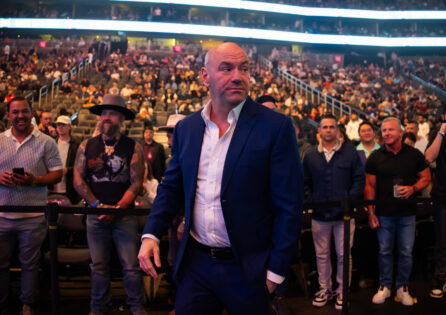
MMA: UFC 300 – Pereira vs Hill Apr 13, 2024 Las Vegas, Nevada, USA UFC president Dana White in attendance during UFC 300 at T-Mobile Arena. Las Vegas T-Mobile Arena Nevada USA, EDITORIAL USE ONLY PUBLICATIONxINxGERxSUIxAUTxONLY Copyright: xMarkxJ.xRebilasx 20240414_mjr_su5_008
Reflecting on the setback, the Ukrainian, who once trained alongside stars Oleksandr Usyk and Vasyl Lomachenko and was part of the nation’s golden era of amateur boxing, said, “I was winning. I could see in his eyes that he was already looking for a corner to capitulate. In moments like these, you sometimes start to neglect defense. And light heavyweight is a division where people hit hard. I wanted to finish the fight. It seemed like a stoppage victory was just around the corner. It turned out that wasn’t the case.”
Initially, everyone appreciated his performance. Feeling motivated, he resumed preparations for the next outing after a brief rest. But by April, things took an unexpected turn.
“They told me I’d received an email terminating the contract,” he added.
Gvozdyk revealed the move came amid his push for a rematch with Kalajdzic.
What may add a layer of intrigue to the situation is how Gvozdyk previously told Boxing Social during an interview that Zuffa told him they were impressed by his performance against Kalajdzic.
Gvozdyk had his reservations about Dana White’s boxing experiment
But despite that, he remained uncertain about his future, as he said, “They have now been in touch with my manager, and they are looking for me to come back at the end of May or middle of June. I’ve requested a rematch against the same guy, but I don’t know if they are going to approve it or not.”
Gvozdyk also spoke about the culture in Zuffa Boxing, revealing how, unlike other traditional promoters where one person is assigned a single task, under Dana White, the team in boxing’s newest promotion has several people taking care of one job. They work like an army unit, the Ukrainian said.
Despite White’s much-publicized stance about working with rival promotions and other sanctioning bodies, Gvozdyk still joined Zuffa because, at age 39, he realized there were not many options left for him in his career. The financial aspect further compelled him to join Zuffa’s roster.
One point from that interview that now ties closely to his current situation came when Gvozdyk remarked, “I haven’t met Dana White; I saw him from a distance, but I saw him; he didn’t see me. I think they will use the same model they used in the UFC for boxing.”
That point is relevant because, while Gvozdyk could be the first boxer to have been cut from the Zuffa roster, cutting fighters is standard practice in the UFC, where even those with considerable tenure can be removed from the roster.
The promotion deserves the benefit of the doubt, as, being a for-profit organization, it is answerable to shareholders and has to protect its profit margins. That goal demands that the promotion frequently check its roster and remove fighters who are either on a losing streak or, more significantly, have little to offer in terms of future prospects.
Taking that aspect into account, since Zuffa operates under the same management and appears to work more or less like the UFC, the team may have felt that extending the journey for someone like Gvozdyk, who is at the final stretch of his career and has little chance of making it back to elite level, may not make much sense anymore.