

In a decade-long period that saw her lace up both inside the ring and the cage, Heather Hardy’s career peaked when, in 2018, she became the WBO world featherweight champion. However, for all the sacrifices she made to reach those heights in combat sports, the Brooklyn-born 44-year-old seemingly paid a heavy price.
Watch What’s Trending Now!
Retired since 2024, Heather Hardy is now facing a battle far more dangerous than some of the opponents she encountered throughout her career. Reports indicate that the former champion has been dealing with potential brain damage that aligns with symptoms of Chronic Traumatic Encephalopathy (CTE) that forced her to step away from combat sports. While coping with those medical issues and pursuing a major lawsuit she filed last year against a string of former promoters and personalities, Hardy now finds herself in a precarious financial position. To help ease that financial burden, she has initiated a GoFundMe page.
“I started a GoFundMe, and the link is in my bio. Thank you to all my friends, fans, and supporters. I love you guys,” Hardy’s Instagram post read.
Her GoFundMe page, meanwhile, provided more detailed information. Explaining how she gave boxing everything she had, Hardy revealed that, besides dealing with the ups and downs of her career, she had been raising her daughter single-handedly.
One of the most remarkable aspects of her journey was that she made her debut in an era when women’s boxing was still evolving. While female fighters existed, they rarely received the encouragement and recognition many enjoy today.
Still, despite those hurdles, she persevered and became a champion. But now she is confronting the long-term effects of a brain injury. Hardy revealed how the condition has severely affected her health to the extent that it has impacted even her ability to secure meaningful employment and earn a consistent income. As a result of those limitations, she is now forced to seek outside help to keep herself financially afloat.
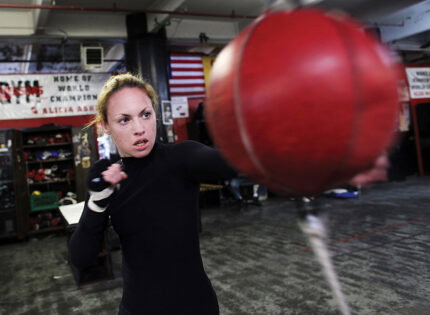
Getty
NEW YORK, NY – APRIL 04: Female boxer Heather Hardy trains at Gleason’s Gym on April 4, 2012 in New York City. Hardy, a 30 year old single mother who wants to turn pro, has been boxing seriously for two years after discovering the sport through kick boxing and yoga. The International Olympic Committee Executive Board has allowed the sport of women’s boxing to be added to the schedule for the 2012 Olympic Games in London, England. This will mark the first time that all of the summer Olympic sports will have female participants. Women’s boxing saw strong growth in the 1990’s as other professional sports such as basketball and soccer saw women sports leagues such as the WNBA and the WUSA take off in popularity. This year also marks the 40th anniversary of the passing of Title IX, a piece of legislation that required equal treatment for women in high school and collegiate athletics and prohibits sex discrimination in schools. (Photo by Spencer Platt/Getty Images)
“If my fights ever inspired you, if you cheered for my championships, or if you’ve ever given everything to a job only to have it take your health and leave you without help, please consider donating and sharing this fundraiser,” her note on the GoFundMe page read. “Every contribution helps me to meet my immediate living needs while I focus on my health, stability, and the next chapter of my life after boxing. To everyone who has ever cheered for me, stood by me, or shares this today, your support means the world to me, and I’m grateful beyond words. Thank you.”
Since the fundraiser was started in early July, it has garnered over $30K in donations. While it’s still nowhere close to the $100K that she is hoping to collect, the fact that many are sending in whatever little help they can should help her feel better about her celebrated career in combat sports.
While the former champion provided ample reasons for making such a drastic move, her current situation is also tied to the major lawsuit she filed last year.
The case before the Manhattan Supreme Court saw her hold physicians, promoters, and even equipment manufacturers accountable for her debilitating condition. The defendants reportedly included Boxing Insider and Boxing Insider Promotions and DiBella Entertainment, who previously promoted Hardy; unnamed “John Doe” defendants; Everlast Worldwide (manufacturers and sellers of combat sports equipment used by Hardy); Frasers Group (the UK-based company that owns Everlast); and Dr. Nitin Sethi, medical director for the New York State Athletic Commission.
While the lawsuit named Lou DiBella also as a defendant, Larry Goldberg, who owns Boxing Insider, was not. Hardy filed a separate case against the New York State Athletic Commission at the New York State Court of Claims.
From the courtroom to crowdfunding: Heather Hardy’s fight continues
Hardy held the defendants responsible for her severe, career-ending brain injuries. She also alleged that they failed to compensate her adequately compared to male boxers and denied her adequate health insurance.
Claiming DiBella violated federal and state laws surrounding equal pay, Hardy said that her 25 fights in New York earned her only $236,450 overall. According to her, that was “pennies” when her promoters “took home mountains of gold.”
“They lined their pockets with her pain—but when she was broken, they tossed her on the scrap heap,” her attorney reportedly told the NY Post at the time.
While Hardy became the first woman in boxing history to take the sport’s major stakeholders to court, her decision to launch her own GoFundMe campaign also appears to be unusual.
From a wider combat sports perspective, most accounts show that a fighter’s associates, friends, and family members initiated a fundraiser to help cover medical expenses.
Even so, there appears to be only one other widely documented case in which a fighter personally organized a GoFundMe account to help deal with a medical situation. That case pertains to Josiah Harrell.
Reports indicate that the 27-year-old set a goal of raising $80,000 after he was diagnosed with Moyamoya disease before his UFC debut. His fundraiser stated that the UFC’s insurance would not cover the surgery because of the circumstances surrounding the diagnosis.
In that context, Heather Hardy’s message has drawn widespread attention on social media. If her fundraiser reaches its goal, the financial support could help her continue addressing her medical condition while also giving her an opportunity to return to work and provide for her daughter.