
Turki Alalshikh has finally put Anthony Joshua vs. Tyson Fury together. But Oscar De La Hoya isn’t convinced. Occasional blockbuster fights, he believes, can’t fix what’s wrong with boxing – a sport where champions and elite contenders too often wait for the biggest payday instead of fighting each other consistently. The problem isn’t simply about putting big fights together; it’s about changing the mindset.
Watch What’s Trending Now!
“Well, look, the way I see boxing now, it’s a big mess,” De La Hoya told Ariel Helwani. “It’s worse than it’s ever been. I’ve been in boxing for 20-something years now as a promoter. Boxing is in the worst place it’s ever been. All these top guys are waiting for that ultimate purse.
“Guys, you have to fight. You have to prove yourself. You have to become a world champion and continue your career. You can’t just be idle and wait for the big money to come. What if it never comes? What if this is live 2.0 all over again?”
Boxing has produced several recent cases where championship obligations have clashed with a fighter’s preferred career path of financial priorities.
Oleksandr Usyk twice chose to give up major heavyweight belts, first to purse Tyson Fury rematch and later to open the division ahead of his final bout. Canelo Alvarez lost his IBF belt after choosing Edgar Berlanga over mandatory challenger William Scull, although he regained it the following year.
More recently, Hamzah Sheeraz reportedly surrendered the WBO super-middleweight championship after a purse bid raised concerns over the financial attractiveness of a Janibek Alimkhanuly defense. Keyshawn Davis and Denzel Bentley provide similar business-versus-mandatory examples, although neither should be described simply as having vacated a title.
De La Hoya’s response intrigued Helwani. He pointed out that similar instances were happening in the past as well, with fighters affiliated with HBO or Showtime not entering fights against each other. Against that backdrop, the situation improved somewhat with the Saudi intervention, as big fights began to be made.

Imago
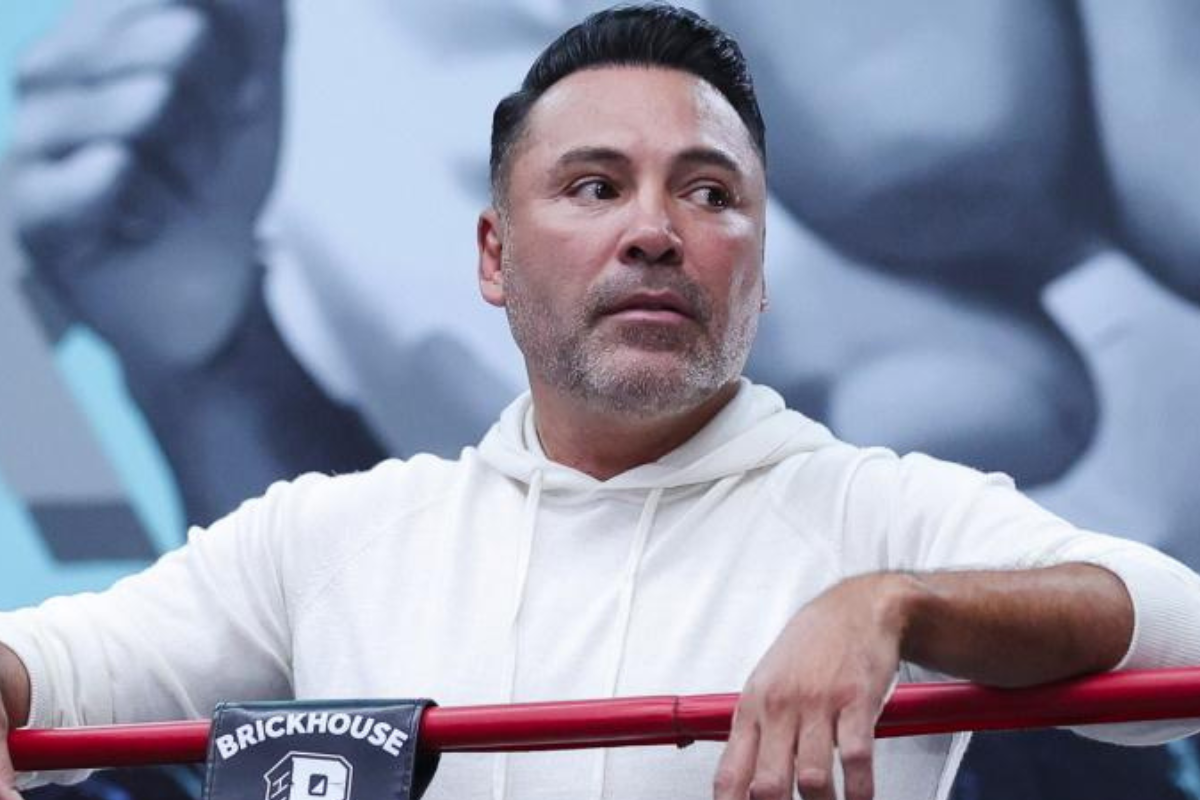
April 20, 2023, Las Vegas, Nevada, USA: Boxing legend and promoter Oscar De La Hoya address the media at the final press conference, PK, Pressekonferenz for the Tank Davis vs Ryan Garcia fight this Saturday from the T Mobile Arena on Showtime Pay Per View. Las Vegas USA – ZUMAd151 20230420_znp_d151_029 Copyright: xAdamxDelGiudicex
While agreeing with the point, De La Hoya wasn’t sold on it entirely.
“Well, we’ve seen some…we’ve seen some,” he added. “We’ve seen a sprinkle of a handful of fights, you know, that have been taking place all because, you know, it’s expensive to make these huge fights happen. And what does Turki do? You know, he has the PIF, you know, money to cover that expense.
“So, yeah, we’ve seen a few fights, a handful of them, which is great for boxing, but boxing is a business that you have to maintain year long. We don’t want to fight the first quarter or the last quarter of the year.
“We want great fights throughout the whole year that lead up to something for the next year; we want to continue building world champions. I truly feel that of all the fighters that are out there, world champions and contenders, the top elite fighters, they’re not fighting each other.”
De La Hoya’s reflections follow one of the year’s biggest showdowns. A Zuffa card in September saw Ryan Garcia defend his WBC welterweight title from Conor Benn. Months earlier, on January 31, Teofimo Lopez and Shakur Stevenson faced off.
While Eddie Hearn’s Matchroom played the pivotal role, Saudi entertainment company SELA and The Ring were also listed as co-promoters of the event at New York’s Madison Square Garden.
In the months that followed, Naoya Inoue and Oleksandr Usyk defended their titles.
Beyond those cards, including the upcoming Canelo Alvarez vs. Christian Mbilli, followed by the much-anticipated showdown between Anthony Joshua and Tyson Fury, you get 4-5 matchups featuring major draws. The situation seems to align with De La Hoya’s views.
While fights between big stars are happening and promises to continue in 2027 as well, from an overall business standpoint, that may not be sufficient.
To sustain a deeply fragmented sport like boxing, you need a year-long calendar featuring both big and small events. Only then can the sport’s long-term health be sustained.
Oscar De La Hoya sounds off on boxing’s power shift
Oscar De La Hoya’s criticism is not new. He has made similar complaints for several years about fighters pricing themselves out of major bouts. He has also taken aim at Saudi-backed spending, questioned some marquee matchmaking, and criticized the direction of The Ring under Turki Alalshikh.
His opposition to Dana White’s Zuffa Boxing has been especially sharp. He has described the promotion as a “Trojan Horse,” arguing that its large initial fighter contracts could eventually give way to less favorable terms.
Beyond De La Hoya’s personal assessment, the situation surrounding boxing merits closer attention, particularly as several reports suggest Turki Alalshikh could be gradually stepping away from the sport.
Since becoming a major force in boxing, Alalshikh and Riyadh Season have helped facilitate an array of matchups by bringing rival promoters together and providing substantial financial backing. His influence was evident in the undisputed fights between Tyson Fury and Oleksandr Usyk, Artur Beterbiev’s meetings with Dmitry Bivol, and the Queensberry-Matchroom 5v5 series.
However, questions now surround how long Alalshikh will remain personally involved.
At the September 30 Fury-Joshua launch, he said his health has been poor and expressed uncertainty about what he would remember in the future while urging boxing’s leading promoters to help complete his remaining plans.
Alalshikh’s influence in boxing also invites comparisons with Al Haymon’s launch of Premier Boxing Champion (PBC) in 2015, although the two operated through fundamentally different business models.
Haymon reportedly used substantial private investment to assemble a deep fighter roster and purchase television exposure, initially placing major boxing on NBC, CBS, FOX, ESPN, and other outlets in an effort to broaden its mainstream reach.
PBC later evolved toward more conventional rights-free, premium-cable, and pay-per-view arrangements.
Alalshikh’s approach has been less about building an exclusive fighter empire and more about using Saudi-backed financial resources to bring competing promoters, networks, and elite fighters into the same events.