Imago
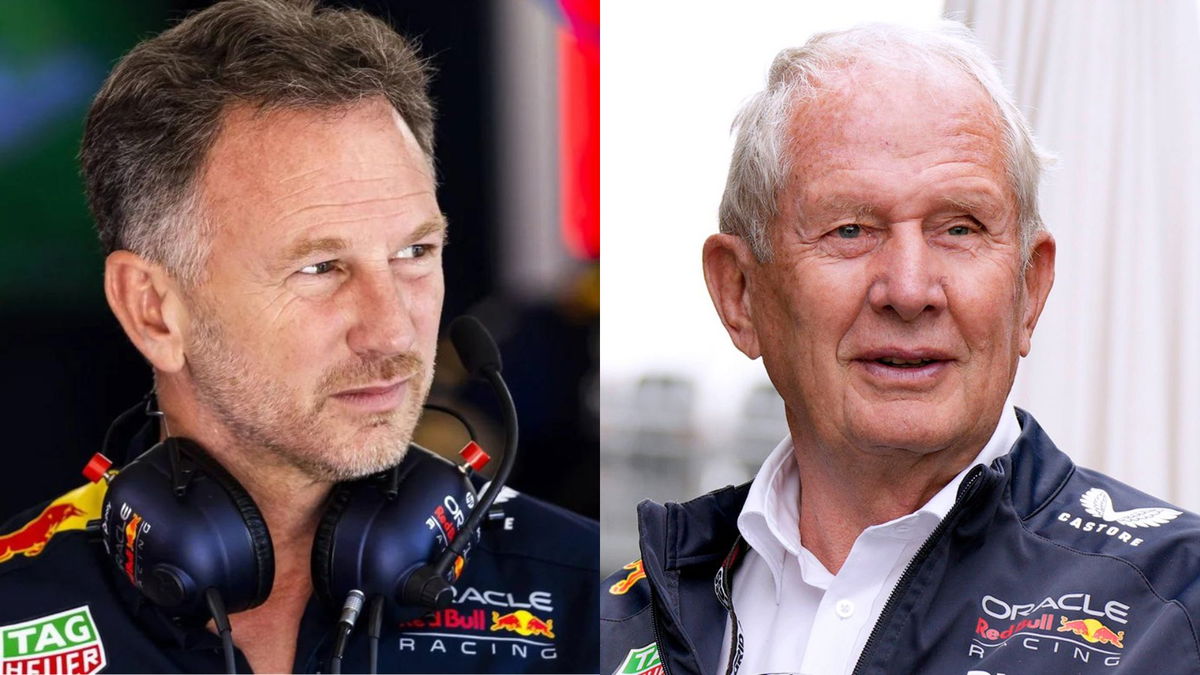
Image courtesy: Imago | (L) Christian Horner and (R) Helmut Marko
Imago
Image courtesy: Imago | (L) Christian Horner and (R) Helmut Marko
An era comes to an end as Helmut Marko finally steps away from Red Bull Racing, closing the book on a 20-year run that helped shape one of Formula 1’s most dominant teams. From day one in 2005, Marko wasn’t just an advisor at the company. In fact, he was a builder, a decision-maker, and often the toughest voice in the room. But things at Red Bull aren’t the same as before, since he’s left.
Watch What’s Trending Now!
The former F1 driver-turned-talent scout played a central role in discovering Sebastian Vettel and Max Verstappen, backing both long before they became world champions. Now, days after his exit, Marko is pulling the curtain back on internal power struggles at Red Bull, and his claims point directly at Christian Horner and a behind-the-scenes shift that changed everything.
ADVERTISEMENT
Internal power struggle at Red Bull Racing
As he exits Red Bull Racing, Helmut Marko didn’t hold back while revisiting what he believes was a defining internal moment for Red Bull Racing in 2022. Speaking about the period surrounding Dietrich Mateschitz’s declining health, Marko laid out his version of events with striking clarity.
“I remember a celebration in 2022 ahead of the Austrian GP. Didi was there, but in poor health. Christian came up to me and said, ‘He won’t make it to the end of the year.’ From that moment on, he started getting close to Chalerm Yoovidhya. When Didi passed away later that year, he did everything he could to take control with Yoovidhya’s support. On behalf of ‘Austria’, I did everything possible to prevent that.”
Now, to understand exactly the weight of that claim, a little context matters. Dietrich Markwart Eberhart Mateschitz [Didi] was not just Red Bull Racing’s spiritual backbone. He was also a 49% owner of Red Bull GmbH. Alongside Marko, he represented the Austrian side of the business and had the final say in major motorsport decisions until his death on October 22, 2022, following a long battle with pancreatic cancer.
ADVERTISEMENT
🚨 | Helmut Marko: “Together with Didi (Dietrich Mateschitz, the late Red Bull founder, ed.), I founded Red Bull Racing in 2005.”
“We appointed Horner as team principal, and I was there as a supervisor. The power was essentially always in Austria — we made the decisions.”
“I… pic.twitter.com/EfZoyozJYs
— Race+ (@racepluscom) December 14, 2025
Opposite that stood Chalerm Yoovidhya. The Thai billionaire and his family (the wealthiest in Thailand) control 51% of Red Bull GmbH (Chalerm’s father is co-creator of the Red Bull brand of energy drinks), making them the majority stakeholders. While Mateschitz was alive, ownership was balanced. After his passing, that balance tilted inevitably.
ADVERTISEMENT
Christian Horner’s role sits right at the center of this shift. As Red Bull Racing’s team principal since 2005, Horner runs the Formula 1 team’s daily operations – from driver management and staffing to competitive strategy. However, he does not own the team. His authority ultimately, as you may have figured out, depends on who holds power at the corporate level.
Top Stories
F1 Rumor: Toto Wolff’s Hypocrisy Exposed as He Offers Ambassador Contract to Max Verstappen After Denying Lewis Hamilton
Oscar Piastri Follows Valtteri Bottas With an Apparent ‘Cameo’ at Paris Olympics 2024
Who Are Lando Norris’s Parents? Meet Adam Norris and Cisca Wauman

“The Number of Guitars We Broke…”: Pierre Gasly Tells All on ‘Extreme’ Childhood With Cutthroat Charles Leclerc

Max Verstappen Hypes Fernando Alonso for Punching Above the Weight After Season Opening Success: “Definitely on the Table”
Getting close to Chalerm Yoovidhya, therefore, would offer Horner something invaluable: stability. Backing from the majority shareholder strengthens his position, limits internal opposition, and ensures long-term control regardless of changes elsewhere within Red Bull’s structure.
From Marko’s perspective, this wasn’t routine politics. It was a fundamental change in how Red Bull Racing would be governed. And, most importantly, who would truly be calling the shots.
ADVERTISEMENT
Marko believes Verstappen could have been champion
For all the champions Helmut Marko has helped shape over two decades at Red Bull Racing, none compares to the bond he shares with Max Verstappen. He has often described it as his “most intimate” driver relationship, built on trust, blunt honesty, and a shared obsession with winning. That closeness is why Marko’s assessment of the 2025 season carries real weight and why his claim has stirred debate across the paddock.
Despite a stunning late-season resurgence, Verstappen narrowly missed out on what would have been a fifth consecutive Formula 1 world title, finishing just two points behind McLaren’s Lando Norris. In Marko’s view, the championship wasn’t lost on track alone. He believes Verstappen would have been champion if Christian Horner had exited the team earlier.
ADVERTISEMENT
Horner’s dismissal in July 2025 effectively ended months of internal instability at Red Bull. While the team publicly avoided framing it as a power struggle, Marko addressed the perception head-on.
“That’s how it’s always been described in the media, but it was nothing personal,” the 82-year-old said.
What followed Horner’s exit was telling. Under new team principal Laurent Mekies, Red Bull Racing found clarity. Verstappen, who had looked resigned to a lost season before the summer break, suddenly looked reborn. Strategic calls improved, internal noise faded, and the Dutchman went on a relentless charge that dragged him back into title contention from what had seemed a hopeless position.
ADVERTISEMENT
Although the comeback fell agonizingly short, it reinforced Marko’s broader belief: Verstappen’s peak is still ahead of him. At 28, he isn’t just faster. He’s calmer, more calculated, and increasingly influential as a team leader. Marko sees a driver who has eliminated emotional errors without losing aggression, a rare combination at the top level.
To him, 2025 wasn’t a missed opportunity, but it was proof. Proof that once stability returned, Verstappen immediately looked like the benchmark again. And proof that his upward curve, in both speed and maturity, is far from flattening out.
ADVERTISEMENT
ADVERTISEMENT
ADVERTISEMENT