
Watch What’s Trending Now!
The 2026 F1 regulations had been building hype for years, with major changes to aerodynamics and engines set to reshape the sport. However, Max Verstappen had already raised concerns about the new system, especially with the battery expected to deliver 50% of the engine’s power. When the first race finally arrived, the action failed to impress many fans. Even Mark Martin, who calls himself a “casual” fan, questioned the racing and drew an unfavorable comparison with NASCAR.
Mark Martin weighs in on Max Verstappen’s take on the new F1 rules
“That’s exactly what Max Verstappen said. It’s fake,” he said. “I’m seeing something happen here. A road that F1 has gone down that I saw NASCAR certainly go down to some degree 5 years ago.” There was ample criticism that still continues since NASCAR moved to the Next Gen cars. Martin feels Formula 1 might be moving in the same direction now.
“He’s [Verstappen’s] been warning that this is not F1 racing.” 4x F1 World Champion Max Verstappen very famously quoted that the new F1 cars were Formula E cars on steroids, owing to how much power the battery was delivering.
Apart from that, however, the major issue was with the deployment and overtake mode.
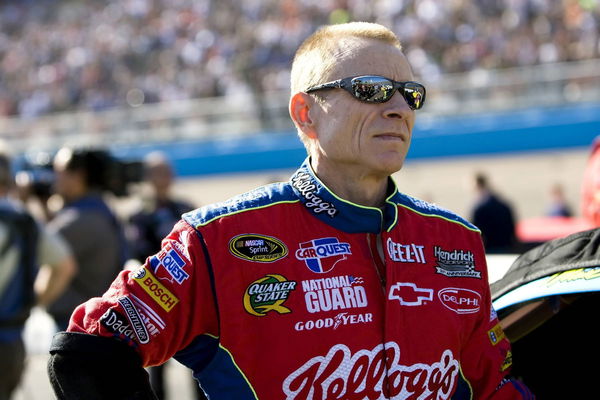
Imago
Avondale, AZ – November 15, 2009: Mark Martin stands by his car beofre the start of the NASCAR Sprint Cup Series Checker O Reilly Auto Parts presented by Pennzoil race at the Phoenix International Raceway in Avondale, AZ on November 15, 2009. – ZUMAa55
“The core base doesn’t want that. It doesn’t want a car to come off the corner and get up to, you know, 300, you know, and some kilometers and then slow down to 260,” Martin added. “You’re going down the straightaway, and you get the max speed and then all of a sudden you start slowing down […] It was a really terrible sight when motorsports is supposed to be about how freaking fast can you go?”
Apparently, Sunday’s race in Melbourne revealed an interesting aspect of the 2026 cars.
As soon as they hit the top speed on straights, it seemed that the engine was cutting off. This was potentially done so that the drivers could harvest more energy, which they desperately need, considering half of the engine power comes from the battery now.
In fact, some were seen downshifting before even getting to the braking point of the corner. Basically, the cars were not going all out where they should’ve been.
Many pointed out these issues, and even though Formula 1 attempted to speak positively about the new regulations, showcasing how there was a massive number of overtakes throughout the Australian Grand Prix, many were not satisfied.
Why were fans not happy with the 2026 F1 Australian GP?
Statistically, the 2026 F1 Australian Grand Prix had an impressive number of overtakes.
But many felt that it wasn’t out of pure racing. Now, this aspect can be a little complicated, but the major issue that many have with the new regulations is the battery deployment and the overtake mode.
Similar to the P2P button in IndyCar, the Formula 1 cars now have an overtake button, which allows them to deploy their full battery power when within one second of the car ahead. While this does allow the drivers to overtake, many argued that it seemed made up.
In a situation where the driver ahead is trying to harvest more energy, the driver attempting the overtake has a simple task to do: just deploy and move ahead.
But later on the circuit, the roles can be swapped. This is what happened at the start of the race between Ferrari’s Charles Leclerc and Mercedes’ George Russell. The two kept swapping places. Essentially, F1 looked more like a game of chess, with the drivers carefully planning each deployment, rather than raw racing.
Mark Martin even feels that the backlash the new regulations have faced from the drivers could trigger the FIA to change some of the deployment rules:
“I have a strong feeling that, based on the driver reaction, they may be forced to make some kind of rule change, like they don’t usually do right here, coming right out of the gate. To be able to limit or regenerate the power somehow, or limit how much battery power is used.”
While he did mention that the race was “fun to watch,” it is quite apparent what the F1 drivers have been warning about. Max Verstappen’s bold comment on the new cars did not seem too wrong. Moreover, this just seems to be the tip of the iceberg, as the drivers have called out multiple safety issues.
This includes the turbo spooling delay at the race start, the randomly locking rear axle (which ended Max Verstappen’s qualifying early on Saturday), and the engine reliability.
However, it is tough to say if there will be any change anytime soon. Formula 1 will simply not move back to the old regulations, just like NASCAR didn’t. It wouldn’t make sense. But as the comparison goes, F1 might not receive praise for these new regulations, just like NASCAR didn’t when they moved to the Next Gen car.