
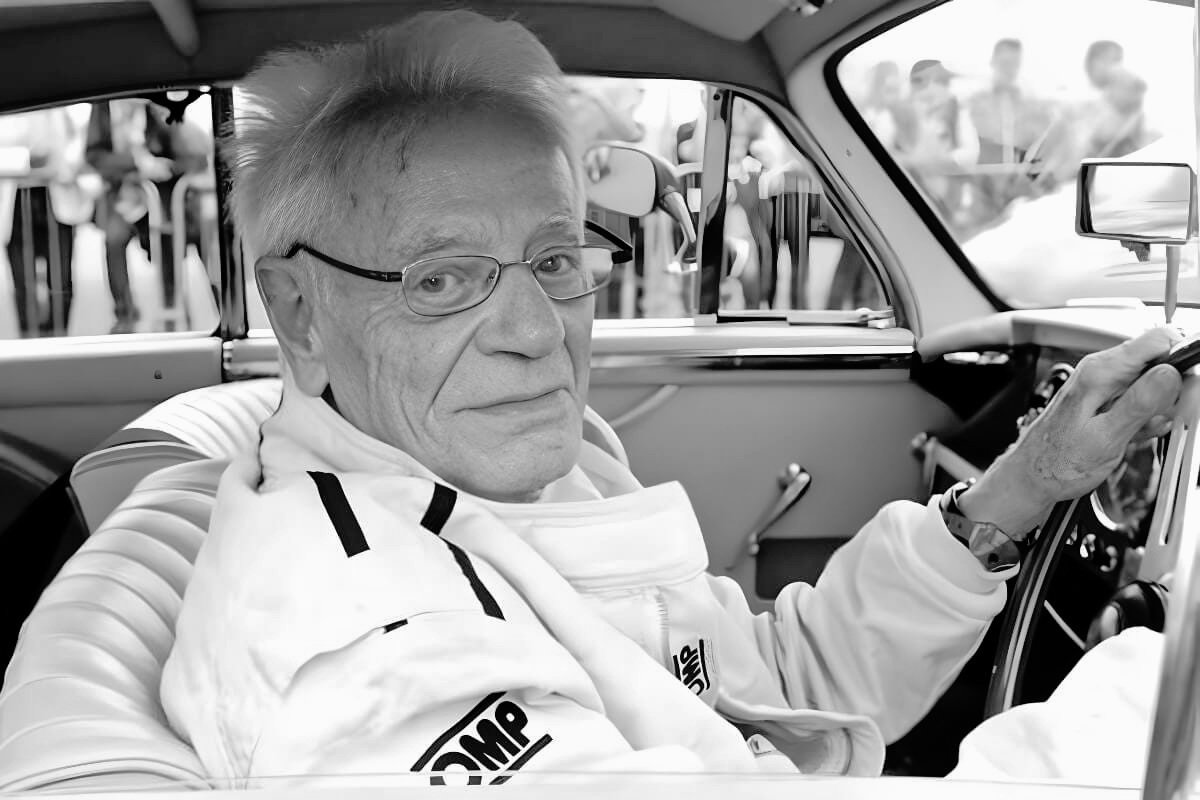
Decades before Ayrton Senna would go on to win three World Championships and dominate Formula 1, there was Hermano da Silva Ramos, known to those closest to him simply as “Nano,” a French-Brazilian son of a Parisian mother and a Brazilian father, who carried two flags on his helmet and a continent’s racing dreams in his heart. One of the first to lay the foundation stone for Brazilians in the pinnacle of motorsport, his portfolio was never limited to a single series or a single country.
Watch What’s Trending Now!
Hermano da Silva Ramos passes away
On May 4, 2026, the 100-year-old Da Silva Ramos passed away in Biarritz, France. He was the oldest living Formula 1 driver, having driven alongside some of the sport’s greatest. At the time of his death, he was also the last surviving F1 World Championship points scorer from the 1950s.
Ramos’ career began in his early 20s when he ran the Interlagos Grand Prix. Back in those days, there was no driver tunnel that supported drivers through the youngers years, as there is today.
In 1953, he began racing an Aston Martin DB2/4 in sports car races in France, a car he used not just on circuits but on public roads, using it for everyday driving and longer journeys. In 1954, Ramos finished the Paris Cup in second place and went on to win the Coupe de Montlhéry. That same year, he became the first Brazilian to compete at the 24 Hours of Le Mans, entering alongside co-driver Jean-Paul Colas. Later that season, he led the Tour de France Auto before running out of fuel.
But his real breakthrough came in 1955, when he debuted in the Dutch Grand Prix. The race was still held at Zandvoort, but contrary to the track today, it stretched 2.6 miles (around 4 kilometers) at the time. Juan Manuel Fangio won the race that day after having clinched pole position; meanwhile, Hermano da Silva Ramos finished P8. This was still quite respectable, considering the poor reliability of the cars back in the day, which mostly resulted in DNFs. It also made him the third Brazilian ever to race in Formula 1, following Chico Landi and Gino Bianco.

Hermano da Silva Ramos, Gordini, Mônaco, 1956. Fotografia: McCavoy.

In the span of two seasons, Ramos participated in seven Formula 1 World Championship races. His P5 finish at Monaco in 1956 became his best result in the sport, starting from 14th on the grid in his Gordini Type 16 and charging through the field on the streets of Monte Carlo, scoring just two championship points.
Those two points, modest as they appear, were enough to make him the Brazilian driver with the most Formula 1 World Championship points for 14 consecutive years, a record that stood until a young Emerson Fittipaldi arrived on the scene in 1970. But winning the title was never the priority. It was to represent his country, the country that would go on to produce some of the most competitive Formula 1 drivers in history, including Ayrton Senna, Nelson Piquet, and Felipe Massa.
In the short time he raced in F1, Ramos shared the grid with some of the most notable drivers from the past, including Giuseppe Farina, Alberto Ascari, Mike Hawthorn, and even Jack Brabham. His legacy now lives on forever.
Fans pay their respects to Ramos
“RIP,” wrote Lucas Di Grassi, with praying hands and the Brazilian flag. The tribute was brief, but from a fellow Brazilian racing driver who understood what it meant to carry that flag on an international stage, it needed no elaboration. Ramos had made it possible, or at least, imaginable, for every Brazilian who came after him to believe that the starting grid of the world’s greatest races was a place where they belonged.
“Legend. Pioneers like him and Chico Landi opened the path for Brazilians to start competing in Formula 1 and motorsport overall,” wrote a fan.
And while the word pioneer gets thrown around loosely in sport, in Ramos’s case, it stands simply accurate. Beyond being one of the best at his craft, he was also one who felt things most deeply.
Before the start of a Venezuelan Grand Prix, the Spanish aristocrat Alfonso de Portago walked over to Ramos, took his hand, pressed it firmly against his own chest, and said: “Do you feel my heart beating? This is what starting the race on the same line as Fangio does to me!”
De Portago died in the Mille Miglia the following year, a loss that hit Ramos so personally that his wife begged him to stop racing. He listened and stepped away. It was grief, not age, not failure, that mostly ended his racing career, and that is deeply telling.
“RIP. Imagine being able to say you got to race against Moss and Fangio and the like,” said one fan. “RIP. Also he was oldest F1 point scorer and if I am not wrong oldest LeMans driver,” noted another comment.
Both records Ramos held until the very morning of May 4, 2026. He was the last surviving participant of the 1955 24 Hours of Le Mans, a race that killed more than 80 people in the stands while Ramos was on the circuit. He carried that memory for 71 years, lending his voice to Emmanuel Reyé’s 2022 documentary Le Mans 55: Une tragédie française as one of its final living witnesses.
Like a fan wrote, “100.000 km/h. Gods of drive.” The technology back then was still being developed, which eventually turned F1 into what it has become today. At the time, it was drivers like Hermano da Silva Ramos who allowed the sport to grow. Ramos will continue to live in the hearts of many.