

Aerodynamics, one of the most important aspects of the current generation Formula 1 cars, has been increasing the complexity of the sport. Subsequently, more regulations started showing up in the FIA’s rulebook, which made the understanding out of reach for common F1 viewers.
Watch What’s Trending Now!
Several technologies come under this specific category, including an aero-assisting component called Bargeboard.
So, one might wonder, what are bargeboards?
This question could pop up in the viewers’ heads because of the importance an F1 team’s crew devotes to it. There have undeniably been many occasions where even minor damage to the bargeboard has ended up causing a frown in the entire garage.
Bargeboards: Why the cars need it
Bargeboard first made its appearance in the 1990s, but the design had often looked simple, considering there were no aero rules to hold down F1 teams back then.
However, over the years, bargeboard grew its significance and has eventually shaped up to be one of the most essential components in an F1 car. How significant?
Well, one of the biggest examples is Max Verstappen at the 2021 Hungarian Grand Prix. The Red Bull driver suffered irreparable damages to the bargeboard at the start of the race, which led to a massive pace deficit for the Dutchman.

Reuters
Formula One F1 – Hungarian Grand Prix – Hungaroring, Budapest, Hungary – August 1, 2021 McLaren’s Lando Norris collides with Mercedes’ Valtteri Bottas and Red Bull’s Max Verstappen Pool via REUTERS/Peter Kohalmi
For the first time in years, a Red Bull car struggled to make a move on a Haas. And such was the pace difference that bargeboard induced in the race. So, what are they?
Bargeboards are basically flow directors, and can be seen near the front suspension and ahead of the side-pods. What they usually do is split the incoming air from under the nose and through the suspension into 3 parts – underfloor, body sides, and outwash.
This helps divert the incoming air efficiently without disrupting the car’s balance around high-speed corners when the energy is significantly high. Hence, in clean air, an F1 car can go incredibly fast, leading to record-breaking lap times.
Why is F1 getting rid of it in 2022?
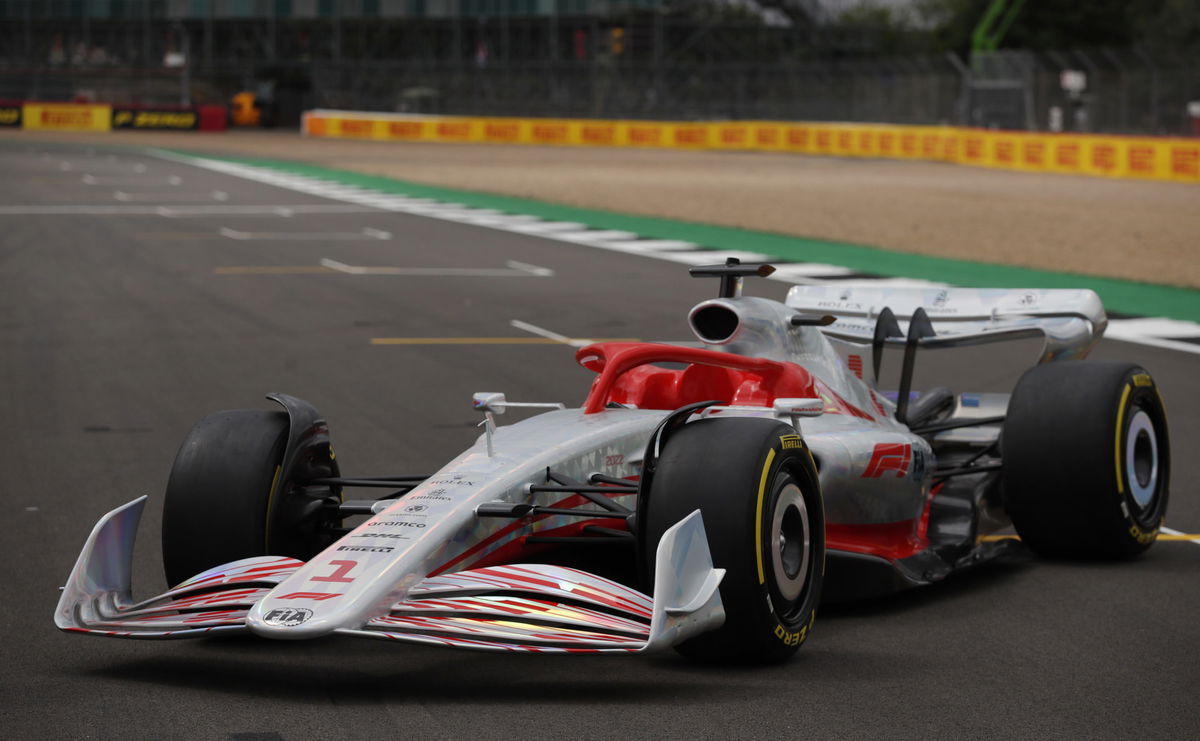
The motive of the upcoming aero regulations is to promote close-racing, which hasn’t been the case over the past decade. Components like bargeboards improvised the overall cornering speeds of an F1 car.
However, the fact that they disrupt the airflow leaves the car behind in tatters. They could cause massive aerodynamical disruptions to the following cars, which will prevent a car from staying within one second of another car around circuits that rely on high downforce.
Reuters
Formula One F1 – British Grand Prix – Silverstone Circuit, Silverstone, Britain – July 15, 2021 The new 2022 F1 car is unveiled during a promotional photoshoot REUTERS/Andrew Couldridge
Hence, the removal of bargeboards and the subsequent addition of wheel covers and pointy rear wings will divert the dirty air upwards than onto the following car. So, with ‘dirty air’ no more a hindrance, an F1 car can follow another car very closely without loss of downforce.
Of course, this is a huge gamble and F1 is certain that the 2022 cars will finally allow wheel-to-wheel battles. But how is the reality going to play out?
Watch Story: Biggest Crashes From 2020 Featuring Leclerc, Vettel & Grosjean