
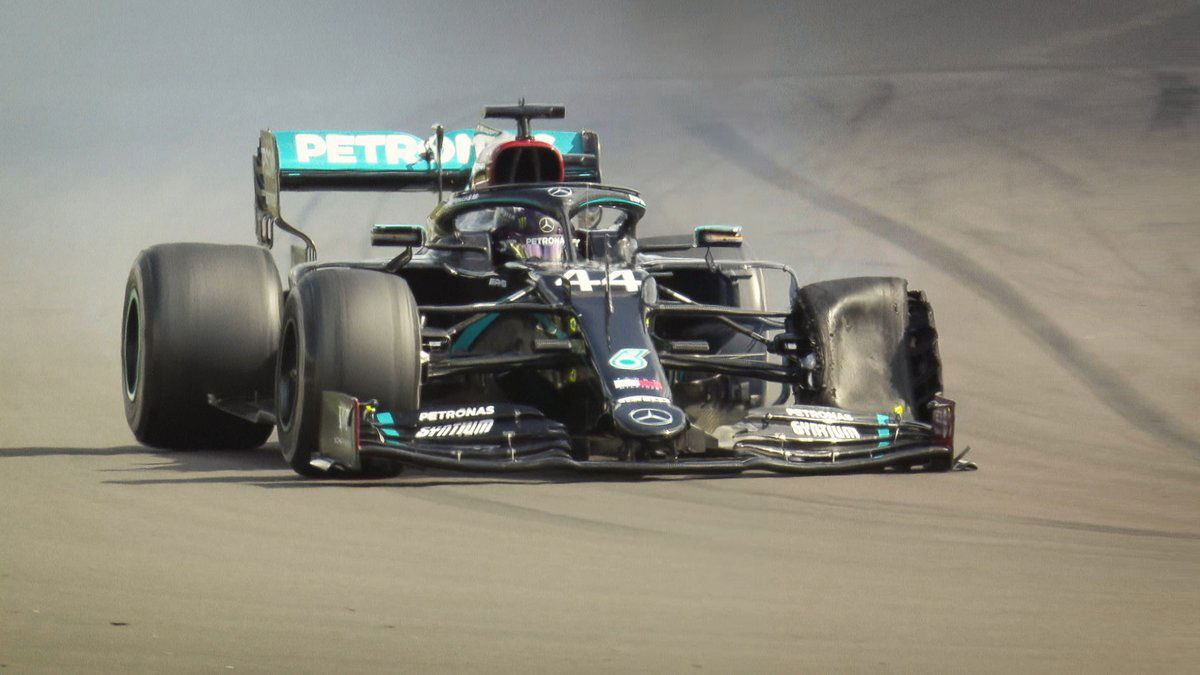
Exploding tires made for a fascinating spectacle in what was an otherwise dull British Grand Prix. While fans would’ve enjoyed the many random front lefts falling off, it wasn’t the same experience for some F1 teams.
Watch What’s Trending Now!
But what was the reason behind those multiple tire failures? Many believed the main cause was debris on track from Kimi Raikkonen’s front wing. While completely plausible, it doesn’t explain why 3 cars suffered punctures on the same tire.
“Individual race circumstances” behind F1 tire punctures
Well, Pirelli analyzed the root cause behind the volatile tires and revealed two main reasons.
The first being, teams opting to stop earlier than usual during safety car conditions, which resulted in a longer second stint. Theoretically, 40 laps on hard tires are completely doable, but the nature of the Silverstone circuit complicated things.
Pirelli explained that the sheer pace of the 2020 cars resulted in immense forces on the Italian manufacturer’s rubber. Keep in mind, Pirelli hasn’t introduced newer tire compounds this season.
As a result, the 2019 tires simply couldn’t keep up with the demands of teams’ cars.
Furthermore, front lefts in particular fell off due to the Silverstone circuit’s design, which heavily punishes that particular tire.

This actually happened, right? 🤯 Still processing those mad final few laps on Sunday! #BritishGP 🇬🇧 #F1
“The key reason is down to a set of individual race circumstances that led to an extremely long use of the second set of tyres” said Pirelli as quoted by F1.com.
“The second safety car period prompted nearly all the teams to anticipate their planned pit stop and so carry out a particularly long final stint: around 40 laps, which is more than three-quarters the total race length on one of the most demanding tracks of the calendar.
“The overall result was the most challenging operating conditions for tyres. These led to the front-left tyre (which is well-known for working hardest at Silverstone) being placed under maximum stress after a very high number of laps, with the resulting high wear meaning that it was less protected from the extreme forces in play.”
Despite teams expressing apprehension over softer tire compounds, Pirelli isn’t changing its plans for the 70th-anniversary race. Teams will have to use the C2, C3, and C4 compounds for this Sunday’s race.
SOURCE- Formula1.com