
Imago
Photo4 / LaPresse 22/09/2019 Singapore, Singapore Grand Prix Formula One Singapore 2019 In the pic: Lewis Hamilton (GBR) Mercedes AMG F1 W10 and Max Verstappen (NED) Red Bull Racing RB15 PUBLICATIONxINxGERxSUIxAUTxONLY Copyright: xPhoto4/LaPressex
Imago
Photo4 / LaPresse 22/09/2019 Singapore, Singapore Grand Prix Formula One Singapore 2019 In the pic: Lewis Hamilton (GBR) Mercedes AMG F1 W10 and Max Verstappen (NED) Red Bull Racing RB15 PUBLICATIONxINxGERxSUIxAUTxONLY Copyright: xPhoto4/LaPressex
F1 has always been about the pinnacle of motorsports. Not just in terms of the cars but in every other aspect as well. This includes the tracks as well, which are arguably some of the best ones around the world. Despite Monaco being the crown jewel of the F1 tracks, the Marina Bay Street Circuit where the Singapore GP is held is arguably a modern, more challenging version of Monaco. But what makes it so challenging? And how does a driver lose so much weight during this race? We’ll answer all your questions.


2008 was the first year when the Singapore GP took place at the Marina Bay street circuit. Ever since it has been one of the most unique circuits on the F1 grid that poses challenging circumstances that no other track does. One of them is the fact that a driver loses up to 4 kgs of weight during the race distance. Sebastian Vettel, who has the most wins at the circuit, advised on having a love-hate relationship with the Singapore GP.
Watch What’s Trending Now!
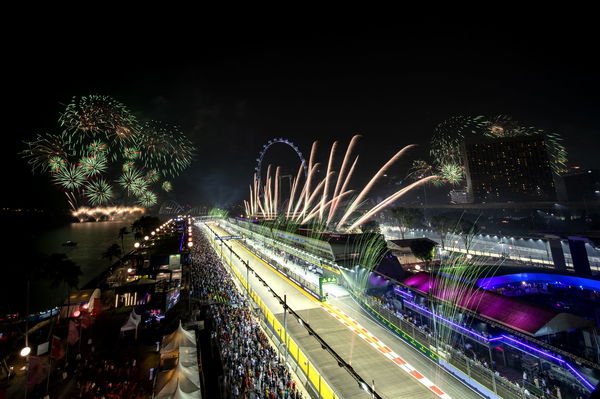
Reuters
2019 FORMULA 1 SINGAPORE AIRLINES SINGAPORE GRAND PRIX. Fireworks at the end of the race Singapore Grand Prix via. Reuters Plus
Vettel said, “It’s a love-hate relationship in a way because I love the challenge, but I know it’s very hard work.” Let’s dive deeper and find out exactly why drivers have this love-hate relationship with the Marina Bay street circuits
What makes the Singapore GP so difficult?
The Marina Bay circuit used to have 23 corners but will have 19 corners this year. A revision was made which will see a straight between turns 15 and 19 (which will become turn 16). It still however remains a track with loads of 90-degree corners. Many quick direction changes and a huge amount of G force are faced by a driver during a lap. The race itself isn’t cut short like Monaco and is held for a full race distance of 305+ km. The slow nature of the lap time combined with the full race distance means the race is about 2 hours long.
And to top that off, the race takes place at night. As the name suggests, the track is adjacent to the bay which means high levels of humidity. Combine that with the high track and ambient temperature, you get torturous conditions for drivers to contend with. Many F1 drivers suggest that the Singapore GP is the most challenging race on the calendar. Also, the drivers lose a lot of fluids from the body during the race distance. Let’s have a look as to why.
Why do drivers sweat so much during the race distance?
As we’ve already explained, the humidity levels are always high around the Marina Bay street circuit with the average being around 80%. The track temperature is around 40 degrees Celsius. Adding to it is the fact that an F1 driver sits inside the car. The F1 car itself is like a mini oven with a high-revving engine and electric systems right behind or underneath the driver. This makes the cockpit extremely hot and hence the drivers sweat profusely. Lewis Hamilton advised on how he lost up to 4 kgs during the race in Singapore.
Even his nemesis Nico Rosberg recently talked about the same during a podcast. According to the Sky Sports F1 podcast, Nico Rosberg said, “I would lose 4 kgs, so 8 pounds of body weight from sweating in those 2 hours. It’s like you’re in a skiing suit and sitting on the asphalt which is 40-45 degrees. Then you have the petrol right behind you which is like 65 degrees. So extremely hot. There’s no fresh air coming in. The seatbelt is really tight and you have the carbon seat molded to your body so you can hardly breathe properly. Corner after corner you have to hold your breath.”
All this adds up to the already challenging circuit that the drivers have to contend with. However, there’s some special training that a driver takes to deal with all these challenges.
What do the drivers do to contend with the challenges that the Singapore GP presents?
The high G force, humidity, and heat are the major challenges faced by the F1 drivers during the Singapore GP. With the speed that an F1 car goes around a corner at any circuit, the training for handling high G’s goes on constantly throughout the season, so that issue is taken care of. However, to train and get used to the sweating, F1 drivers spend a lot of time in the sauna as they perform physical activity in the heat and humidity.

Imago
PEREZ Sergio F1 Team Red Bull Racing START FIA Formula 1 GP Singapore 2022 on 02 10 2022 Copyright: xJerryxAndrex
Carlos Sainz posted a story on his Instagram as he rode an exercise bike in a Sauna with the caption, “Extreme situations call for extreme measures… Getting ready for Singapore!!” His teammate Charles Leclerc advised “Spending a lot of time in saunas, even during the summer, at very high temperatures.” Even Sergio Perez shared his training routine for Singapore saw him weightlifting and riding an exercise bike in the Sauna.
The Grand Prix at Marina Bay this year will be 63 laps instead of 61 due to the track changes. While the recent revision, like the updated Singapore sling and new straight between turn 15 and 16 has made it a tad bit easier for the drivers, Singapore still remains the most challenging race for the drivers.
WATCH THIS STORY | How Fernando Alonso’s 2008 Singapore GP Win Became One of F1’s Worst Controversies – Crashgate
Written by

Edited by

Aishwary Gaonkar